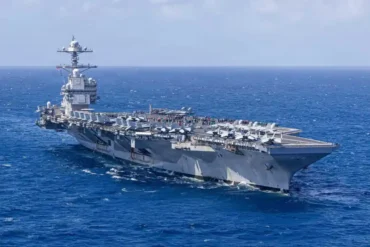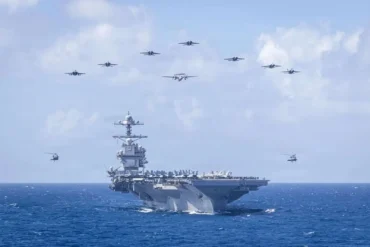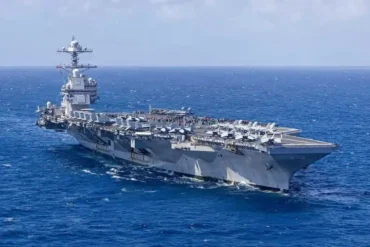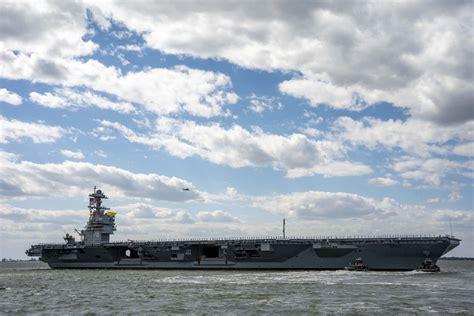
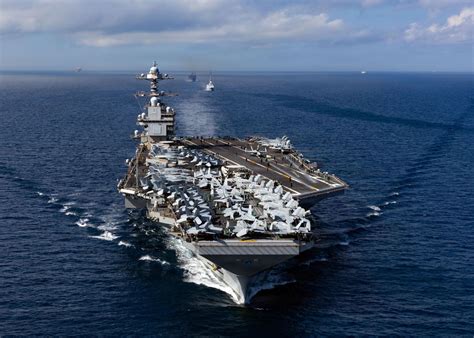
On December 8, 2025, a startling revelation emerged from a leaked Pentagon wargame simulation known as the Overmatch Brief. The assessment, made public by The New York Times, reveals a grim scenario: China could neutralize or sink the USS Gerald R. Ford, the U.S. Navy’s most advanced aircraft carrier, in the early stages of a Taiwan conflict.
The simulations outlined in the Overmatch Brief paint a bleak picture of future warfare in the Western Pacific. They describe a tightly coordinated Chinese assault involving cyber warfare, space-based targeting disruption, and missile saturation tactics that consistently overwhelmed the Ford’s defense network before its air wing could even engage.
The Strategy Behind China’s Dominance
According to the leaked brief, Chinese forces began their simulated attacks with cyber intrusions resembling the real-world Volt Typhoon campaign. These cyber operations targeted U.S. logistics, electrical grids, and communications infrastructure, effectively delaying mobilization and response times. In the same window, counter-space attacks knocked out critical U.S. surveillance and navigation satellites, blinding the battle management systems aboard the carrier strike group.
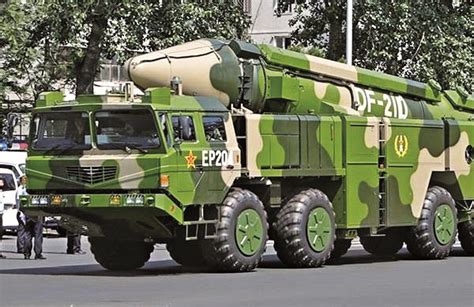
Once the U.S. technological edge was blunted, the simulations depicted multi-wave salvos of anti-ship ballistic missiles (ASBMs), hypersonic glide vehicles, and land- and sea-launched cruise missiles. These came from a dense regional array of PLA Rocket Force platforms, including DF-21D and DF-26 missile systems, H-6K bombers, and submarine-launched cruise missiles. The result was chilling: the Ford’s layered Aegis and onboard defenses were rapidly overwhelmed.
USS Gerald R. Ford: A Titan With Critical Vulnerabilities
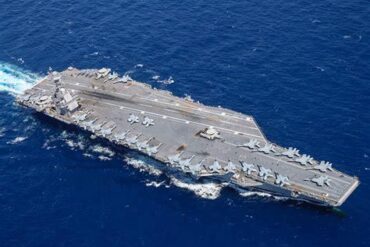
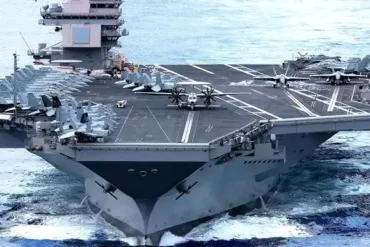
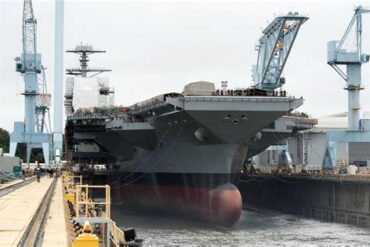
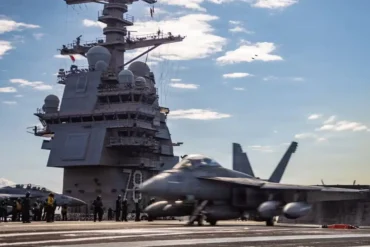
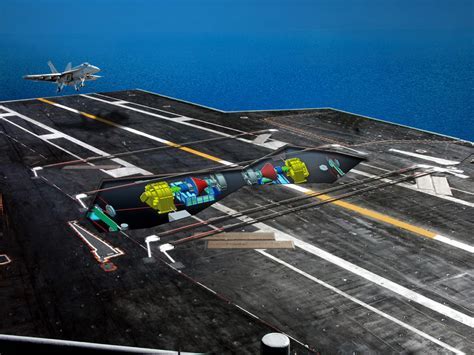
The USS Gerald R. Ford, centerpiece of the U.S. Navy’s next-generation carrier fleet, boasts a displacement of 100,000 tonnes, two A1B nuclear reactors, and a 333-meter flight deck. It supports over 75 aircraft, uses the Electromagnetic Aircraft Launch System (EMALS), and features an advanced radar suite. Its projected cost stands at $12.8 billion, not including billions more in R&D.
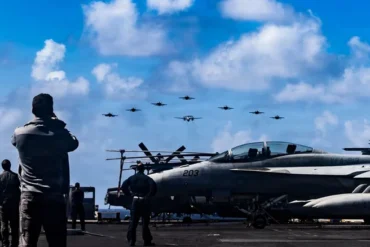
Despite this formidable profile, the simulations show that damage to just the flight deck, radar, or propulsion systems was enough to neutralize its combat capabilities. In many scenarios, the Ford was rendered unable to launch aircraft — essentially dead in the water, though still afloat. This outcome forced wargame commanders to weigh the risk of introducing additional carriers into the conflict, potentially incurring similar losses.
Hypersonics and Precision Overmatch
A major factor in the Ford’s vulnerability was China’s burgeoning hypersonic arsenal. The Overmatch Brief estimates up to 600 hypersonic weapons in the Chinese inventory, capable of flying at Mach 5 or greater, with mid-course maneuvering to defeat interceptors. These weapons were not deployed in isolation, but rather in tightly choreographed salvos, using real-time targeting data from satellites, unmanned aerial systems, and coastal radars.
This tactic created overlapping engagement zones, rendering even sophisticated U.S. carrier groups highly exposed. The simulations conclude that a carrier operating within this contested space faces a high probability of mission kill or destruction before completing its objectives.
Strategic Implications for U.S. Military Planning
Beyond the battlefield scenarios, the Overmatch Brief draws attention to systemic vulnerabilities in U.S. military force design. It critiques the current reliance on a few high-value platforms—like aircraft carriers, stealth fighters, and satellite constellations—that can be neutralized by cheaper, mass-produced weapons.
The assessment underscores that U.S. defense spending—currently at 3.4% of GDP—is near an 80-year low. It notes a severe mismatch between industrial output capacity and the demands of a prolonged high-intensity war. It argues for a paradigm shift in U.S. military posture, calling for:
- More distributed and survivable force structures
- Hardening of regional bases
- Resilient communication networks resistant to cyber and EMP attack
- Accelerated missile production pipelines
- Expanded roles for unmanned vessels and smaller, expendable platforms
The Broader Geostrategic Warning
Ultimately, the Overmatch Brief offers a dire but urgent warning: In a Taiwan Strait conflict, the U.S. Navy’s most expensive and technologically advanced platforms may be outpaced by the sheer scale, speed, and sophistication of China’s precision strike arsenal. The Ford’s loss in the wargame is symbolic not only of a tactical failure but of a strategic imbalance that could tip the scales of power in the Indo-Pacific.
To preserve deterrence and military relevance, the U.S. must rapidly adapt its doctrine, procurement models, and industrial base. As China continues to shape a battlespace optimized for denying U.S. access, the margin for error — and delay — is narrowing.