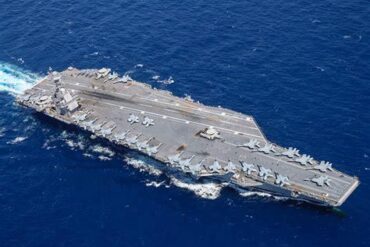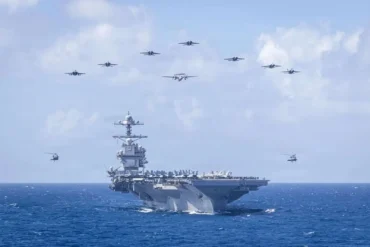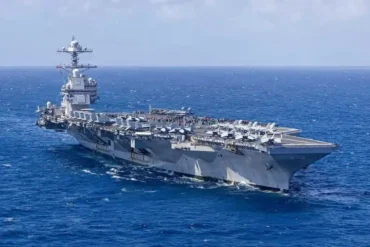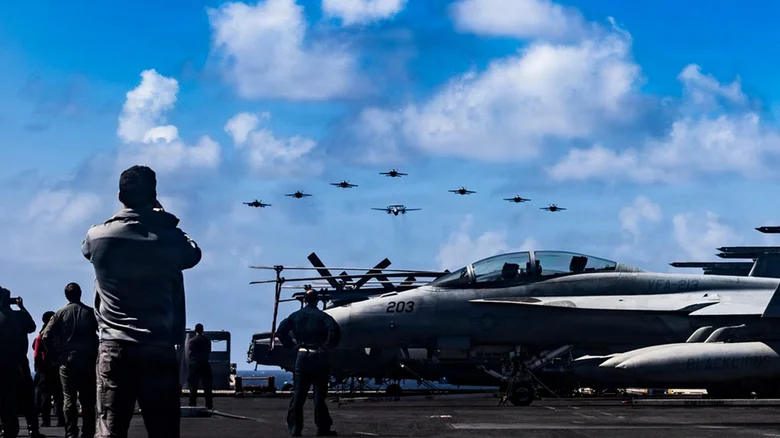
The sight of Navy aircraft flying in tight formation over the USS Gerald R. Ford was not a random spectacle staged for dramatic effect. It was a calculated, ceremonial, and strategically symbolic moment tied to a change-of-command ceremony for Carrier Air Wing 8, executed while the world’s largest aircraft carrier operated in the Caribbean Sea. For observers at sea level, the formation was breathtaking. For naval insiders, it was a deliberate message about continuity, readiness, and power projection.
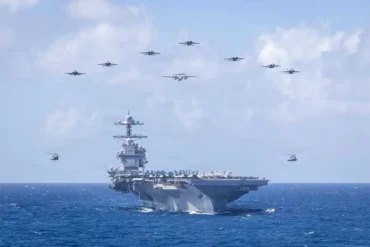
Military flyovers are typically associated with stadium crowds or solemn memorials. Witnessing one from the deck of a deployed supercarrier elevates the symbolism. In late January, seven strike fighters, a Grumman E-2D Advanced Hawkeye, and two MH-60 SeaHawk helicopters swept low over the carrier’s deck. The choreography reflected precision. The aircraft composition reflected capability. The location reflected intent.
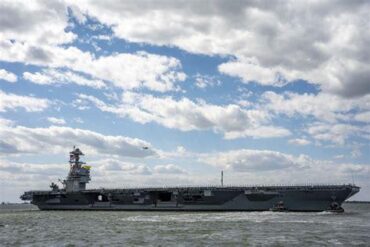
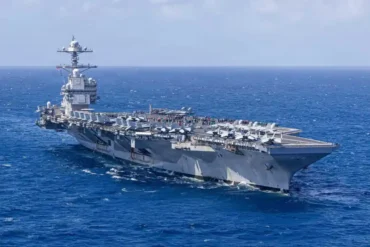
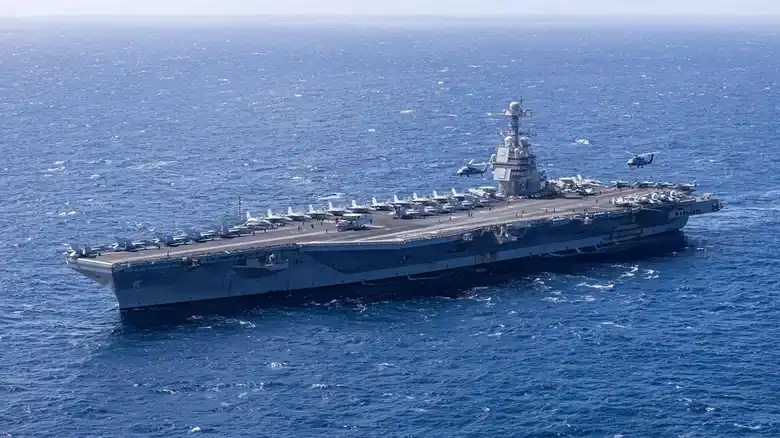
The USS Gerald R. Ford was not docked safely in Norfolk when this particular ceremony was marked from the sky. It was deployed — and extended. By that point, the carrier and its crew had been at sea for approximately 230 days, nearing the endurance levels seen during its previous 239-day deployment in 2023–2024. Sustained deployment changes the emotional texture of command transitions. At sea, leadership is not symbolic. It is operational reality.
The Change of Command Behind the Flyover
While Capt. David Skarosi assumed command of the USS Gerald R. Ford in May 2025 during a formal ceremony in Norfolk, the January flyover marked a separate but equally important transition — the change of command for Carrier Air Wing 8. Air wings are not static attachments; they are dynamic fighting units composed of multiple squadrons, each responsible for specific mission sets including strike warfare, airborne early warning, electronic attack, and anti-submarine operations.
A change of command within the air wing signals more than administrative turnover. It marks a shift in tactical leadership for the very aircraft that extend the carrier’s reach hundreds of miles beyond the horizon. The flyover was both tribute and affirmation. Aircraft roared over the deck not simply to impress, but to underscore unity between sea and air components under new leadership.
The Navy’s social media amplified the imagery, pairing video of F/A-18E Super Hornets streaking past the deck with the phrase “Peace Through Strength.” That phrase was not accidental. It situates the event within a strategic framework: visible readiness deters escalation.
Deployment Context: From the Arctic to the Caribbean
The Gerald R. Ford’s operational arc in 2025 adds deeper context to the flyover. Less than six weeks after Skarosi took command, the carrier deployed to the North Atlantic, ventured into the Arctic Circle, and then transitioned to sustained operations in the Mediterranean through November. The mission was extended twice. That extension alone signals evolving geopolitical demands.
By late 2025, Navy leadership redirected the carrier to the Caribbean in support of U.S. Southern Command operations. This shift reflects the carrier’s flexibility as a mobile airbase capable of addressing emerging threats or security missions across theaters. When a supercarrier moves, it carries diplomatic gravity with it.
The flyover occurred during this extended, multi-theater deployment. In that context, it becomes both a morale event and a subtle signal of operational stamina.
Technology and Capability on Display
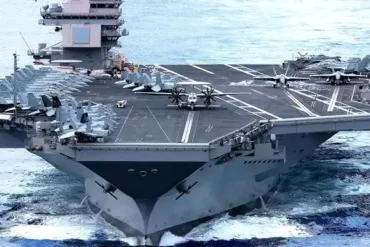
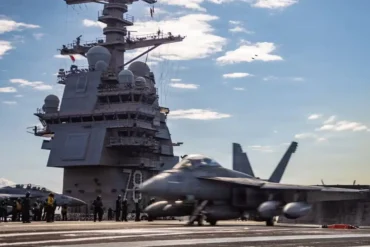
The USS Gerald R. Ford represents a generational leap over the Nimitz-class carriers it is designed to replace. Its Electromagnetic Aircraft Launch System (EMALS) replaces traditional steam catapults, enabling smoother, more efficient launches. Advanced arresting gear improves recovery operations. These systems increase sortie rates and reduce mechanical strain.
A formation of seven fighters, an E-2D Hawkeye, and SeaHawks flying over a Ford-class deck is not only ceremonial — it is a demonstration of integrated carrier strike capability. The E-2D provides airborne early warning and battle management. Super Hornets project offensive reach. MH-60 helicopters conduct maritime security and boarding operations, as evidenced by at least one right-of-visit boarding earlier in January.
Every aircraft type in the formation represented a layer of maritime dominance.
Symbolism, Morale, and Strategic Messaging
Ceremonies at sea carry unique weight. Crews deployed for more than seven months operate under sustained tempo and separation from home. A formation flyover during a command transition reinforces continuity and shared mission.
At the same time, visibility matters. A supercarrier operating in the Caribbean, backed by a fully functional air wing and broadcast under the banner of strength, communicates resolve to allies and adversaries alike. It says the ship is not merely present — it is prepared.
The formation over the USS Gerald R. Ford was therefore not just aviation choreography. It was a layered statement: leadership is stable, capability is intact, deployment endurance is proven, and American naval power remains forward, mobile, and unmistakably visible.