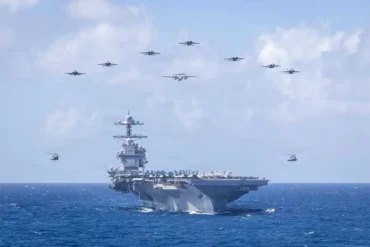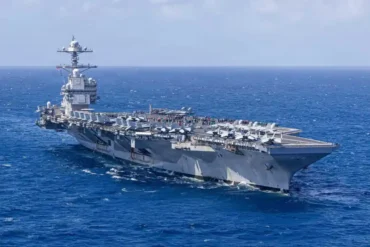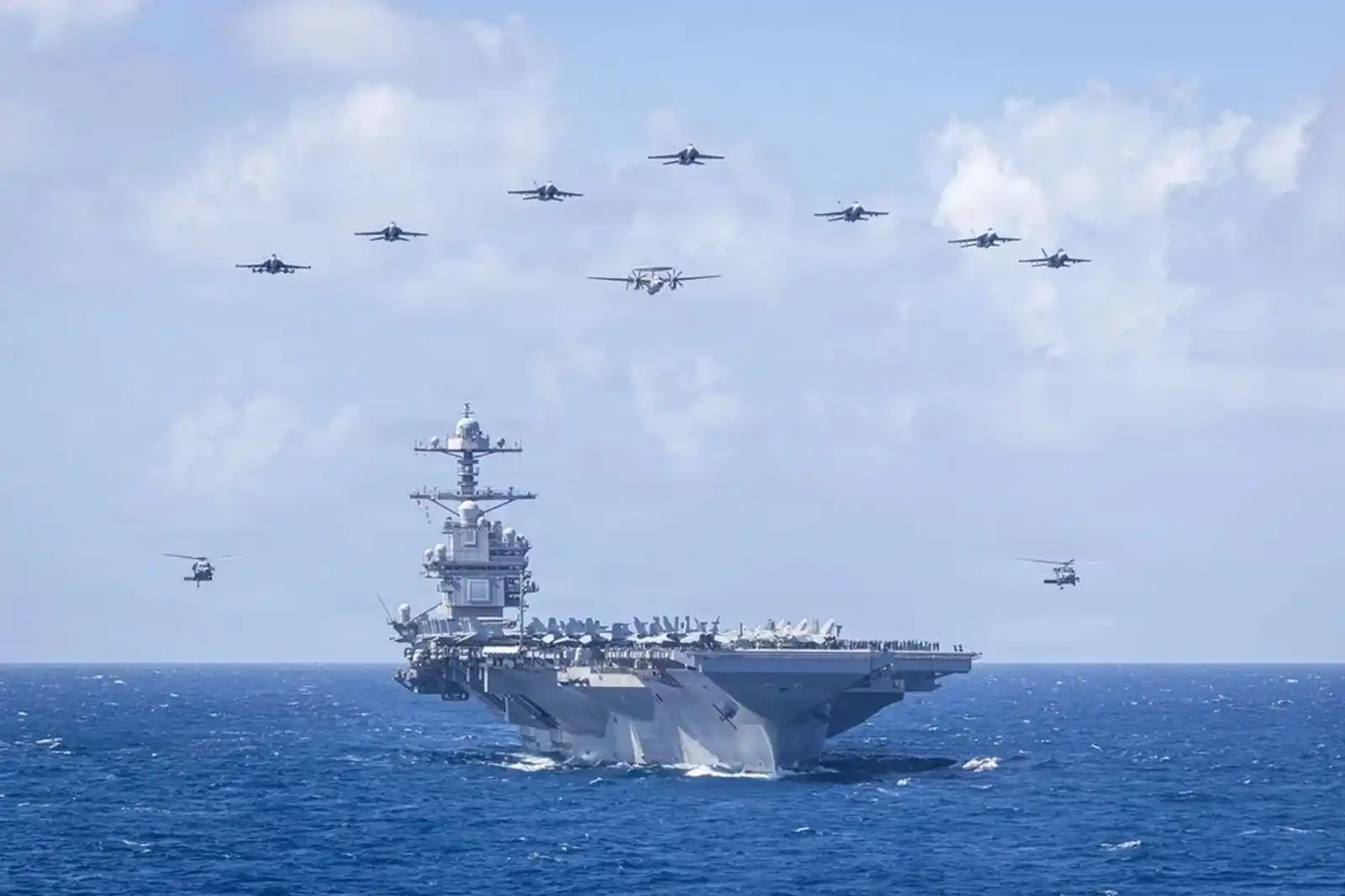
The United States Navy has redeployed the aircraft carrier USS Gerald R. Ford (CVN-78) to the Eastern Mediterranean for its second combat operation under Operation Epic Fury, reinforcing a widening maritime and air campaign directed at Iranian military infrastructure. The move injects sustained sea-based strike capability into a volatile theater already defined by high-tempo air operations, missile exchanges, and intensified naval engagements.
Following a prior deployment that included operations off Venezuela, the Ford has now repositioned with strategic precision, transitioning from Western Hemisphere tasking to a forward combat posture near the Middle East. The redeployment underscores the carrier’s role not merely as a capital ship, but as a mobile aviation complex engineered for prolonged, high-intensity warfare. Its arrival tightens the U.S. operational geometry against Iran while minimizing reliance on fixed regional air bases—installations that remain vulnerable to ballistic missile and drone attack.
The Eastern Mediterranean station offers a balance of proximity and maneuverability. From this maritime axis, carrier-based aircraft can project power deep into contested airspace while retaining defensive depth provided by layered naval escorts. The Ford’s movement into theater coincides with a broader escalation that began with a presidential authorization on February 27, followed by a large-scale strike wave on February 28 involving more than 100 aircraft and Tomahawk cruise missile launches targeting Iranian command-and-control nodes and missile facilities.
Advanced Sea-Based Strike Architecture in Active Combat
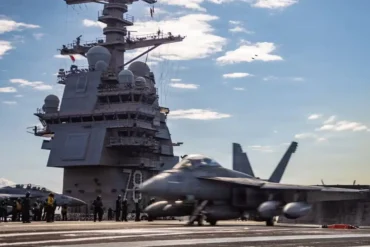
What distinguishes USS Gerald R. Ford from previous carriers is not only size or displacement, but the internal architecture designed for higher sortie generation and faster weapons handling. The Ford-class replaces traditional steam catapults with the Electromagnetic Aircraft Launch System (EMALS), enabling smoother and digitally optimized aircraft launches. This system reduces stress on airframes and allows a broader range of aircraft weights and configurations to be launched with precision control.
Recovery operations rely on Advanced Arresting Gear (AAG), built to manage both legacy and next-generation aircraft. Beneath the flight deck, 11 Advanced Weapons Elevators move ordnance at high speed from magazines to arming stations, each capable of lifting up to 24,000 pounds. In engineering terms, the design aims to sustain approximately 160 sorties per day, with the ability to surge beyond that threshold in combat conditions.
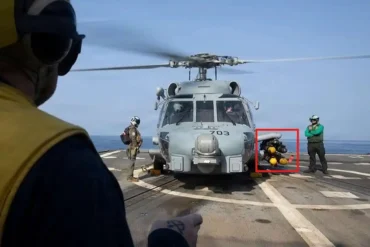
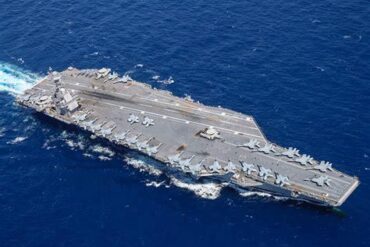
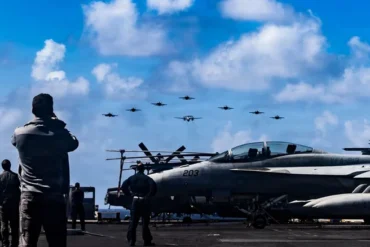
That technical ambition is no longer theoretical. Operation Epic Fury is unfolding as a real-world stress test. Aircraft from Carrier Air Wing 8 embarked aboard the Ford include F/A-18E/F Super Hornets for precision strike and maritime attack, EA-18G Growlers for electronic warfare and suppression of enemy air defenses, E-2D Hawkeye airborne early warning aircraft for battlespace management, and MH-60 helicopters for anti-submarine and search-and-rescue missions. Together, they form a self-contained air force afloat.
Coordinated Dual-Carrier Posture and Battlespace Dominance
The Ford is operating in parallel with a second carrier strike group in the broader region, allowing U.S. commanders to mass approximately 150 tactical aircraft when required. This dual-carrier presence expands operational flexibility. Strike packages can be launched in coordinated waves from multiple maritime vectors, complicating Iranian radar tracking and response timelines.
Escort vessels integrated into the strike group provide additional firepower and defense. Guided-missile destroyers contribute Tomahawk land-attack cruise missiles and ballistic missile defense capabilities, while layered air defense systems create a protective envelope against cruise missiles, drones, and aircraft. The presence of Cooperative Engagement Capability allows sensor data from ships and aircraft to be fused into a shared targeting picture, enabling one platform to fire using another’s radar track.
This network-centric warfare model reduces reaction time and improves resilience against saturation attacks. In recent phases of Epic Fury, U.S. and allied defenses have intercepted incoming projectiles using systems such as Patriot and THAAD, supplemented by sea-based interceptors. The Ford’s command-and-control capacity enhances this defensive lattice, serving as both strike hub and air defense coordinator.
Targeting Iran’s Maritime and Missile Infrastructure
The early phase of Operation Epic Fury focused on degrading Iranian command structures, naval assets, ballistic missile sites, and intelligence facilities. Tomahawk missiles opened the campaign, striking fixed infrastructure before follow-on air sorties expanded the damage assessment and suppression effort.
Within the maritime domain, U.S. forces targeted the Iranian platform Shahid Bagheri, described as a drone and helicopter carrier intended to extend Tehran’s reach at sea. The strike signaled an intent not merely to attrit surface combatants, but to dismantle distributed aerial reconnaissance and unmanned systems networks operating from maritime launch points. Removing such nodes reduces Iran’s ability to disperse drones across contested waters and shortens the reach of maritime surveillance.
The Ford’s air wing is structured precisely for this blend of counter-maritime strike and air defense suppression. Electronic attack aircraft degrade radar coverage and communications, while precision-guided munitions eliminate hardened facilities. The carrier’s mobility ensures these operations remain adaptable; it can reposition to adjust flight paths, complicate missile targeting solutions, and shift strike axes with minimal warning.
Logistics, Endurance, and Industrial Validation
Although nuclear-powered and capable of extended operations without refueling, a carrier remains dependent on a complex logistics chain for aviation fuel, munitions, spare parts, and sustainment supplies. The Ford conducted a resupply stop at Souda Bay, Crete, before assuming its combat station. This underscores a fundamental reality: sustained high-tempo naval warfare demands synchronized industrial throughput as much as tactical excellence.
The ship departed Norfolk in June 2025 and has now exceeded eight months of continuous operational deployment. Such endurance highlights both the strain placed on personnel and the evolving reliability of advanced systems that once faced developmental scrutiny. EMALS, arresting gear, and weapons elevators are now being evaluated under the uncompromising conditions of active combat operations. Reliability translates directly into sortie volume; sortie volume translates into operational leverage.
For naval planners and defense industry observers, this deployment represents a proving ground. The Ford-class was conceived to convert electrical generation capacity and deck layout efficiency into tangible combat output. Operation Epic Fury offers measurable validation of that doctrine.
Strategic Signaling and Escalation Control
Beyond tactical execution, the redeployment of USS Gerald R. Ford carries unmistakable strategic messaging. A carrier strike group embodies sovereign, mobile airpower that does not require host-nation permission for daily operations. Its presence alters regional force calculations immediately upon arrival.
In the context of escalating tensions with Iran, the Ford’s stationing in the Eastern Mediterranean enables rapid strike expansion without committing ground forces or expanding permanent basing footprints. It offers policymakers scalable options—precision strikes, maritime interdiction, air defense reinforcement—within a single adaptable platform. This flexibility reinforces deterrence by signaling capacity without predetermining escalation thresholds.
For Tehran, the implication is complex. Iranian planners must account for a moving target capable of projecting force across multiple domains. Defensive resources must be distributed across airspace, coastlines, and maritime approaches. Decision cycles compress when adversary airpower can launch from variable sea positions beyond predictable fixed bases.
Operational Momentum in Epic Fury
Operation Epic Fury continues to evolve as a multi-domain campaign integrating air, sea, and missile forces. The Ford’s redeployment for a second combat operation marks a continuation rather than a culmination. Its air wing is already contributing to sustained sortie generation in coordination with regional assets, reinforcing air defense layers and extending strike coverage.
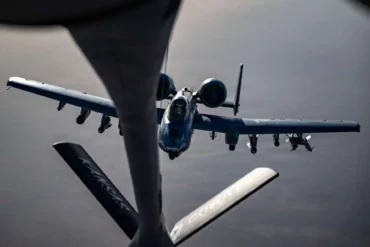
The convergence of two carrier strike groups, long-range bombers, missile defense networks, and allied contributions forms a dynamic operational mosaic. In that mosaic, the USS Gerald R. Ford serves as both centerpiece and amplifier—an engineering expression of maritime strategy brought into live combat context.
As events unfold, the carrier’s performance will shape not only immediate operational outcomes but also the long-term assessment of next-generation naval warfare. Sea-based aviation remains one of the few instruments capable of projecting decisive force without permanent territorial footprint. In the Eastern Mediterranean, that instrument is now fully engaged, its flight deck cycling aircraft into a conflict defined by precision, endurance, and the persistent contest for control of air and sea.