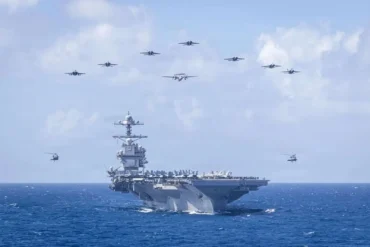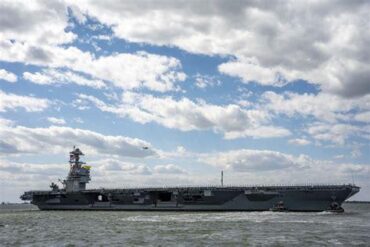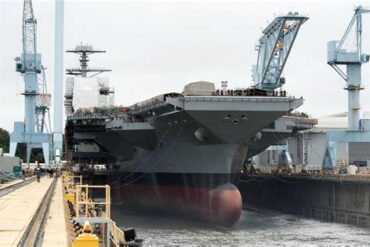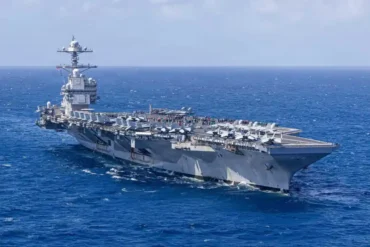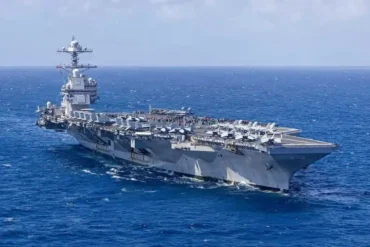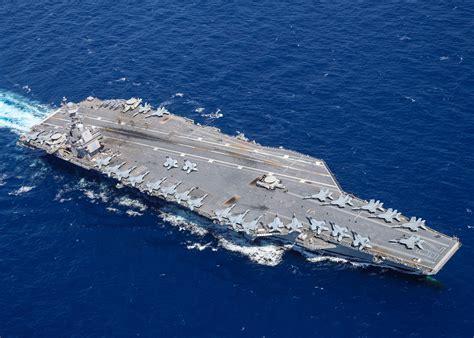
For centuries, the United States Navy has maintained maritime dominance through innovation, adaptability, and unmatched combat power. Today, that superiority is embodied in a singular vessel — the USS Gerald R. Ford (CVN-78). Commissioned on July 22, 2017, this nuclear-powered aircraft carrier represents the cutting edge of naval warfare and is widely regarded as the most lethal warship in active service.
Spanning 1,100 feet in length and displacing over 100,000 tons, the Ford isn’t just a floating airport — it’s a fully self-sustaining weapons platform designed to project American military might across the globe for decades. Its ability to remain at sea for 25 years without refueling fundamentally transforms the traditional limits of endurance, making it as strategic as it is tactical.
Next-Generation Design Meets Overwhelming Firepower
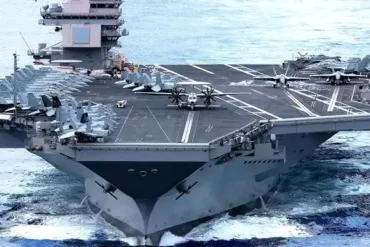
At its core, the USS Gerald R. Ford is more than a successor to the Nimitz-class aircraft carriers. It is a revolutionary leap forward in carrier design, integrating technologies that allow it to launch aircraft at unprecedented rates while improving crew efficiency, survivability, and combat power. The U.S. Navy itself describes the Ford as the “most capable, adaptable, and lethal combat platform in the world.”
Key technological enhancements include:
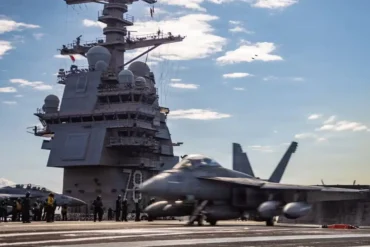
- Electromagnetic Aircraft Launch System (EMALS): Replacing traditional steam catapults, EMALS reduces wear and tear on aircraft and enables quicker sortie generation.
- Advanced Arresting Gear (AAG): Provides smoother and safer aircraft recovery.
- Dual-band radar systems: Allow for superior target detection, tracking, and engagement.
- Optimized island structure: Enhances flight deck operations and improves visibility for control crews.
These upgrades collectively enable the Ford to launch up to 25% more sorties per day than its predecessors — a crucial edge in high-intensity conflict scenarios.
The Air Wing: Lethality from the Skies
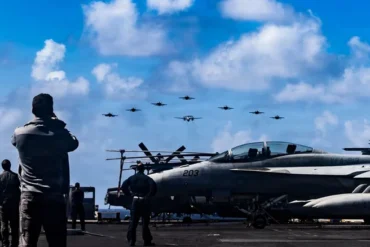
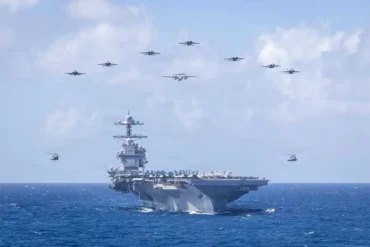
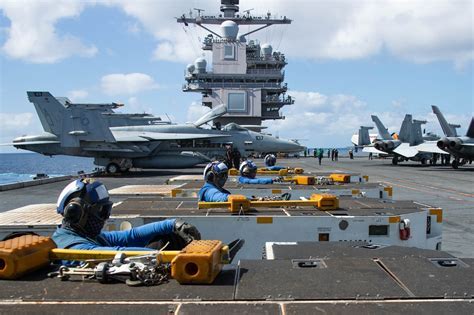
The true killing power of an aircraft carrier lies in its air wing, and the Ford class boasts a formidable aerial arsenal. The Ford’s flight deck is capable of launching and recovering up to 90 aircraft, with its current complement including:
- F/A-18E/F Super Hornets: These multi-role fighters are the workhorses of the Navy’s carrier-based aviation, offering both air-to-air and air-to-ground capabilities.
- EA-18G Growlers: Specialized in electronic warfare, they suppress enemy radar and communication systems.
- E-2D Advanced Hawkeye: These early-warning aircraft extend the carrier’s sensor range, acting as airborne command centers.
- MH-60R/S Seahawks: Multipurpose helicopters for anti-submarine warfare, search and rescue, and logistical support.
Each of these aircraft extends the carrier’s ability to strike targets up to 1,250 miles inland, without requiring aerial refueling — an enormous operational advantage.
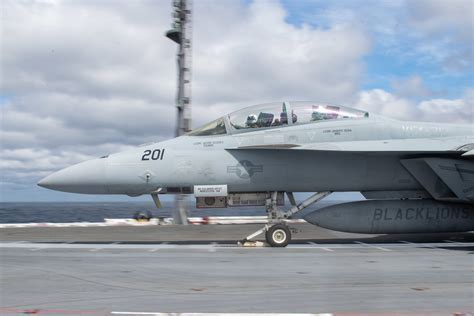
While the F-35C Lightning II has yet to be fully integrated into the Ford’s air wing as of 2025, its future inclusion would further amplify the ship’s stealth and strike capabilities. When deployed, this fifth-generation fighter will offer unmatched sensor fusion, low observability, and precision strike capacity.
Global Reach and Unmatched Endurance
One of the defining features of the USS Gerald R. Ford is its nuclear propulsion system, which not only gives the ship incredible range but also immense power to support its advanced electronics and high-tempo operations. Unlike traditional warships that require regular refueling, the Ford’s twin nuclear reactors enable it to remain operational at sea for a quarter of a century without refueling — a feat that redefines naval logistics.
This range is measured not in miles, but in time and mission capability. Whether it’s a show of force in the South China Sea, a deterrent in the Mediterranean, or counter-narcotics operations in the Caribbean, the Ford can respond quickly, decisively, and persistently.
Combat Proven: First Deployment and Operational Impact
The Ford’s first combat deployment came during an eight-month cruise in 2023, showcasing its full operational capability in real-world scenarios. This deployment was not merely a shakedown or trial; it was a combat-ready display of strategic lethality, conducted with a full Carrier Strike Group (CSG).
In October 2025, the Ford was redeployed to the Caribbean Sea to support counter-narcotics operations around Venezuela, demonstrating the carrier’s flexibility in non-traditional warfare environments. This mission served to underscore its peacetime value as a force multiplier, projecting deterrence while ensuring regional stability.
Carrier Strike Group 12: Power in Numbers
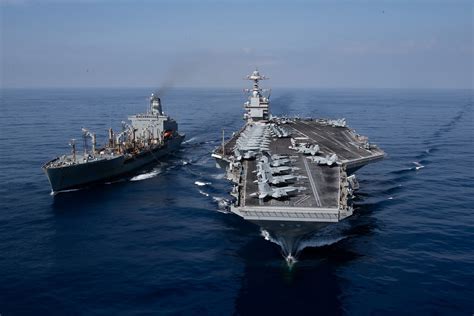
The Ford does not operate in isolation. Its combat power is magnified exponentially by the presence of Carrier Strike Group 12 (CSG-12), a combined fleet of destroyers, cruisers, submarines, and support vessels. This naval ensemble ensures the Ford is not only protected from surface, subsurface, and aerial threats, but also enhanced in its offensive reach.
CSG-12 typically includes:
- Guided-missile destroyers (Arleigh Burke-class): Equipped with the Aegis Combat System and Tomahawk missiles.
- Cruisers (Ticonderoga-class): Air and missile defense platforms with broad sensor coverage.
- Attack submarines (Virginia-class): For stealth reconnaissance and anti-submarine warfare.
This integrated structure makes the Ford-led CSG a self-sufficient warfighting machine, able to operate in contested environments for extended durations without resupply.
A Technological and Strategic Masterpiece
Beyond firepower, what sets the USS Gerald R. Ford apart is its technological sophistication and sustainability. The carrier’s all-electric systems — including its launch systems, advanced weapons elevators, and radar arrays — are powered directly by its nuclear core. This makes it a model for future carriers, reducing dependency on fossil fuels and enabling a smaller logistical footprint.
The ship also carries major crew optimizations. With a crew size of around 4,600 personnel, it operates with roughly 600 fewer sailors than Nimitz-class vessels, thanks to automation and improved workflows. This not only reduces operational costs over the carrier’s lifespan but also contributes to more streamlined and efficient mission execution.
Projecting Power in a Multipolar World
In an age of rising global tensions and multipolar threats, the Gerald R. Ford provides the U.S. Navy with unmatched strategic versatility. It’s not just about engaging enemy fleets; it’s about ensuring the freedom of navigation, conducting humanitarian missions, and reinforcing alliances through visible and overwhelming presence.
From confronting near-peer adversaries like China and Russia to engaging in low-intensity conflicts and peacekeeping missions, the Ford offers the White House a tool of precision escalation and powerful diplomacy. Its ability to appear on a coastline within days — equipped with multirole aircraft, stealth drones (in future deployments), and electronic warfare capability — fundamentally shifts the balance of power in any regional conflict.
The Future of Lethality: What Comes Next
While the USS Gerald R. Ford is the current zenith of naval power, it is also the vanguard of an evolving class. Additional Ford-class carriers are in various stages of construction, including the USS John F. Kennedy (CVN-79) and USS Enterprise (CVN-80). These ships will inherit the Ford’s core technologies while further refining their systems for unmanned operations, directed energy weapons, and greater survivability in electronic warfare domains.
Moreover, future iterations are expected to integrate artificial intelligence and advanced cyber warfare capabilities, ensuring superiority in both physical and digital combat spaces.
Conclusion: A Legacy Forged in Steel and Strategy
The USS Gerald R. Ford (CVN-78) is more than a ship. It is a symbol of American resolve, ingenuity, and global reach. With unmatched technological prowess, an air wing that can devastate adversaries hundreds of miles inland, and the backing of a fully integrated strike group, it stands as a floating fortress and a monument to modern warfare.
In a world of emerging threats and rapidly shifting battlefronts, the Ford remains steadfast — always ready, always lethal, and always at the tip of America’s strategic spear.