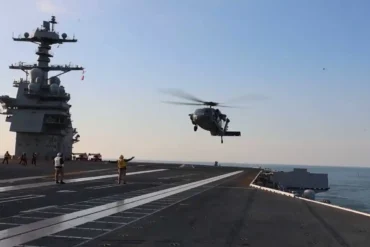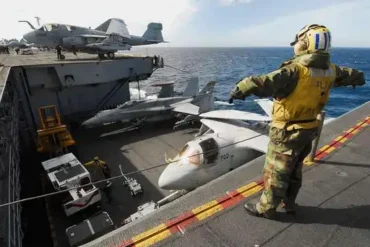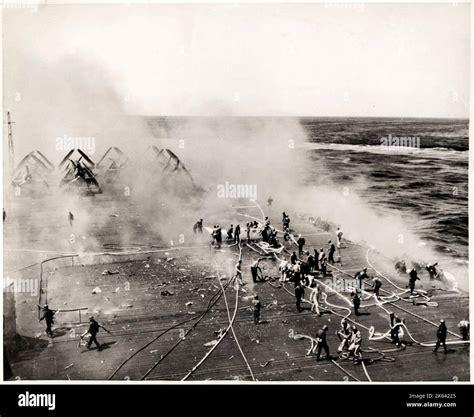
The flight deck of a US aircraft carrier is a place where precision meets controlled chaos, a tightly choreographed environment layered with risk. When a fire breaks out here, the transformation is immediate and unforgiving. What moments before was a synchronized ballet of aircraft launches and recoveries becomes a high-stakes emergency where seconds dictate survival, containment, and mission continuity.
In such an environment, danger is never theoretical. The deck is saturated with volatile elements—jet fuel, live ordnance, and high-performance aircraft systems—all operating in close quarters. Fire, even in its smallest form, is treated as an existential threat. There is no such thing as a “minor” blaze on a carrier’s flight deck, only early-stage disaster or fully realized catastrophe.
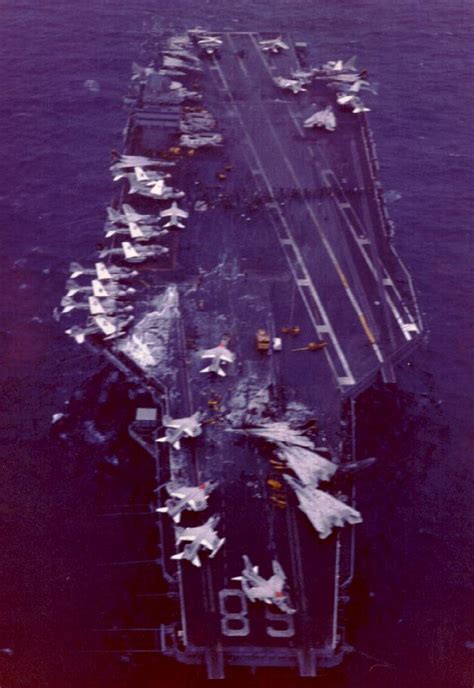
The urgency of this reality has been written in history, most notably during the USS Nimitz disaster in 1981, when a landing EA-6B Prowler crashed into parked aircraft, igniting a chain reaction of fire and explosions. The consequences were devastating, not only because of the initial impact but due to how quickly fire fed on the surrounding hazards.
The First Critical Seconds: Immediate Reaction and Alarm Activation
The instant flames or smoke are detected, the response begins not with command, but with proximity. The nearest crew members initiate the first countermeasures, sprinting toward designated firefighting stations embedded across the deck. These stations are strategically positioned to ensure that no point on the deck is beyond rapid response reach.
Simultaneously, alarm systems and communication lines are activated, transmitting the emergency across the carrier. Within seconds, the localized reaction escalates into a coordinated ship-wide response. Every crew member understands their role, not through improvisation, but through relentless training designed to eliminate hesitation.
The goal in these opening moments is brutally simple: contain the fire before it grows beyond immediate suppression capability. Delay, even by seconds, risks escalation into a multi-point inferno.
Crash and Salvage Teams: The Red Jersey Firefighters
As the alarm spreads, the specialized crash and salvage crews—known as the “red jerseys”—take command of the situation. These personnel are not generalists; they are highly trained emergency responders equipped to handle the unique dangers of aviation fires at sea.
Directed by the Aircraft Crash and Salvage Officer (Air Bos’n), these teams move with calculated aggression. Their responsibilities extend beyond extinguishing flames. They must rescue injured personnel, secure hazardous equipment, and prevent secondary explosions.
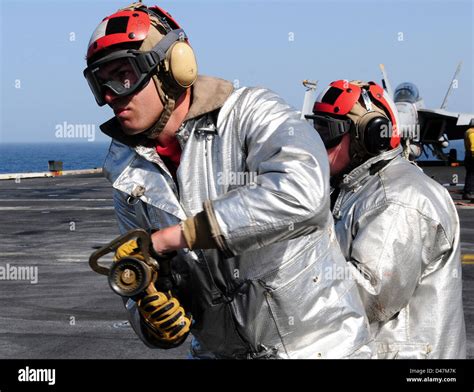
Their equipment arsenal reflects the complexity of the threat. The primary tool is the Aqueous Film-Forming Foam (AFFF) system, engineered to blanket burning fuel and cut off oxygen supply. Unlike water, which can spread fuel fires, AFFF forms a suppressive layer that halts combustion at its source.
Supporting systems include:
- Saltwater hoses, used for cooling surrounding areas and preventing heat spread
- PKP dry chemical extinguishers, effective against fuel-based fires
- CO2 extinguishers, ideal for electrical or confined-space hazards
This layered response ensures that the fire is attacked from multiple angles, reducing the chance of resurgence.
Why Flight Deck Fires Escalate So Quickly
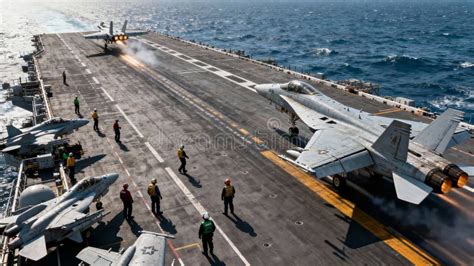
A carrier’s flight deck is uniquely vulnerable because it combines fuel saturation with explosive potential. Aircraft are often fully fueled with JP-5 aviation fuel, a substance specifically designed for stability but still highly flammable under the right conditions.
When a fire ignites, leaking fuel can spread flames across the deck in seconds, creating a fast-moving fire front. Add to this the presence of armed missiles, bombs, and ammunition, and the situation becomes exponentially more dangerous.
The USS Nimitz tragedy demonstrated this with chilling clarity. Even after the primary fire was extinguished, concealed ordnance detonated, killing additional crew members who believed the danger had passed. This highlights a critical truth: fire is only the first phase of the threat.
Heat buildup can also compromise aircraft structures, causing secondary fuel leaks or triggering mechanical failures. The deck itself, while reinforced, can suffer damage that complicates movement and firefighting efforts.
System Failures and Lessons Learned from Disaster
One of the most sobering aspects of historical incidents is how technical delays amplify destruction. During the Nimitz fire, the AFFF washdown system—designed to flood the deck with foam—was not fully activated for over two minutes. Portions of the system malfunctioned, releasing seawater instead of foam.
In a setting where fire can double in intensity within seconds, such delays are catastrophic. The result was not just greater damage, but a prolonged firefighting battle that exposed more crew members to danger.
Modern carriers have since implemented redundant systems, faster activation protocols, and rigorous maintenance standards to ensure that suppression systems respond instantly and reliably. Training has also evolved, emphasizing anticipation and preemptive positioning, rather than reactive measures alone.
The Narrow Margin Between Control and Catastrophe
What defines a successful response is not the absence of fire, but the speed and precision of containment. On a carrier’s flight deck, there is no buffer zone, no safe distance. Firefighters operate within meters of burning fuel, unstable ordnance, and active aircraft systems.
Every action is calculated against a shrinking timeline. The difference between a controlled incident and a catastrophic loss often comes down to how effectively the first responders act within the first minute.
Even after flames are extinguished, the deck remains a hazard zone. Crews must carefully inspect for hidden heat sources, fuel residues, and unexploded ordnance, ensuring that the fire does not reignite or trigger delayed explosions.
Controlled Chaos: Mastery Under Pressure
A fire on a US aircraft carrier’s flight deck is not merely an emergency—it is a test of discipline, training, and system design under extreme pressure. The environment demands perfection in execution, where hesitation can cost lives and decisive action can prevent disaster.
What emerges from these scenarios is not just a story of danger, but of highly coordinated resilience, where every crew member becomes part of a rapid-response machine engineered to confront one of the most volatile situations imaginable.
In the end, the flight deck remains one of the most dangerous workplaces in the world—not because of the fire itself, but because of everything waiting to ignite alongside it.