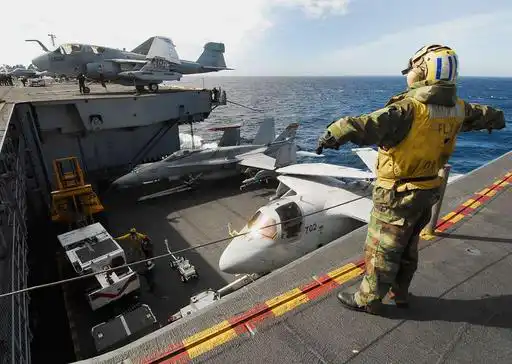
The flight deck of an aircraft carrier is one of the most hazardous work environments in the world. Described as “controlled chaos,” this compact, intensely regulated arena requires extreme discipline, training, and adherence to safety protocols to prevent catastrophic accidents. Amidst roaring jet engines, racing aircraft, and dozens of personnel maneuvering in tight coordination, safety is not optional—it is the very bedrock of survivability.
The Flight Deck: A Hotbed of Risk and Responsibility
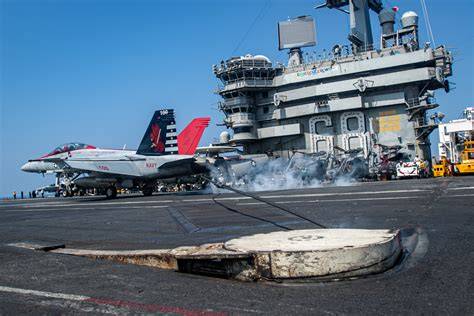
A modern aircraft carrier’s flight deck spans approximately 4.5 acres of steel, densely populated with jets, helicopters, personnel, and weaponry. At any moment, multiple aircraft may be launching or recovering, demanding simultaneous orchestration of dozens of complex actions. The risks are immense: jet intakes that can suck in people or gear, scorching exhausts, spinning rotors, arresting cables under extreme tension, and the ever-present threat of collisions, fires, or structural failures.
George C. Wilson, author of Supercarrier, accurately dubbed the flight deck as “a million accidents waiting to happen.” These risks are compounded by environmental extremes—intense noise, blazing heat, volatile winds, and limited visibility under night operations. Against this backdrop, stringent safety protocols are the only line of defense.
Roles and Hierarchies: The Precision of Team-Based Operations
Every individual on the flight deck has a defined role within a rigid command structure, ensuring that responsibility is never ambiguous. Oversight begins with the Air Boss, positioned in the Primary Flight Control (Pri-Fly), who has ultimate authority over flight deck operations. On-deck coordination is handled by the Handler, managing the precise location of every aircraft.
Key personnel include:
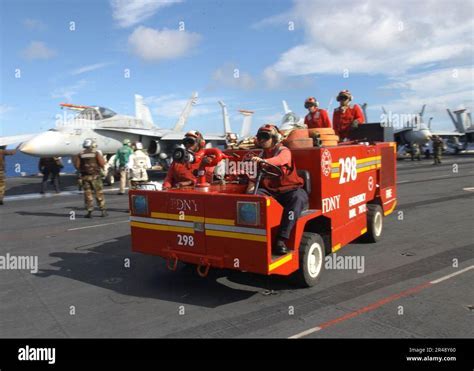
- Crash and Salvage Crews, trained to extinguish fires and rescue pilots.
- Arresting Gear Technicians, ensuring cables are properly tensioned.
- Flight Deck Officers and Safety Observers, who patrol constantly to enforce rules.
- Medical Corpsmen, on standby for injuries.
- Catapult and Arresting Gear Crews, managing launch and recovery systems.
Each team’s operational discipline prevents interference and maintains safe lanes for movement and evacuation.
Color-Coded Jerseys: Visual Command and Communication
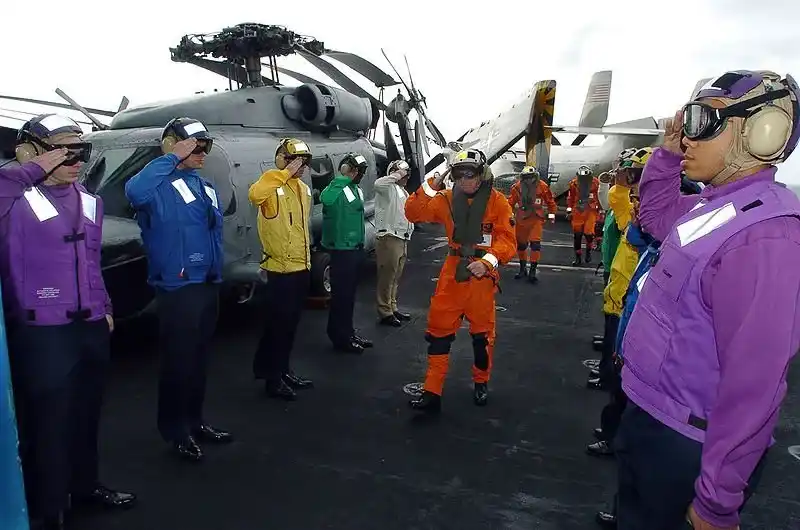
Flight deck personnel wear color-coded jerseys, instantly identifying their function and authority. This system facilitates non-verbal communication critical in high-noise environments.
- Yellow: Aircraft directors—control aircraft movement.
- Blue: Plane handlers and elevator operators.
- Red: Ordnance crews—handle munitions and fire emergencies.
- Green: Catapult and arresting gear personnel.
- Purple: Fuel handlers, nicknamed “Grapes.”
- Brown: Plane captains—assigned to individual aircraft.
- White: Safety officers, medical staff, and quality assurance.
These visual cues enable seamless coordination, especially when spoken communication is impossible.
Mandatory Flight Deck PPE: Gear that Saves Lives
Each crew member is outfitted with Personal Protective Equipment (PPE) engineered for the extreme demands of the deck. This includes:
- Helmet with cranial protection, impact-resistant shell, and chinstrap.
- Goggles, rated for high-speed debris.
- Hearing protection: double-layered with inner foam and external earmuffs.
- Float coat (Mk-1 life preserver), containing survival tools and water-activated lights.
- Steel-toed flight boots, slip-resistant and flame retardant.
- Fire-retardant gloves and flame-resistant coveralls.
Failure to wear any component is not tolerated, and inspections are conducted before each flight evolution.
The Discipline of Walkdowns and Debris Control (FOD Walks)
Before flight operations begin, the deck undergoes a FOD (Foreign Object Debris) walkdown. All available personnel line up shoulder-to-shoulder and sweep the flight deck for stray tools, bolts, or trash. Even a single loose screw can be lethal if ingested by a jet engine, or cause skidding on landing. FOD checks are repeated multiple times daily and during flight pauses.
The flight deck is treated as sacrosanct airspace—no gear, personal items, or unsecured equipment is allowed without proper tethering or inventory logging.
Movement Discipline: A Ballet of Precision
One misstep on a carrier deck can be fatal. Personnel are trained to never walk behind jet exhausts or in front of intakes, and to maintain eye contact when crossing aircraft paths. Jet blasts can exceed 200 mph, capable of blowing personnel into the ocean.
Movement across the landing area is restricted by signal lights and controller approval. During recovery operations, the landing area becomes an exclusion zone, and crossing it without clearance is a grave violation.
Additionally, personnel are forbidden to:
- Sit, kneel, or rest on the flight deck.
- Turn their backs to the landing strip.
- Wear jewelry or unsecured accessories.
- Use cell phones or personal electronics.
These seemingly minor infractions can cause delays, damage, or injury in critical seconds.
Communication Protocols and Hand Signals
With deafening sound levels reaching 150+ decibels, verbal commands are futile. Instead, standardized hand signals and illuminated wands are used to direct aircraft, coordinate crew movements, and indicate readiness.
Aircraft directors use complex gestures to:
- Launch or halt aircraft.
- Signal arresting hook checks.
- Alert pilots of fuel or ordinance issues.
Signals must be learned to precision, and practiced until muscle memory eliminates hesitation. The entire choreography is drilled repeatedly until second nature.
Training and Qualification: Earning the Deck
Before setting foot on the flight deck, all personnel undergo Flight Deck Safety Training and must pass written and practical tests. Topics include:
- Aircraft recognition and behavior.
- Launch and recovery sequences.
- Emergency response protocols.
- Damage control and firefighting.
- Communication systems.
Qualifications are not permanent. Periodic re-certification ensures protocols remain sharp, especially after deployments or downtime. Failure to pass results in reassignment.
Emergency Drills and Live-Action Simulations
Emergency preparedness is a pillar of deck safety. Drills simulate:
- Aircraft crashes and recovery.
- Fire suppression and toxic smoke containment.
- Man overboard scenarios.
- Cable snap-back injuries.
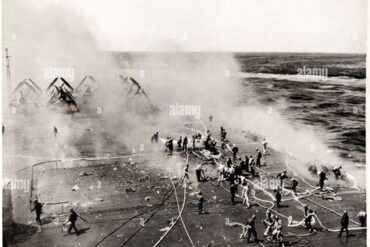
These events demand fast, collective response. For instance, arresting cable failures can whip across the deck with lethal force. Personnel are trained to immediately drop flat when “cable loose” is shouted. Every second counts. Fires can engulf aircraft in moments, and the margin between control and disaster is razor-thin.
Technological Aids and Safety Innovations
Modern aircraft carriers integrate advanced technologies to supplement human vigilance:
- Deck-edge cameras and night vision systems.
- Digital aircraft tracking via the Integrated Launch and Recovery Television Surveillance System (ILARTS).
- Wearable sensors to monitor personnel exposure to noise, vibration, and heat.
- Automatic Arresting Gear Monitoring, checking cable tension and condition.
However, even the most advanced systems cannot replace human judgment, experience, and real-time decision-making on the flight deck.
Conclusion: Safety as Culture, Not Just Protocol
Safety on the aircraft carrier flight deck is not just about rules—it is a culture embedded into every action, every gesture, every breath. It is a culture of vigilance, precision, and respect for the environment, where even the most seasoned sailor never lets down their guard.
While movies may depict the flight deck as a dramatic playground of high-speed launches, the truth is far more sobering. Every day, hundreds of men and women operate in conditions that leave no room for error. Their commitment to safety, discipline, and teamwork keeps not only themselves alive but ensures the striking power of naval aviation is always ready, always lethal, and always professional.