In the complex and highly regulated world of aviation, aircraft maintenance inspections are crucial to ensuring both operational safety and regulatory compliance. These inspections are not merely procedural obligations; they form the backbone of airworthiness, preventing mechanical failures and ensuring consistent aircraft performance. In this article, we explore the intricate details behind the acronyms representing required aircraft maintenance inspections, offering a comprehensive understanding vital for pilots, aircraft owners, and aviation professionals.
Understanding Aircraft Maintenance Inspection Acronyms
Aircraft maintenance is governed by strict protocols defined by regulatory authorities like the Federal Aviation Administration (FAA). Each required inspection is often abbreviated into an acronym for ease of reference. Understanding these acronyms is essential for maintaining a proper inspection schedule and ensuring compliance with aviation standards.
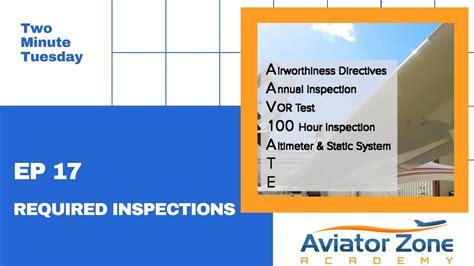
The most frequently encountered acronyms include AAVIATE, which represents a checklist used to remember required inspections and documents necessary to maintain an aircraft’s airworthiness.
Breaking Down AAVIATE: The Core Inspection Acronym
AAVIATE serves as a mnemonic device summarizing the essential maintenance checks:
- A – Annual Inspection
- A – Airworthiness Directives (ADs)
- V – VOR Equipment Check (for IFR flights)
- I – 100-Hour Inspection
- A – Altimeter and Pitot-Static System Check (for IFR flights)
- T – Transponder Inspection
- E – Emergency Locator Transmitter (ELT) Inspection
Each of these checks plays a unique role in guaranteeing that the aircraft is safe for operation. Missing even one could lead to catastrophic failure or severe legal penalties.
Annual Inspection: The Foundation of Airworthiness
The Annual Inspection is a comprehensive examination mandated for almost all aircraft. Under 14 CFR Part 91.409, this inspection must occur every 12 calendar months and must be performed by an A&P mechanic with Inspection Authorization (IA). It covers every critical aspect of the aircraft, from engine performance to structural integrity, avionics, and control surfaces.
Failure to perform an annual inspection results in the aircraft being classified as unairworthy, prohibiting its legal operation until the inspection is satisfactorily completed. Notably, even aircraft that are not flown must still comply with this annual requirement unless formally placed in storage status under a controlled maintenance program.
Airworthiness Directives (ADs): Compliance is Not Optional
Airworthiness Directives are legally enforceable regulations issued by the FAA or other aviation authorities when an unsafe condition exists in a product. ADs are designed to correct unsafe conditions in aircraft, engines, propellers, or appliances.
There are three primary types of ADs:
- Emergency ADs, requiring immediate compliance.
- One-time ADs, necessitating a single corrective action.
- Recurring ADs, requiring ongoing compliance at specified intervals.
Maintaining records of AD compliance is critical. Failure to adhere to even one directive can invalidate the aircraft’s airworthiness certificate.
VOR Equipment Check: Essential for IFR Flight
When operating under Instrument Flight Rules (IFR), aircraft equipped with VOR navigation systems must undergo a VOR check every 30 days. This check ensures the accuracy of the VOR equipment, which is vital for safe navigation, particularly when operating without outside visual reference.
Pilots can perform VOR checks themselves under certain conditions, or they may opt for a maintenance technician to perform it, providing a formal record in the aircraft’s logbooks.
100-Hour Inspection: Mandatory for Commercial Use
Aircraft used for hire or flight instruction are subject to a 100-hour inspection. Despite similarities to an annual inspection, the 100-hour inspection has its distinct identity and separate scheduling. Only an A&P mechanic is required to conduct a 100-hour inspection; IA endorsement is not necessary.
Interestingly, aircraft can legally exceed the 100-hour limit by up to 10 flight hours for the purpose of reaching a location where the inspection can be performed. However, the overrun hours must be included in calculating the next 100-hour interval.
Altimeter and Pitot-Static System: Trust in Accurate Readings
For IFR operations, an inspection of the altimeter, static system, and automatic pressure altitude reporting system must occur every 24 calendar months. The purpose is to ensure that critical flight instruments provide accurate readings at all altitudes and flight conditions.
Errors in these systems can lead to altitude deviations, navigation errors, and controlled flight into terrain (CFIT), underlining the immense importance of periodic checks.
Transponder Inspection: Maintaining Signal Integrity
A transponder emits identification and altitude information to Air Traffic Control (ATC) radar systems. Every aircraft equipped with a transponder must undergo a test and inspection every 24 calendar months according to 14 CFR Part 91.413.
This inspection confirms that the transponder accurately relays data. Failing to maintain transponder functionality not only risks safety but also contravenes regulations, exposing operators to penalties.

Emergency Locator Transmitter (ELT) Inspection: Vital for Rescue Operations
An ELT automatically broadcasts a distress signal when subjected to a significant impact, aiding search and rescue operations. Regulations require that ELTs be inspected every 12 calendar months for:
- Proper installation
- Battery corrosion
- Operation of the control and activation mechanisms
- Sufficient signal strength
Moreover, if an ELT battery reaches 50% of its useful life or is used in an actual emergency, replacement becomes mandatory.
Special Inspections and Considerations Beyond AAVIATE
While AAVIATE covers the primary mandatory inspections, other scenarios demand special inspections, such as:
- Progressive Inspections: Often used by large flight schools or commercial operators.
- Phase Inspections: Dividing inspections into segments to reduce downtime.
- Condition Inspections: Replacing the annual inspection for certain Experimental category aircraft.
These specialized programs must be pre-approved and meticulously documented to ensure that they meet regulatory standards.
Conclusion: Mastery of Acronyms Equals Mastery of Compliance
In aviation, the mastery of acronyms like AAVIATE and a thorough understanding of inspection requirements directly correlate with operational excellence and safety. Ignorance or neglect of even a single requirement can lead to severe repercussions, including accidents, loss of insurance coverage, financial penalties, and revocation of pilot certificates.
Aircraft owners and operators must commit to proactive maintenance planning, scrupulous recordkeeping, and a relentless focus on compliance to uphold the sacred trust bestowed upon them by passengers and the broader aviation community.
The skies are unforgiving of oversight; only through meticulous attention to required maintenance inspections can we ensure that every flight is not just an act of movement, but a triumph of human ingenuity and dedication to safety.