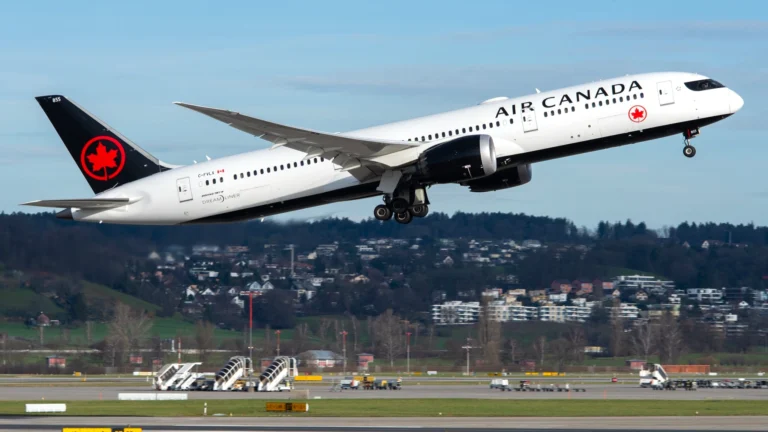
The long-haul journey from Auckland to Vancouver was barely underway when an unexpected and unsettling development forced Flight AC40 to abandon its trans-Pacific crossing. Just minutes after lifting off from Auckland Airport, pilots detected a strange odor in the cockpit—an anomaly serious enough to halt the climb, declare an emergency, and return the aircraft to New Zealand. What could have been a routine 13-hour flight instead became the latest flashpoint in a growing global conversation about aircraft fume events and aviation safety.
Operating one of the longest routes in Air Canada’s network, the Boeing 787-9 Dreamliner had departed with 269 passengers and 14 crew members onboard. The aircraft’s return, executed calmly and without injury, underscored the industry’s rigid safety protocols while simultaneously raising fresh questions about the rising frequency of unexplained odors and fumes at cruising altitudes.
The incident unfolded swiftly but deliberately, following a playbook refined through decades of aviation risk management. Yet the broader implications extend far beyond a single aircraft looping over the ocean and touching back down where it started.
A Trans-Pacific Flight Interrupted Within Minutes
The flight was scheduled to leave Auckland at 2:00 p.m. local time, eventually pushing back after a brief delay. Shortly after takeoff, as the aircraft climbed through approximately 12,000 feet, pilots noticed an unusual smell emanating within the cockpit. In commercial aviation, any unexplained odor—particularly one that cannot be immediately identified—is treated as a potential threat.
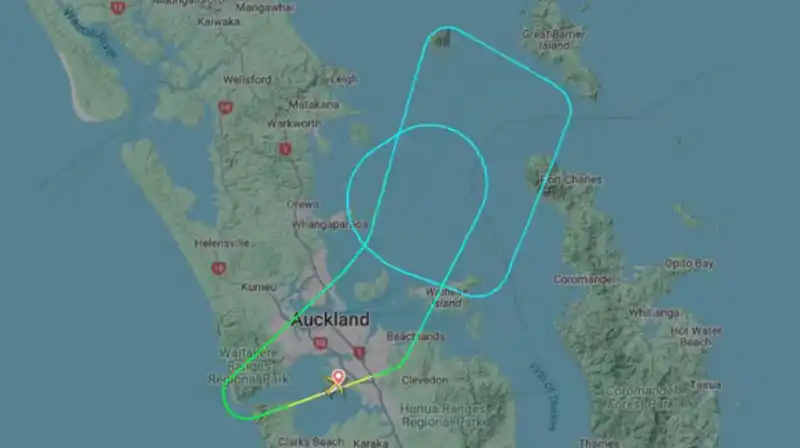
Rather than continue climbing over open ocean, the crew leveled off near 12,900 feet and initiated emergency procedures. Air traffic data later revealed the aircraft performing two wide holding loops over the Hauraki Gulf, a maneuver consistent with fuel-dumping preparations. Given the jet’s heavy fuel load for a 7,055-mile journey, reducing weight before landing was both necessary and routine.
The aircraft returned safely to Auckland, where emergency services stood by as a precaution. Passengers disembarked without incident, and no injuries were reported. Air Canada later confirmed that the aircraft was taken offline for a full technical inspection, emphasizing that the decision to return was made “out of an abundance of caution.”
Why Fuel Dumping and Rapid Returns Are Standard Practice
Long-haul aircraft like the Boeing 787-9 are designed to carry enormous fuel loads, enabling nonstop flights across oceans and continents. However, that same fuel becomes a liability when an aircraft needs to land shortly after departure. Maximum takeoff weight far exceeds maximum landing weight, making fuel dumping a critical safety measure.
In the case of Flight AC40, the pilots’ choice to circle offshore rather than return immediately reflects a disciplined approach to risk. Dumping fuel over water, at altitude and within designated airspace, minimizes environmental impact while ensuring structural safety during landing. These procedures are rehearsed extensively in simulators and form part of every long-haul pilot’s emergency training.
The calm execution of these steps helped ensure that what could have been a frightening experience for passengers remained largely controlled and orderly.
Air Canada’s Boeing 787 Fleet and the Importance of the Route
Flight AC40 is operated four times weekly using a 298-seat Boeing 787-9, the longest-range aircraft in Air Canada’s fleet. With 32 Dreamliners in service, the airline relies heavily on the type for demanding trans-Pacific routes linking Canada with Australia and New Zealand.
These aircraft are celebrated for their fuel efficiency, advanced avionics, and improved cabin environment, including lower cabin altitude and higher humidity. Ironically, it is precisely these advanced systems—particularly those related to air circulation and engine bleed air—that are often scrutinized when fume events occur.
Air Canada also benefits from its Star Alliance partnership with Air New Zealand, which operates daily Auckland–Vancouver flights. This partnership enabled relatively swift rebooking for affected passengers, limiting disruption despite the aircraft being grounded for inspection.
A Pattern Emerges: Fume Events Across the Fleet
While this incident marked the first Air Canada Boeing fume event in over a year, it fits into a broader pattern that has drawn increasing scrutiny. Over the past year, multiple Air Canada and Air Canada Rouge flights—primarily involving Airbus aircraft—have experienced smoke, fumes, or acrid odors in either the cockpit or cabin.
These incidents have prompted emergency landings, rapid descents, and in some cases, runway evacuations. Although serious injuries have been avoided, several passengers and crew members have required medical attention, highlighting the unpredictable nature of exposure.
Notably, a previous 787-9 incident in July 2024 saw a flight from Montréal to London Heathrow divert to Gander after passengers reported a strong burning smell mid-flight. That event, like the Auckland occurrence, ended safely—but reinforced concerns that no aircraft type is entirely immune.
Understanding Aircraft Fume Events and Their Causes
Fume events are broadly defined as incidents in which smoke, vapors, or unusual odors enter the cockpit or cabin. Potential sources include overheated oil seals, hydraulic fluid leaks, electrical malfunctions, or contamination of the air supply.
Modern jetliners typically use bleed air from engines to pressurize and ventilate the cabin. While heavily filtered and regulated, this system can, under certain conditions, allow trace contaminants to enter the airflow. Even small concentrations can produce noticeable smells—and in rare cases, physiological symptoms.
Investigations by major outlets, including The Wall Street Journal, have revealed that reported fume events in the United States alone occur at a rate of more than 20 per day, a figure nearly ten times higher than a decade ago. Experts caution that many incidents likely go unreported, either because symptoms are mild or odors dissipate quickly.
Health Implications for Crew and Passengers
For most travelers, a brief exposure to unidentified odors results in no lasting harm. However, occupational health specialists warn that repeated exposure, particularly among flight crew, can have cumulative effects.
Dr. Robert Harrison, an occupational medicine specialist at the University of California, San Francisco, has treated more than 100 crew members for toxic exposure related to fume events. According to Harrison, inhaled contaminants can circulate rapidly through the bloodstream and affect the central nervous system, leading to symptoms ranging from headaches and dizziness to memory loss and balance issues.
While severe reactions remain relatively rare, documented cases include chronic respiratory problems, cognitive impairment, tremors, and persistent migraines. The variability in individual response makes prevention and early reporting essential.
What Passengers Should Do If They Smell Fumes
Aviation safety experts stress that passengers play a vital role in early detection. If an unusual smell is noticed onboard, travelers should notify cabin crew immediately, describing the odor as precisely as possible—whether it smells like burning oil, chemicals, or electrical smoke.
If symptoms such as nausea, dizziness, or confusion develop, seeking medical evaluation upon landing is strongly advised. Some diagnostic tests, including those for carbon monoxide exposure, are time-sensitive and most effective when conducted shortly after the incident.
A Safe Landing, but Unanswered Questions Remain
The safe return of Flight AC40 to Auckland demonstrates that aviation safety systems work as intended when anomalies arise. Pilots detected a problem, followed established procedures, and prioritized the well-being of everyone onboard. Yet the growing frequency of such events suggests deeper systemic questions that the industry continues to grapple with.
As global air traffic rebounds and long-haul routes proliferate, airlines, manufacturers, and regulators face mounting pressure to better understand—and ultimately reduce—the occurrence of fume events. For now, vigilance remains the primary defense, ensuring that when something smells wrong at 12,000 feet, the response is swift, decisive, and grounded in safety above all else.