Newark Liberty International Airport is preparing to test a technology that signals a decisive shift in how major aviation hubs move people on the ground. Beginning in spring 2026, the Port Authority of New York and New Jersey will deploy autonomous, zero-emission electric shuttles on a closed section of the airfield at EWR. The objective is not spectacle. It is capacity, efficiency, and the redesign of landside mobility at one of the United States’ most complex airports.
For decades, airport ground transfers have been the hidden friction in air travel. Passengers endure crowded buses, long curbside waits, and circuitous AirTrain routes that were designed for a different era of passenger volume. Newark’s broader redevelopment—including a replacement AirTrain scheduled for 2030 and plans for a future Terminal B—creates both disruption and opportunity. The autonomous shuttle trials are a live experiment in whether automation can deliver faster, cleaner, and more frequent connections between terminals, parking, and future transit hubs.
The testing program builds on a 2024 request for innovation that envisioned an electric autonomous network linking key points across the airport. That proposal matured over five years of development, winter weather validation, and prior demonstrations at both JFK and Newark since 2022. Now the concept enters a competitive proving ground.
A Controlled Trial of Three Autonomous Shuttle Systems
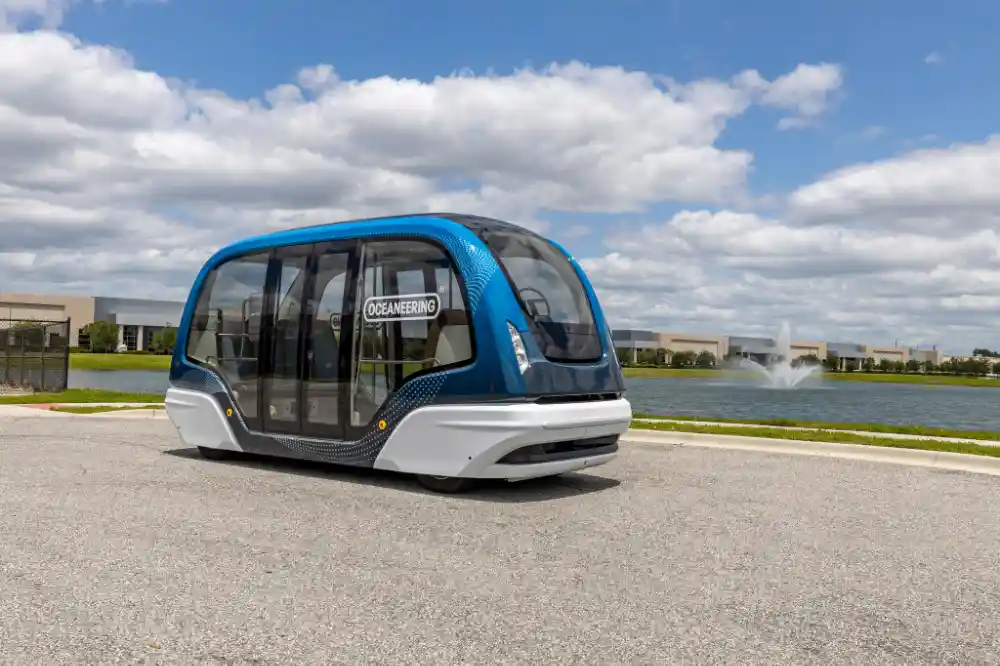
Three companies—Oceaneering, Ohmio, and Glydways—will each operate during a roughly two-week evaluation window. Oceaneering begins in March 2026, followed by Ohmio later that month, with Glydways entering testing in May. The vehicles will run in a non-public operating zone designed to simulate a high-capacity loop where multiple shuttles operate in tight intervals, known as headways. Tight headways are critical; they determine whether autonomous fleets can move large passenger volumes without creating new bottlenecks.
The trials will measure more than simple functionality. Engineers and planners will evaluate redundancy systems, obstacle detection performance, battery endurance, remote supervision protocols, and integration with airport traffic management. Airports are unusually complex environments, with ground service equipment, aircraft movements, and unpredictable pedestrian flows. Any autonomous system must perform flawlessly in conditions that are closer to choreographed chaos than a suburban test track.
Data collected from these runs will inform a potential formal request for proposals in 2027. In practical terms, the airport is stress-testing suppliers before committing to a long-term deployment that could reshape its ground circulation strategy.
Why Landside Mobility Is the Real Battleground
Airport innovation often focuses on aircraft—new engines, new wings, new fuels. Yet for passengers, the most immediate pain points occur on the ground. Transfers between terminals, parking decks, rental car facilities, and rail links can quietly consume more time than the flight itself.
Newark’s existing AirTrain dates back to the 1990s. While functional, it was not built for today’s passenger volumes or for the airport’s evolving terminal footprint. The redesigned AirTrain will improve access to Terminal A, and autonomous shuttles could extend that improved connectivity across other facilities and to the future Terminal B. The aim is simple: compress transfer times and reduce cognitive load. Fewer confusing transfers. Fewer waits. More predictable movement.
Zero-emission electric shuttles also address environmental and noise concerns. Airports are under increasing regulatory and community pressure to decarbonize landside operations. Electrification reduces local emissions, while automation can optimize routing and spacing to avoid idling and congestion. The technology therefore serves two masters: operational efficiency and sustainability.
Passenger Experience and the Question of Trust
In the short term, most travelers will not encounter these vehicles. The spring 2026 trials occur in limited, non-public zones. But if the program advances, passengers may eventually board shuttles without a human driver at the wheel. That shift requires more than technical validation. It requires psychological acceptance.
Autonomous systems rely on layered redundancy—multiple sensors, independent braking systems, fail-safe communication links—to ensure that no single failure compromises safety. Regulatory approval will demand rigorous demonstration that the vehicles can detect obstacles, respond to unpredictable events, and default to safe states. Trust is not granted by marketing. It is earned by performance data.
For travelers with mobility needs, automation could deliver meaningful gains. High-frequency loops reduce waiting times during peak hours. Level boarding and automated dispatch can improve accessibility. If implemented thoughtfully, autonomous fleets may offer a smoother, quieter, and more reliable ride than conventional diesel or hybrid buses.
A Strategic Procurement Test, Not a Publicity Stunt
For Newark Liberty International Airport, the initiative functions as a procurement stress test. The Port Authority is rebuilding critical infrastructure while maintaining day-to-day operations. Construction disrupts normal routes, and passenger volumes continue to climb. Autonomous shuttles represent a potential lever to maintain circulation capacity during transition periods and to scale service once the new AirTrain opens.
The competitive structure—three vendors, controlled environments, measurable performance benchmarks—reflects a methodical approach. Officials will analyze how many vehicles can operate simultaneously, what realistic service levels look like, and how systems integrate with airport security and oversight requirements. Liability frameworks, remote monitoring protocols, and emergency response integration remain open questions.
Automation is not inevitable. Conventional electric buses remain a viable alternative if they prove more cost-effective or operationally resilient. The trials are designed to answer precisely that: can autonomous fleets outperform traditional solutions in Newark’s specific environment?
Airports are miniature cities, dense with moving parts and unforgiving timelines. Introducing driverless mobility into that ecosystem is ambitious. Yet ambition is often the catalyst for structural improvement. If the trials demonstrate reliability, scalability, and safety, Newark could position itself at the forefront of next-generation airport transit—offering a glimpse of a future where ground transfers are no longer the weak link in air travel, but a seamless extension of it.