The Space Shuttle was one of the most recognizable machines ever built, blending the appearance of an airplane with the power of a rocket. Yet despite its wings and aircraft-like shape, the shuttle could not simply take off and fly back to its launch site after landing. Once it returned from orbit, the spacecraft became an unpowered glider with no jet engines capable of sustained flight. That limitation forced NASA to solve a major logistical problem during the Shuttle Program: how to move a massive orbiter across the country safely and efficiently.
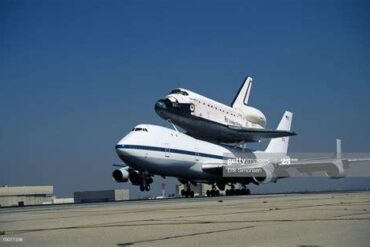
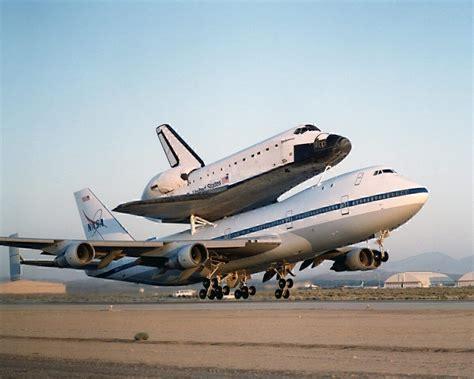
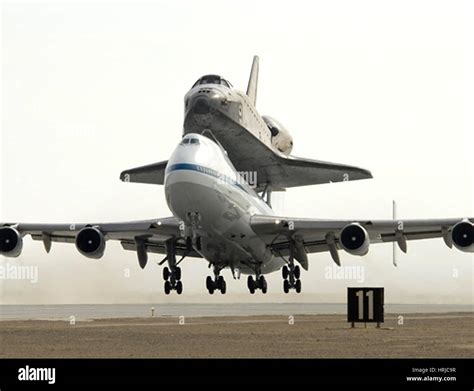
The answer became one of the most fascinating engineering partnerships in aviation history — a heavily modified Boeing 747 carrying a space shuttle mounted directly on top of its fuselage. These aircraft became known as the Shuttle Carrier Aircraft, or SCA, and they played a critical role throughout NASA’s shuttle operations for more than three decades.
NASA needed a transport system because space shuttles frequently landed far from Kennedy Space Center in Florida. Weather conditions often diverted missions to Edwards Air Force Base in California, where long dry lakebed runways offered safer landing options. Once the shuttle touched down there, it could not return to Florida on its own. Without a transportation aircraft, missions would have faced enormous delays and operational complications.
The agency explored several options before selecting the Boeing 747. One competing candidate was the massive Lockheed C-5 Galaxy military transport aircraft. Although the C-5 offered exceptional cargo capacity, NASA determined that the Boeing 747 had aerodynamic advantages better suited for carrying an orbiter externally. The 747’s wing design handled the unusual weight distribution more effectively, and NASA preferred owning its own fleet rather than depending on Air Force scheduling and availability.
The timing also worked in NASA’s favor economically. During the 1970s, airline market conditions made used Boeing 747s available at lower prices, allowing NASA to acquire and modify them more affordably than expected. Two aircraft eventually became the backbone of the program: NASA 905 and NASA 911.
Transforming a commercial passenger jet into a shuttle transport aircraft required extensive engineering modifications. The interior of the 747 was stripped down dramatically. Passenger seating and most cabin furnishings were removed, leaving primarily the upper cabin area for crew operations. In place of airline amenities, NASA installed monitoring systems and specialized avionics designed to oversee shuttle-related electrical and structural loads during transport flights.
The most visible changes appeared on the exterior. Engineers mounted three large support struts on top of the fuselage to secure the orbiter in place. These attachment points distributed the shuttle’s immense weight across the aircraft structure. Additional vertical stabilizers were added to the tail section because the orbiter created enormous aerodynamic turbulence during flight. Without those extra stabilizers, the aircraft’s directional control and stability would have been severely compromised.
Carrying a spacecraft on top of an airplane dramatically altered flight performance. The Shuttle Carrier Aircraft experienced increased drag, reduced fuel efficiency, and lower cruising speeds compared to a normal Boeing 747. Flights typically operated at lower altitudes and required multiple refueling stops during cross-country journeys. Even with those limitations, the system proved remarkably reliable.
The modified 747s also played a vital role before the shuttle program officially began. In 1977, NASA used the aircraft during the Approach and Landing Tests involving the prototype orbiter Enterprise. During these tests, the shuttle was released midair from the top of the 747 using explosive bolts. The orbiter crews then practiced gliding and landing procedures without powered engines, validating how future missions would conclude after reentering Earth’s atmosphere.
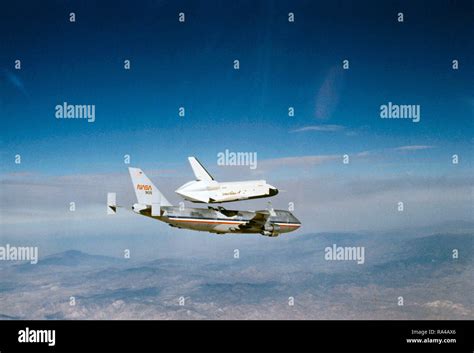
These dramatic release tests became some of the most iconic moments in aerospace history. They demonstrated that the shuttle could safely transition from orbital spacecraft to controlled atmospheric glider, a concept that seemed almost science fiction at the time.
After the Space Shuttle Program ended in 2011, the Shuttle Carrier Aircraft entered retirement alongside the orbiters they once transported. NASA 911 completed its final journey in 2012 and was placed on public display at the Joe Davies Heritage Airpark in Palmdale, California. Meanwhile, NASA 905 undertook one final national tour, ferrying retired orbiters to museums across the United States before retiring to Space Center Houston.
Today, the sight of a Boeing 747 carrying a space shuttle remains one of the most unforgettable images in aviation and spaceflight history. The combination symbolized two different eras of technological ambition meeting in a single machine — the golden age of jumbo jets and the age of reusable spacecraft. Even decades later, the Shuttle Carrier Aircraft continue to represent NASA’s ability to solve enormous engineering challenges with creativity, practicality, and bold design.