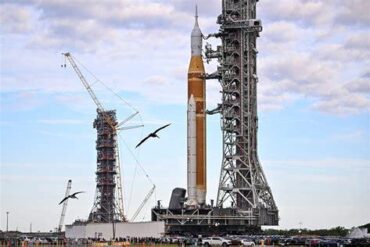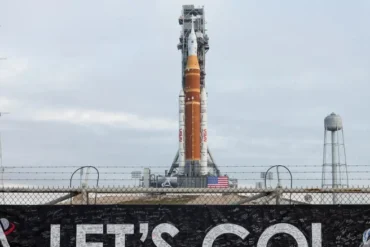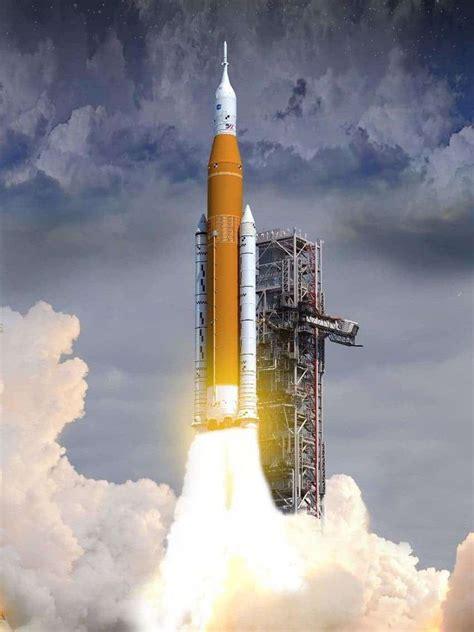
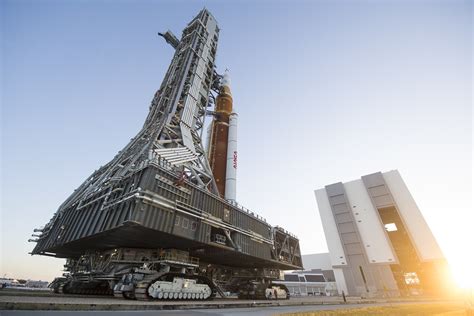
NASA’s Space Launch System (SLS) represents a bold and monumental return to super heavy-lift rocketry, engineered specifically to deliver crew and cargo far beyond Earth orbit. As the technological backbone of the Artemis program, the SLS is designed to reestablish human presence on the Moon and eventually venture toward Mars. Developed by an industrial coalition led by Boeing, Aerojet Rocketdyne, Northrop Grumman, and United Launch Alliance (ULA), the SLS is not merely an evolution of past vehicles—it is a high-stakes response to geopolitical pressures, technological ambition, and institutional legacy.
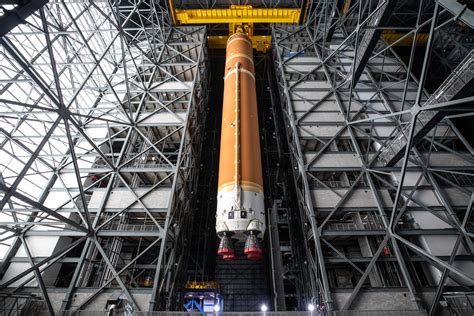
The vehicle’s towering configuration, with a height of up to 111 meters, a massive 8.4-meter core stage, and an initial thrust exceeding 42 meganewtons, places it among the most powerful launch systems ever built. Its architecture recycles proven components from the Space Shuttle era, notably the RS-25 engines and five-segment solid rocket boosters, blending legacy hardware with new engineering.
The Genesis of SLS: Politics, Shuttle Legacy, and Ares Cancellation
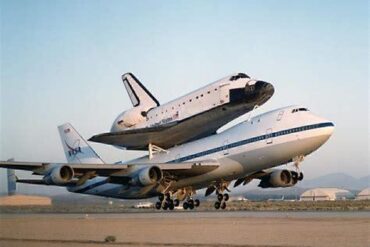
The SLS was born from a confluence of technical necessity and political compromise. Following the termination of the Space Shuttle program in 2011 and the cancellation of the Constellation program’s Ares I and V, NASA faced a void in crewed deep-space launch capability. Congress intervened with a legislative mandate under the NASA Authorization Act of 2010, compelling the agency to develop a new vehicle using existing Shuttle-derived hardware.
This directive led to a vehicle deeply tied to its political roots. The reuse of Shuttle components was not only a cost-control measure but also a political necessity aimed at preserving aerospace jobs across multiple states. While this enabled rapid hardware adaptation, it also introduced complex integration challenges and a patchwork of legacy constraints. Delays mounted as project management navigated budgetary limitations and shifting program priorities. Originally slated for a 2016 debut, the SLS didn’t launch until November 16, 2022, with the uncrewed Artemis I mission.
Engineering Excellence: Core Configuration and Propulsion Design
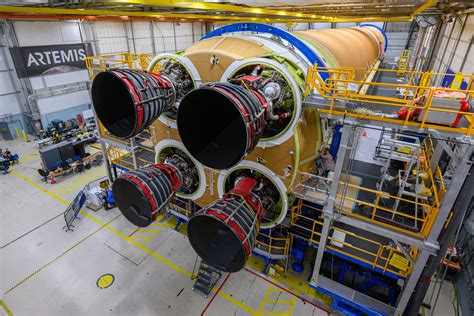
At the heart of the SLS lies its Core Stage, a 64.6-meter hydrogen-oxygen tank structure housing four modernized RS-25 engines. These engines, designated as RS-25D for the earlier units and later upgraded to RS-25E, are capable of operating at 111% of their original rated thrust, delivering high-efficiency performance under cryogenic conditions.
Attached to this core are two five-segment Solid Rocket Boosters (SRBs) built by Northrop Grumman. These boosters, adapted from the Shuttle’s four-segment configuration, burn powdered aluminum and ammonium perchlorate to produce the initial liftoff thrust. For future SLS versions—particularly Block 2—the BOLE (Booster Obsolescence and Life Extension) program will introduce composite-cased SRBs, increasing performance while reducing mass.
Variant Architecture: Block Evolution for Increasing Capability
The SLS design follows a modular upgrade path through multiple block configurations, each enhancing payload capacity and mission scope:
- Block 1: Utilizes the Interim Cryogenic Propulsion Stage (ICPS), a single-engine RL10-powered upper stage. Capable of launching 95 metric tons to Low Earth Orbit (LEO) and over 27 metric tons to Trans-Lunar Injection (TLI).
- Block 1B: Replaces the ICPS with the Exploration Upper Stage (EUS)—a four-engine variant that drastically improves capacity and mission complexity. TLI capacity exceeds 38 metric tons.
- Block 2: Features advanced BOLE boosters and the EUS, pushing the capability to 130 tons to LEO and over 46 tons to TLI, enabling Mars-bound payloads and deep space observatories.
Each block version retains the same core diameter and general vehicle footprint, ensuring compatibility with existing infrastructure while progressively enhancing performance.
Artemis Missions: From Lunar Orbits to Surface Landings
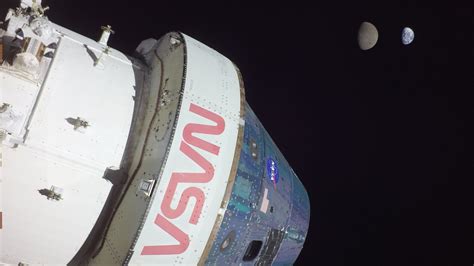
The SLS program is central to the Artemis lunar exploration architecture. Following the successful Artemis I flight in 2022—which validated Orion’s systems and demonstrated TLI injection—the vehicle will next be used in Artemis II, planned for April 2026. This mission will carry astronauts on a lunar flyby trajectory, testing life support systems and mission planning in preparation for landing operations.
Subsequent missions will escalate in ambition:
- Artemis III (2027): Aims to achieve the first crewed lunar landing since Apollo 17, delivering astronauts to the lunar surface via SpaceX’s Starship Human Landing System.
- Artemis IV and V (2028–2030): Will inaugurate the use of Block 1B, delivering modules for the Lunar Gateway, an orbital outpost that will support extended surface operations and staging for Mars missions.
Cost Realities: Billion-Dollar Rockets and Sustainability Debate
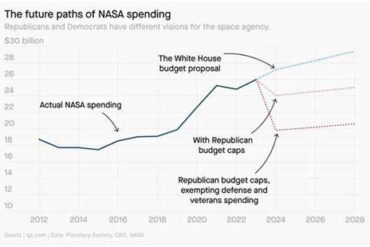
Despite its technological prowess, the SLS has drawn sustained criticism over its exorbitant cost structure. By the end of 2023, NASA had invested $26.4 billion in development alone. Each flight is estimated to cost between $2.2 and $2.5 billion, according to independent audits. The Trump administration’s FY 2026 budget even proposed terminating the SLS program after Artemis III, citing an inflated launch cost approaching $4 billion per mission when including ground systems and operations.
These figures sharply contrast with the economics of commercial launch providers like SpaceX, whose Starship system promises reusable, super heavy-lift launches at a fraction of the cost. Critics argue that NASA’s insistence on using Shuttle legacy hardware, driven by political obligations rather than competitive analysis, has shackled the agency to an outdated cost paradigm.
Political Gravity: Jobs, Congress, and Industrial Survival
The SLS is, in many ways, a product of institutional politics as much as it is of aerospace engineering. Its development has preserved thousands of jobs across Alabama, Florida, Louisiana, California, and Utah—creating a durable coalition of Congressional support that ensures continued funding.
However, this strategy has created friction with evolving aerospace trends. While commercial companies advocate for agile, iterative development and reusability, SLS remains a single-use, monolithic platform, bound to a fixed industrial base and legacy component contracts. This has raised alarms from oversight bodies like the Office of Inspector General (OIG) and the Government Accountability Office (GAO), both of which have flagged management inefficiencies and warned of long-term sustainability risks.
Beyond Artemis: Science Missions and Commercial Alternatives
Looking forward, the SLS could theoretically serve flagship science missions such as the Europa Clipper, the Habitable Worlds Observatory, or deep space telescope deployments. Yet the vehicle’s intense vibration profile and uncertain flight rate present major integration hurdles. Additionally, NASA’s intent to transfer production to Deep Space Transport LLC post-Artemis IV raises questions about privatized cost control and manufacturing continuity.
Meanwhile, commercial heavy-lift systems—particularly Starship and Blue Origin’s New Glenn—are aggressively challenging the SLS model with rapid prototyping, full reusability, and integrated vertical architecture. As launch markets shift toward cost-efficiency and responsiveness, SLS risks becoming a symbolic achievement rather than a practical workhorse.
Conclusion: A Colossus With an Uncertain Future
The Space Launch System is an audacious and technically competent feat of engineering. It marks a critical step in reestablishing America’s deep space capabilities and restoring the possibility of human exploration beyond Earth orbit. Yet, its political entanglements, astronomical costs, and competition from more agile commercial systems raise existential questions about its long-term viability.
Whether SLS becomes a bridge to the stars or a relic of political compromise will depend not just on technical success, but on its ability to adapt within a rapidly evolving space economy. Until then, it remains NASA’s flagship rocket—brilliant, burdensome, and boldly pointed at the Moon.