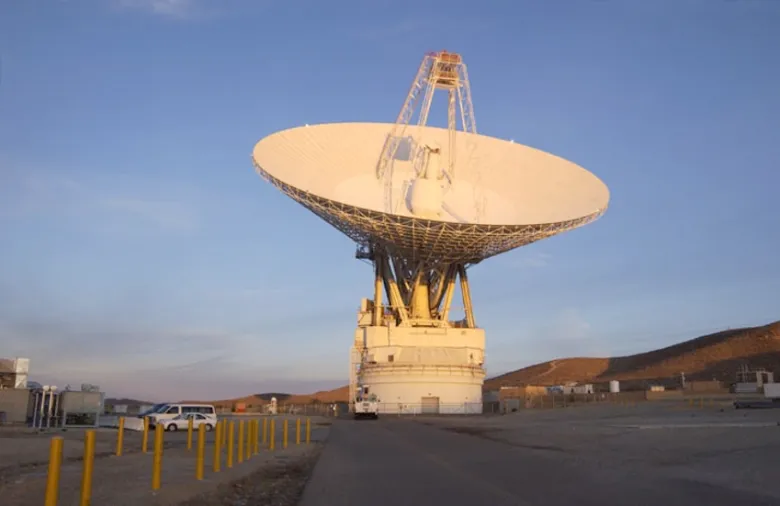
In a sobering development for space exploration, NASA’s iconic Deep Space Network (DSN) antenna, DSS-14, also known as the Mars Antenna, has sustained serious structural damage, raising red flags across the agency’s global operations. Located at the Goldstone Deep Space Communications Complex in California, DSS-14 is a linchpin in maintaining communication with spacecraft traveling billions of miles from Earth.
The damage occurred in September 2025, when the 70-meter antenna over-rotated, causing mechanical stress to the structure’s internal components. The result was significant cabling and piping damage, alongside a malfunction in the fire suppression system, which led to brief flooding. According to NASA’s Jet Propulsion Laboratory (JPL), the flooding was contained swiftly, but the overall damage has left DSS-14 non-operational.
The Timing Couldn’t Be Worse: Government Shutdown Deepens Impact
Just weeks after the incident, the situation was worsened by the U.S. federal government shutdown on October 1, 2025. The shutdown has hampered efforts by engineers at JPL to collaborate effectively with NASA administrators, delaying decisions on repair logistics and funding. As of now, no clear timeline has been announced for when DSS-14 will be fully functional again.
This communications outage is more than a logistical hurdle. It poses serious operational risks to upcoming missions, notably Artemis II, NASA’s 10-day crewed mission to orbit the Moon scheduled for next year. With DSS-14 offline, the Deep Space Network’s global redundancy is compromised, leaving missions more vulnerable to data delays, communication blackouts, and operational instability.
The Deep Space Network: NASA’s Global Lifeline
NASA’s DSN is comprised of three facilities spread nearly 120 degrees apart in longitude: Goldstone, California (USA), Madrid (Spain), and Canberra (Australia). This strategic spacing allows uninterrupted communication with spacecraft, regardless of Earth’s rotation.
Each site features a fleet of giant parabolic antennas, including:
- 34-meter antennas: Both high-efficiency and beam waveguide types.
- 70-meter antennas: DSS-14 belongs to this class, the largest and most powerful.
The beam waveguide design includes underground sensors housed in climate-controlled rooms, making it easier for engineers to upgrade systems without interrupting operations. In contrast, the older high-efficiency models are more difficult to maintain.
Why DSS-14 Matters: More Than Just Mars
While often referred to as the Mars Antenna, DSS-14 plays a much broader role in NASA’s mission architecture. It is the primary node for high-gain, deep space communications across missions that span the solar system—from Mercury to the outer gas giants.
In 2022, DSS-14 was vital during Artemis I, providing over 900 hours of communication support. Even with all antennas active, the mission experienced data blackouts, a stark reminder of the network’s growing strain. These interruptions are not mere nuisances; they jeopardize mission integrity and can hinder split-second decision-making in critical phases.
The antenna’s failure is not an isolated event but a symptom of a broader infrastructure crisis. The hardware, some dating back to 1963, is overdue for modernization. Despite being the first of its kind, DSS-14 now embodies the challenges of maintaining legacy equipment amid an era of mission proliferation and data overload.
Oversubscription and Fragility: A Network Under Pressure
NASA’s own Office of Inspector General (OIG) issued a 2023 audit warning that the DSN is “oversubscribed”. As the number of both crewed and robotic missions has increased, so has the volume of data. According to the OIG, demand has occasionally surged to 140% of network capacity, creating bottlenecks and system stress.
The DSN is no longer just a support system—it is a mission-critical platform. Every deep space endeavor, from planetary science to crewed lunar missions, hinges on a network that’s stretched thin. With DSS-14 offline, the remaining antennas must absorb additional traffic, increasing the risk of latency, lost data, or operational errors.
Artemis II and the Threat of Communication Disruption
The implications for Artemis II are particularly severe. Scheduled to orbit the Moon in 2026, the mission depends on real-time, high-bandwidth communication links. DSS-14 was expected to be one of the core antennas facilitating this.
Its absence introduces a margin of risk that mission planners are desperately working to mitigate. While the Madrid and Canberra DSN stations can cover gaps, the loss of redundancy weakens NASA’s assurance against failure. During Artemis I, despite full DSN availability, communication lapses occurred. Without DSS-14, those risks only multiply.
Reinforcements on the Horizon: DSN Aperture Enhancement
NASA and JPL are actively pursuing expansion through the Deep Space Network Aperture Enhancement Program (DSNAEP). This initiative is adding six new 34-meter antennas, intended to ease operational pressure and improve system resilience. These newer antennas will incorporate beam waveguide technology and are being integrated with modern software-defined systems for adaptive signal processing.
However, these upgrades are not immediate solutions. The installations are ongoing, and full operational capability may not arrive until 2027 or beyond. Until then, the DSN must function with reduced capacity and heightened mission risk.
A Wake-Up Call for Infrastructure Modernization
The DSS-14 crisis reveals more than just a mechanical failure—it highlights a systemic vulnerability in the U.S. space communication infrastructure. The DSN is a national asset, but it is aging, underfunded, and increasingly overburdened.
The 2025 government shutdown serves as a case study in how political dysfunction can cascade into operational paralysis for critical national programs. Delays in repair coordination, approvals, and budgetary release have turned what might have been a short-term outage into a strategic communications crisis.
NASA’s roadmap to Mars and beyond depends on uninterrupted data links. The failure of DSS-14 should be a catalyst for investment, not only in hardware but also in process agility and crisis resilience. Without these, the future of deep space exploration remains tethered to fragile infrastructure.
Final Thoughts: The Cost of Silence in Space
NASA’s DSS-14 is not just another antenna. It is the beating heart of the Deep Space Network, a technological marvel that has connected humanity with the cosmos for over half a century. Its current silence is deeply symbolic—a warning signal that the foundations of our space program require urgent reinforcement.
Until DSS-14 is restored, every mission, every byte of data, and every astronaut’s safety will hang in the balance of an overstressed system. In the vacuum of space, communication is survival—and right now, one of Earth’s most vital voices is quiet.