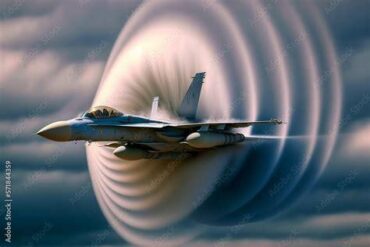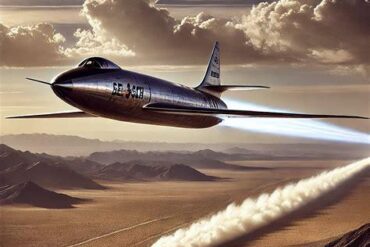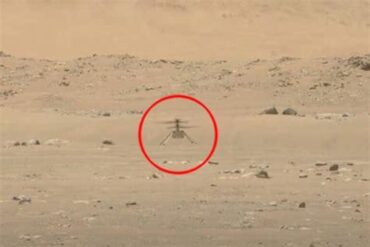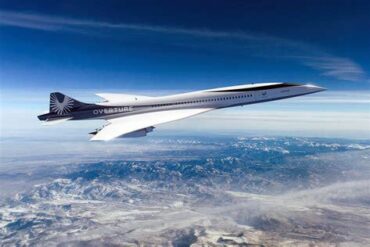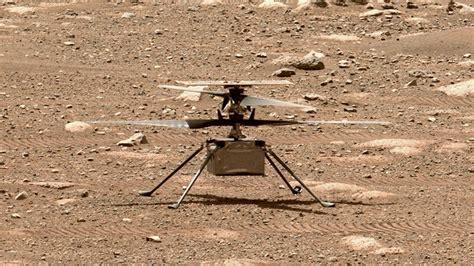
Mars exploration has entered a remarkable new era. After proving that powered flight is possible on another world with the historic Ingenuity helicopter, NASA is now testing technology that pushes the limits of aerospace engineering even further. In a groundbreaking series of experiments at the Jet Propulsion Laboratory (JPL) in California, engineers have successfully accelerated rotor blades for a next-generation Mars helicopter to Mach 1.08, officially pushing them beyond the speed of sound in a simulated Martian environment.
This achievement represents far more than a technical milestone. It is a critical step toward building a new class of aerial explorers capable of carrying heavier scientific instruments, mapping vast stretches of Martian terrain, and supporting future human missions to the Red Planet. The technology is expected to play a central role in NASA’s ambitious Skyfall mission, which aims to deploy multiple helicopters across Mars before the end of the decade.
Why NASA Needs a Supersonic Mars Helicopter
On Earth, helicopters rarely approach the sound barrier because doing so introduces severe aerodynamic challenges. Shock waves form around rotor blades, vibration increases dramatically, and structural loads become much harder to manage. For conventional aviation, these effects are generally avoided.
Mars presents a completely different challenge. The planet’s atmosphere is extraordinarily thin, containing only about 1% of Earth’s atmospheric density. While this reduced density lowers aerodynamic drag, it also creates a major problem: there is far less air available for generating lift.
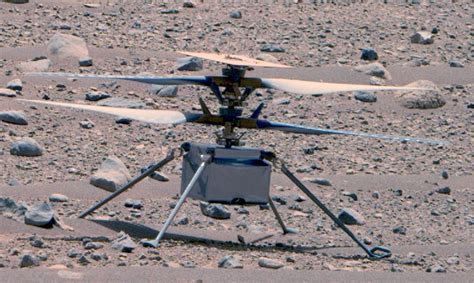
The original Ingenuity helicopter overcame this obstacle with ultra-lightweight construction and rapidly spinning rotor blades. During its operational life between April 2021 and January 2024, Ingenuity completed an astonishing 72 flights, far exceeding expectations and demonstrating that aerial exploration on Mars is both practical and valuable.
However, Ingenuity was primarily a technology demonstrator. Its ability to carry payloads was extremely limited. Future missions require helicopters capable of transporting advanced sensors, imaging systems, terrain-mapping equipment, and potentially even scientific samples.
To achieve these objectives, NASA engineers needed a significant increase in lifting capability. One solution was obvious yet challenging: make the rotor blades spin fast enough to generate dramatically more lift.
After extensive testing, JPL engineers successfully pushed rotor tip speeds beyond Mach 1, proving that a future Mars helicopter can safely operate in a regime previously considered impractical for rotorcraft.
From Ingenuity to the Skyfall Mission
The success of Ingenuity fundamentally changed NASA’s approach to planetary exploration. What began as a high-risk experiment evolved into one of the most successful technology demonstrations in spaceflight history.
Building on that success, NASA’s upcoming Skyfall mission envisions a fleet of three advanced helicopters arriving at Mars. Rather than functioning as simple scouts, these aircraft will become sophisticated autonomous explorers capable of conducting missions over large distances.
A major innovation lies in how the helicopters will reach the Martian surface. Traditional Mars landings have historically required increasingly complex engineering solutions.
Earlier missions relied on giant airbags that allowed landers to bounce across the surface after impact. More recent missions, including the Curiosity and Perseverance rovers, employed the spectacular sky-crane system, which lowered heavy vehicles to the surface using cables before the descent stage flew away.
Skyfall introduces an entirely new concept. Instead of waiting for touchdown, the helicopters will separate from their carrier vehicle while it is still descending through the atmosphere. They will then fly independently to safe landing locations on the surface.
This strategy eliminates significant landing complexity while allowing multiple aircraft to be deployed rapidly across a wider operational area.
The Engineering Challenge of Breaking the Sound Barrier
Achieving supersonic rotor speeds is not as simple as increasing motor power.
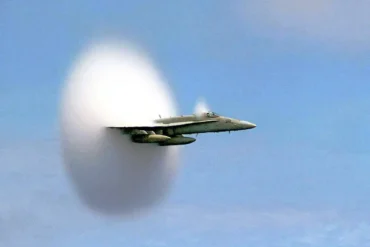
As rotor blades approach Mach 1, airflow behaves in increasingly unpredictable ways. Shock waves form along portions of the blade, causing sudden pressure changes that can lead to intense vibration, reduced efficiency, and structural stress.
For spacecraft intended to operate millions of miles from Earth, reliability is paramount. A single rotor failure could immediately end a mission worth hundreds of millions of dollars.
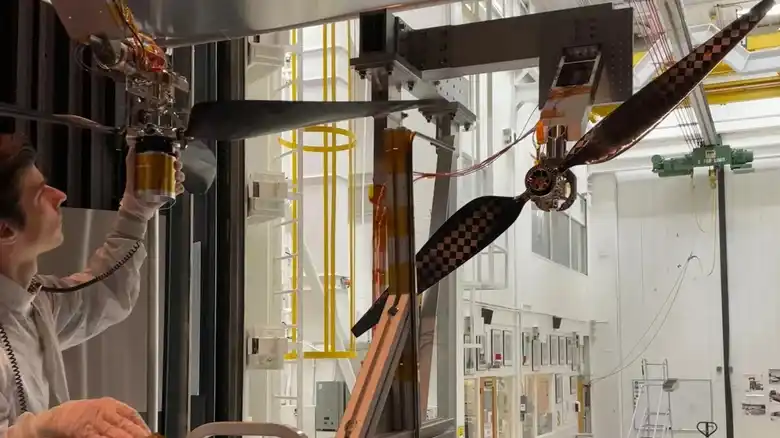
NASA therefore conducted extensive testing within simulated Martian atmospheric conditions. Engineers focused on ensuring that the blades could withstand the enormous forces generated during supersonic operation.
The original Ingenuity helicopter operated at rotor speeds of approximately 2,700 revolutions per minute, maintaining a comfortable margin below transonic conditions. The new design required substantially higher rotational speeds, ultimately reaching approximately 540 miles per hour at the rotor tips to exceed the sound barrier in Mars-like conditions.
The successful tests demonstrated not only aerodynamic viability but also structural durability, validating years of research into advanced materials, blade geometry, and propulsion systems.
Autonomous Intelligence for Extreme Environments
Another revolutionary feature of NASA’s next-generation helicopter is its advanced autonomous flight system.
Operating aircraft on Mars presents unique challenges because communication delays between Earth and Mars can range from several minutes to over twenty minutes depending on planetary positions. Real-time piloting is therefore impossible.
To overcome this limitation, NASA is integrating sophisticated autonomy systems that allow helicopters to make critical decisions independently. These systems continuously monitor flight conditions, terrain hazards, navigation data, and vehicle health.
If unexpected problems occur, the aircraft can automatically adjust its flight path, avoid dangerous terrain, and select alternative landing sites without waiting for instructions from mission controllers.
This level of autonomy represents a major advancement in robotic exploration and serves as a technological precursor for future human-support systems on Mars.
Mapping the Future of Human Mars Exploration
The practical value of these helicopters extends far beyond scientific curiosity.
Future astronauts will require detailed knowledge of potential landing zones, resource locations, terrain hazards, and infrastructure sites. Surface rovers can gather some of this information, but their operational range remains limited.
Helicopters offer an entirely different perspective. They can rapidly survey vast regions, identify promising exploration targets, and generate high-resolution maps that would take rovers months or years to create.
Advanced sensor packages carried by the new helicopters could detect geological formations, subsurface structures, mineral deposits, and environmental conditions critical to future settlement planning.
In many ways, these aircraft will become the aerial reconnaissance force for humanity’s eventual arrival on Mars.
Nuclear Electric Power Opens a New Frontier
The Skyfall mission is also expected to become the first interplanetary mission powered by nuclear electric propulsion, a transformative technology that could reshape deep-space exploration.
Traditional spacecraft depend heavily on solar power. While highly effective near Earth, solar panels become progressively less useful farther from the Sun. Beyond Jupiter, available sunlight drops so dramatically that conventional solar-powered missions face significant limitations.
Nuclear electric propulsion offers a powerful alternative. By generating electricity through nuclear systems, spacecraft can maintain high-performance operations for extended periods without relying on solar energy.
The implications are enormous. Missions could travel farther, operate longer, and support larger scientific payloads than ever before.
The same technological foundation is expected to support future lunar infrastructure as well. NASA’s proposed Lunar Reactor-1 system aims to provide continuous electrical power for permanent Moon bases, including during the harsh fourteen-day lunar night when solar energy becomes unavailable.
A New Chapter in Planetary Aviation
NASA’s successful supersonic rotor testing marks one of the most significant advances in extraterrestrial aviation since Ingenuity first lifted off from the Martian surface. By combining supersonic rotor technology, autonomous flight systems, innovative deployment methods, and next-generation nuclear power, the agency is creating a new class of robotic explorers capable of transforming how humanity investigates other worlds.
What once seemed impossible—a helicopter breaking the sound barrier on another planet—is rapidly becoming a practical engineering solution. As the Skyfall mission moves closer to reality, these extraordinary aircraft may soon become indispensable tools for exploring Mars, preparing future human landings, and extending humanity’s reach deeper into the solar system than ever before.