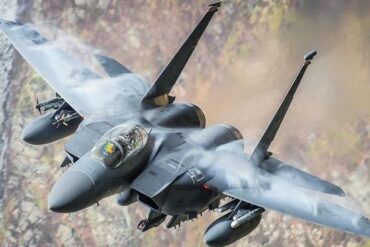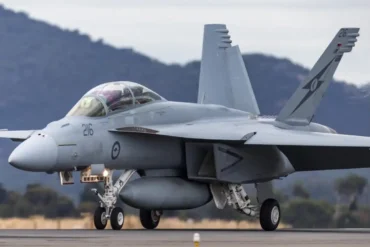
The McDonnell Douglas F/A-18 Hornet, introduced in the late 1970s, has been a cornerstone of modern naval aviation. Renowned for its versatility as both a fighter and attack aircraft, one of its most remarkable capabilities is achieving supersonic speeds, thereby breaking the sound barrier. This phenomenon is not only a testament to the aircraft’s engineering excellence but also a captivating display of aerodynamics in action.
Understanding the Sound Barrier
The term “sound barrier” refers to the increase in aerodynamic drag and other undesirable effects experienced by an object when it approaches the speed of sound, approximately 1,235 kilometers per hour (767 miles per hour) at sea level. Breaking this barrier means surpassing this speed, entering the realm of supersonic flight.
The F/A-18 Hornet’s Supersonic Capabilities
The F/A-18 Hornet is designed to operate effectively at both subsonic and supersonic speeds. Its twin-engine configuration provides the necessary thrust to overcome the increased drag associated with transonic flight (speeds approaching the speed of sound). The aircraft’s aerodynamic design, including its swept wings and streamlined fuselage, minimizes resistance, allowing it to efficiently transition into supersonic speeds.
Visual Phenomena: The Vapor Cone
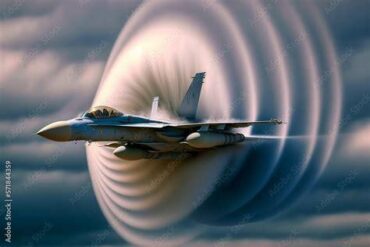
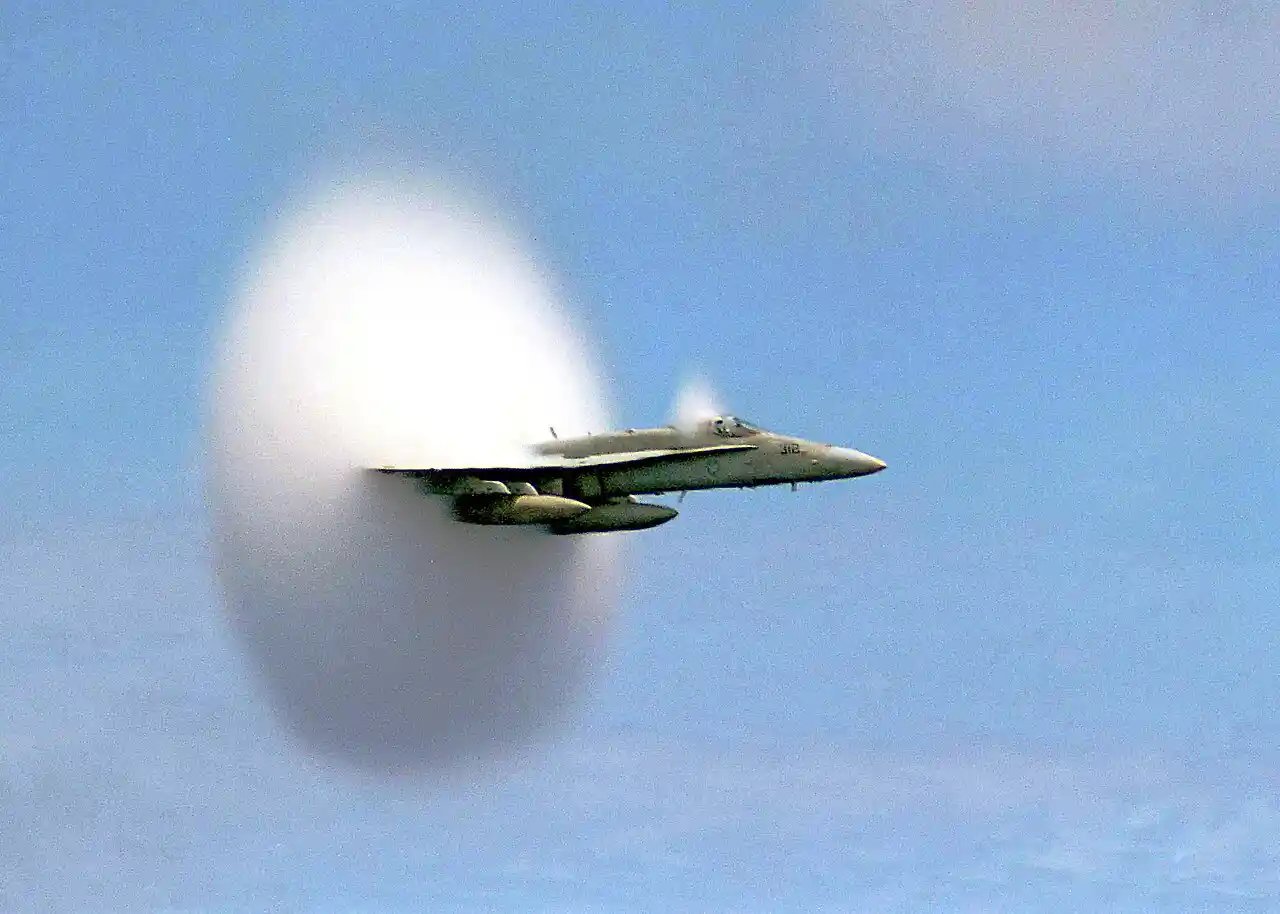
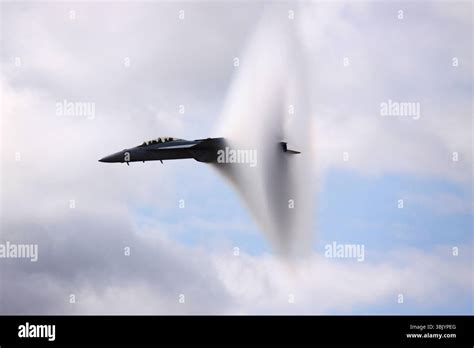
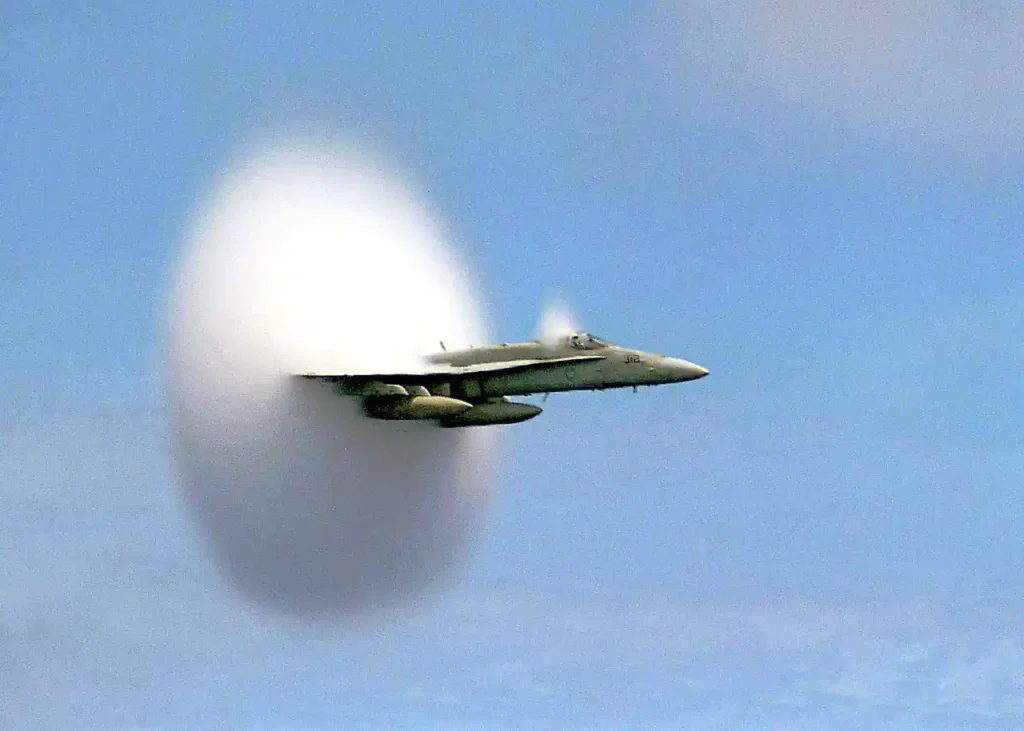
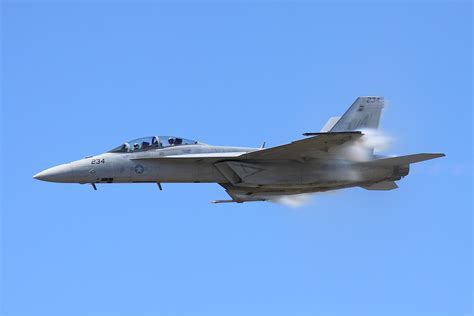
One of the most striking visual effects associated with an F/A-18 breaking the sound barrier is the formation of a vapor cone, also known as a shock collar or Prandtl-Glauert singularity. This occurs when a rapid drop in air pressure around the aircraft causes moisture in the air to condense, forming a visible cloud. This phenomenon is often observed during high-speed maneuvers, especially in humid conditions.
The Sonic Boom
As the F/A-18 surpasses the speed of sound, it generates a sonic boom—a thunderous noise resulting from the shock waves created by the aircraft as it displaces air molecules faster than they can react. This boom is essentially a continuous sound wave that trails the aircraft while it remains at supersonic speeds. Observers on the ground perceive it as a sudden explosion-like noise.
Operational Considerations
While the F/A-18 is capable of supersonic flight, pilots must adhere to strict regulations regarding where and when they can break the sound barrier. Over land, especially in populated areas, supersonic flight is generally restricted due to the potential for sonic booms to cause structural damage and disturb civilians. Therefore, such maneuvers are typically reserved for over-ocean flights or designated military training areas.
Historical Highlight
A notable instance showcasing the F/A-18’s supersonic prowess occurred on July 7, 1999, when an F/A-18C Hornet assigned to Strike Fighter Squadron 151 (VFA-151) was photographed breaking the sound barrier off the coast of Pusan, South Korea. The image captured the aircraft enveloped in a vapor cone, providing a vivid illustration of the Prandtl-Glauert singularity.
Technical Aspects
The F/A-18’s ability to break the sound barrier is facilitated by several key design features:
- Aerodynamic Design: The aircraft’s sleek profile and swept-back wings reduce aerodynamic drag, allowing for smoother airflow at high speeds.
- Powerful Engines: Equipped with twin afterburning turbofan engines, the F/A-18 can produce significant thrust, essential for achieving and sustaining supersonic flight.
- Structural Integrity: The airframe is constructed to withstand the stresses associated with high-speed flight, ensuring both performance and pilot safety.
Training and Safety
Pilots undergo extensive training to handle the complexities of supersonic flight. Understanding the aerodynamic and physiological effects of breaking the sound barrier is crucial. Additionally, adherence to safety protocols ensures that such maneuvers are conducted without undue risk to both the pilot and those on the ground.
Public Perception and Sonic Booms
Sonic booms have been a subject of public concern due to their startling nature and potential to cause minor structural damage, such as broken windows. As a result, military organizations are mindful of these effects and plan supersonic training flights in areas where they will have minimal impact on civilian populations.
Conclusion
The F/A-18 Hornet’s capability to break the sound barrier exemplifies the advancements in modern aeronautical engineering. Its design, power, and performance continue to make it a formidable asset in military aviation, while the awe-inspiring phenomena associated with its supersonic flight capture the imagination of aviation enthusiasts worldwide.
FAQs
What is a vapor cone, and why does it form around the F/A-18 during high-speed flight?
A vapor cone, or shock collar, forms when an aircraft approaches the speed of sound, causing a rapid drop in air pressure and temperature around it. This leads to the condensation of moisture in the air, creating a visible cloud. The phenomenon is more pronounced in humid conditions.
Are sonic booms harmful to structures or people on the ground?
Sonic booms can cause minor structural damage, such as cracked windows, and can be startling to people. Due to these potential effects, supersonic flight over populated areas is generally restricted.
How fast can the F/A-18 Hornet fly?
The F/A-18 Hornet can reach speeds of approximately Mach 1.8, which is nearly twice the speed of sound. However, operational speeds are often lower, depending on mission requirements and airspace regulations.