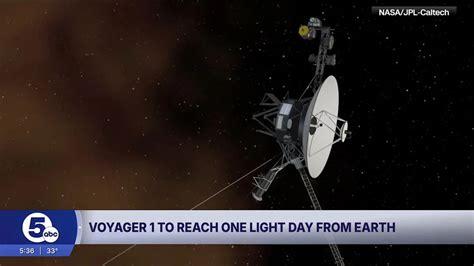
Nearly 50 years after its launch, NASA’s Voyager 1 spacecraft is preparing to reach one of the most extraordinary milestones in the history of space exploration. On November 18, 2026, the probe will travel far enough from Earth that a radio signal traveling at the speed of light will require an entire day to make the journey between the spacecraft and our planet. This distance, approximately 16.1 billion miles, represents a new chapter in humanity’s long-distance exploration of the cosmos.
Voyager 1’s achievement is remarkable not only because of the distance it has traveled, but also because of how long it has survived. When it launched from Florida’s Space Coast in September 1977, the world was dramatically different. Personal computers were only beginning to emerge, Jimmy Carter was president of the United States, and the success of Star Wars had just captured global imagination. Yet the small spacecraft built during that era continues to send valuable information from a region of space no human-made object had ever reached before.
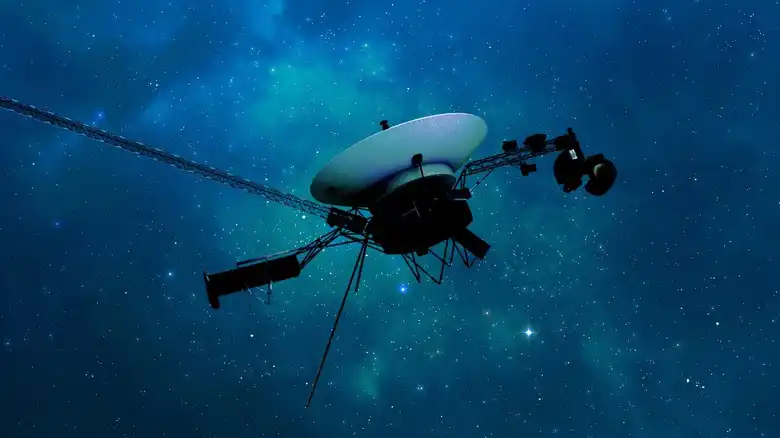
Voyager 1’s Unprecedented Journey Beyond the Solar System
Traveling through space at approximately 38,000 mph relative to the Sun, Voyager 1 has become the most distant human-made object ever created. The scale of its journey is difficult to comprehend. If a vehicle traveling at 50 mph attempted to cover the same distance, it would require nearly 37,000 years. Even a passenger aircraft moving at around 550 mph would need more than 3,000 years to reach Voyager 1’s current location.
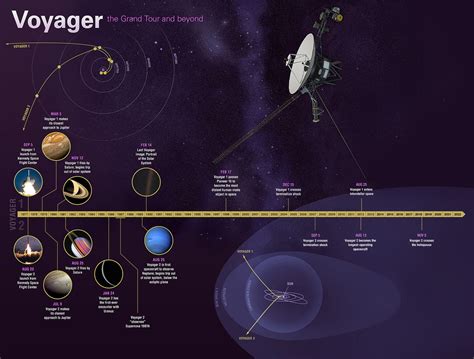
The spacecraft’s mission began with a focused goal: explore the outer planets of the solar system. Voyager 1 completed historic flybys of Jupiter and Saturn, collecting data that transformed scientists’ understanding of these distant worlds. During its 1979 encounter with Jupiter, the spacecraft helped reveal details about the planet’s atmosphere, moons, and faint ring system. It also observed volcanic activity on Io, one of Jupiter’s largest moons and one of the most geologically active places known in the solar system.
At Saturn in 1980, Voyager 1 studied the planet’s famous rings and numerous moons, providing information that shaped decades of planetary science. The spacecraft later captured one of the most iconic images in astronomy: the Pale Blue Dot, a tiny view of Earth photographed in 1990 from billions of miles away. That image became a powerful reminder of Earth’s fragile place within the vast universe.
Communicating Across Billions of Miles of Empty Space
Maintaining contact with Voyager 1 has become one of NASA’s greatest engineering challenges. Because of its enormous distance from Earth, signals traveling between the spacecraft and mission control require almost 23 hours to arrive in one direction. Every command sent to Voyager 1 and every piece of data returned from the probe involves waiting nearly an entire day.
This communication delay became especially challenging in 2023, when Voyager 1 developed a technical problem that prevented it from transmitting usable scientific information. Engineers on Earth had to diagnose and repair a spacecraft located billions of miles away, knowing that every message and response required many hours of waiting. After months of careful work, NASA restored Voyager 1’s ability to send meaningful data in April 2024.
Despite its age, Voyager 1 still operates several scientific instruments. Its magnetometer continues measuring magnetic fields, helping researchers understand the boundary between the Sun’s influence and the space between stars. The spacecraft’s plasma wave subsystem also provides information about conditions in interstellar space by detecting waves in surrounding plasma.
However, Voyager 1’s power supply is slowly declining. The spacecraft relies on a radioisotope power system that generates electricity from radioactive material, and engineers have gradually switched off some systems to preserve energy. Eventually, communication with Voyager 1 will end, but the spacecraft will continue drifting silently through deep space.
Voyager 1 and Voyager 2: Humanity’s Longest Exploration Mission
Voyager 1 is part of a legendary pair of spacecraft. Its twin, Voyager 2, launched slightly earlier in 1977 but received its number because it followed a different route through the solar system. While Voyager 1 took the faster path toward Jupiter and Saturn, Voyager 2 followed a longer trajectory that allowed it to visit Uranus and Neptune.
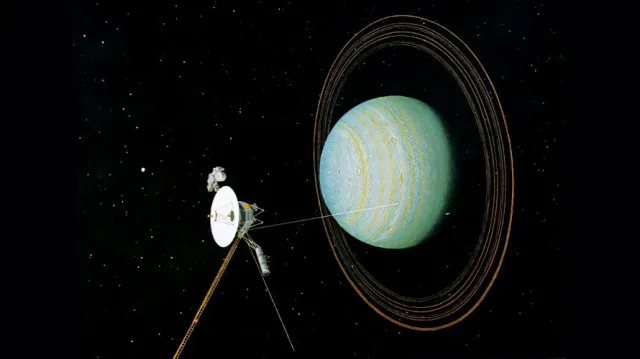
Voyager 2 remains the only spacecraft ever to conduct close flybys of both Uranus and Neptune. Its discoveries included new moons, atmospheric details, and valuable information about the outer planets. In 2018, Voyager 2 also entered interstellar space, becoming the second human-made object to cross beyond the protective influence of the Sun.
Like Voyager 1, Voyager 2 faces the challenge of limited power. NASA has shut down several instruments to extend its operational lifetime, while others continue collecting scientific measurements. The spacecraft is still providing data about cosmic rays and the environment beyond the solar system, offering scientists a unique perspective from a place no other mission has reached.
A Legacy That Defines Human Curiosity
The upcoming one light-day milestone is more than a measurement of distance. It represents decades of scientific ambition, careful engineering, and human determination. Voyager 1 was never designed to operate for half a century, yet it has continued far beyond its original expectations.
The spacecraft carries the famous Golden Record, a message intended for any potential extraterrestrial civilization that might one day discover it. Inside are sounds, images, and greetings from Earth, representing humanity’s attempt to share a small piece of our existence with the universe.
As Voyager 1 continues its journey into the darkness between stars, it stands as a symbol of exploration without boundaries. Long after its instruments stop working, the spacecraft will remain a permanent traveler through the cosmos, carrying evidence that humanity once looked beyond its own world and dared to explore what lies beyond.