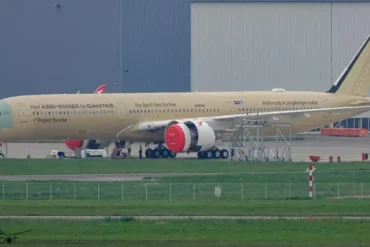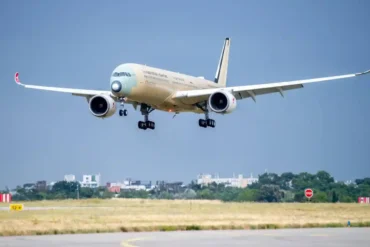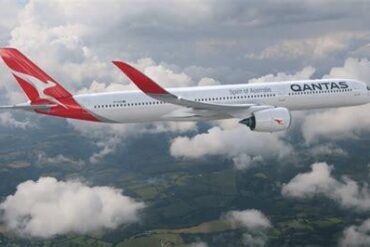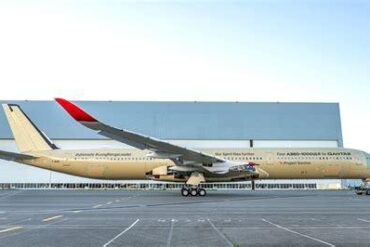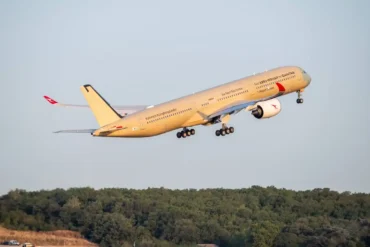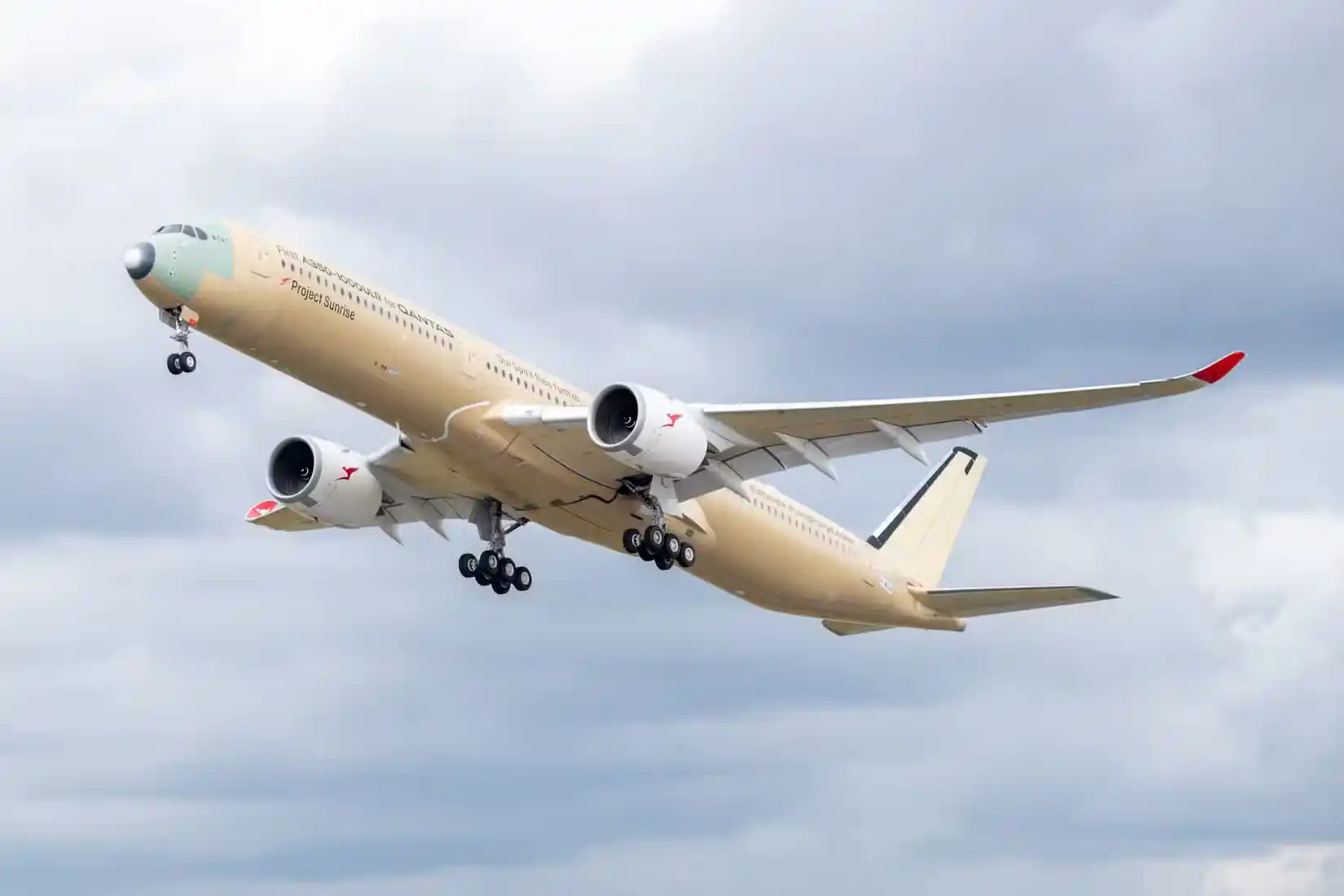
The dream of flying nonstop from Australia’s east coast to Europe and North America has taken a decisive step toward reality. Airbus has successfully completed the maiden flight of the first Airbus A350-1000ULR built specifically for Qantas’ ambitious Project Sunrise, marking the beginning of a certification campaign that could redefine the limits of commercial aviation.
For nearly a decade, Project Sunrise has stood as one of the aviation industry’s most ambitious undertakings. Conceived to connect Sydney and Melbourne directly with cities such as London and New York without intermediate stops, the initiative seeks to eliminate the traditional constraints of ultra-long-haul travel. The successful first flight of the specially modified aircraft signals that the program has moved beyond planning, engineering studies, and regulatory negotiations into a tangible phase of real-world testing.
The milestone arrives after years of development, redesigns, and delays. While passengers will still need to wait until 2027 before stepping aboard the record-breaking services, the aircraft’s emergence from the factory and successful entry into flight testing represent the clearest indication yet that the world’s longest nonstop commercial flights are approaching operational reality.
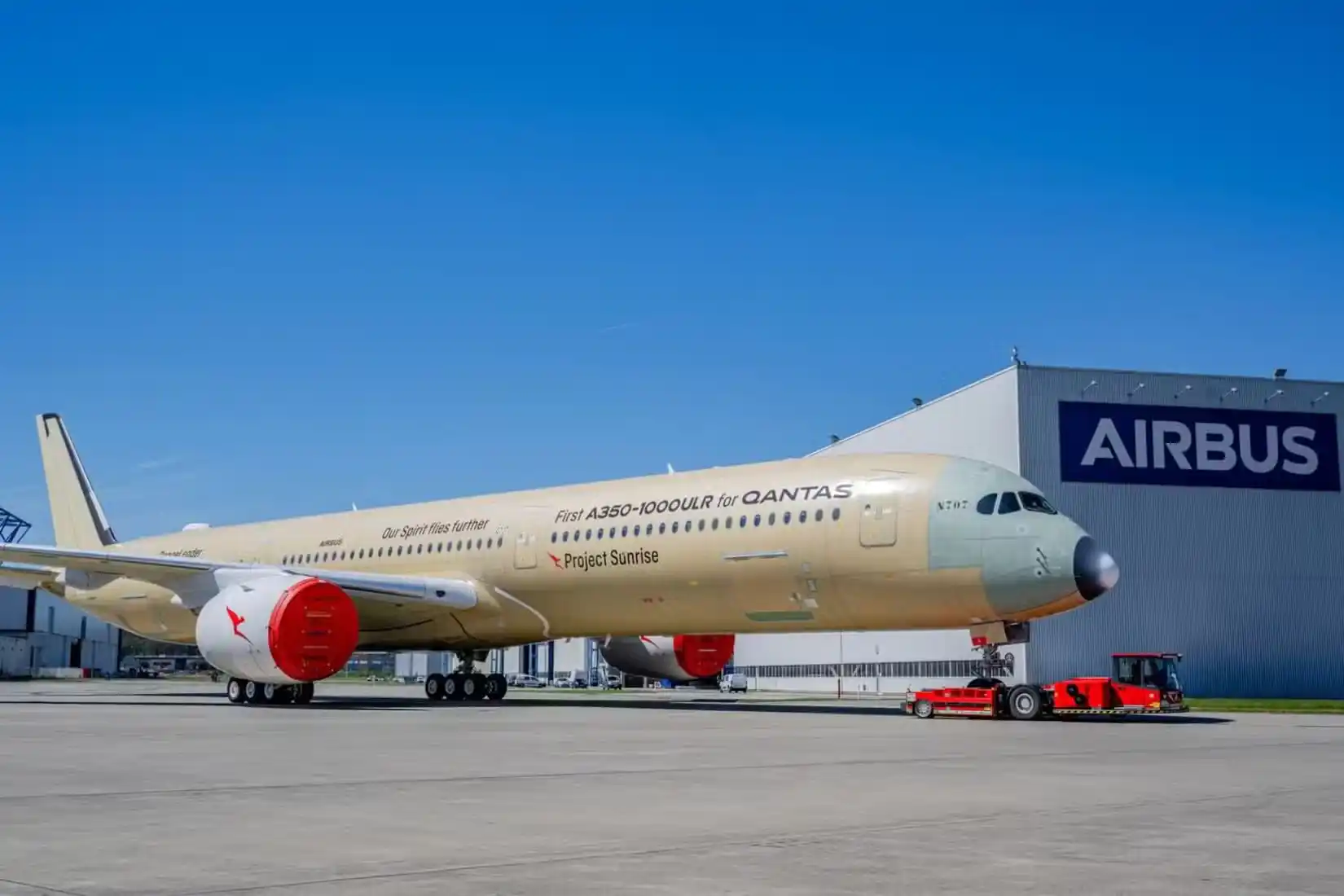
Airbus A350-1000ULR Takes Flight For The First Time
The aircraft that completed the maiden flight is the first of twelve Airbus A350-1000ULRs ordered by Qantas. Unlike a standard A350-1000, this variant has been engineered specifically for missions that could exceed 20 hours in duration, placing extraordinary demands on fuel capacity, aircraft systems, operational efficiency, and passenger comfort.
The initial flight departed from Toulouse-Blagnac Airport, Airbus’ primary manufacturing and testing center. During the sortie, flight crews evaluated overall aircraft performance while also assessing the new fuel system architecture that forms the foundation of the aircraft’s ultra-long-range capability. According to Airbus, the maiden flight officially launches a certification program expected to continue for several months.
This phase of testing is particularly important because the A350-1000ULR incorporates modifications not found on conventional production aircraft. Engineers must validate every aspect of the design, from fuel transfer operations and system integration to structural performance under the increased weight associated with carrying significantly more fuel than standard variants.
The successful completion of the maiden flight demonstrates that the engineering concept behind Project Sunrise is functioning as intended. It also provides Airbus and regulators with the first real-world data needed to advance toward certification and eventual commercial service.
The Engineering Behind Project Sunrise
The Airbus A350-1000ULR has been developed to push the boundaries of what is achievable in commercial air transportation. Its primary objective is straightforward yet technically demanding: fly farther than any scheduled passenger aircraft currently in service.
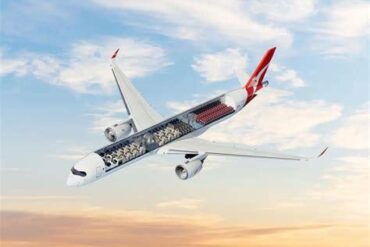
To achieve that goal, Airbus introduced several major modifications. The most significant is an enhanced fuel system that includes an additional fuel tank capable of carrying approximately 20,000 liters of extra fuel. This additional capacity dramatically extends the aircraft’s range and enables missions that would otherwise be impossible.
Structural reinforcements have also been incorporated to accommodate higher takeoff weights resulting from the increased fuel load. Every aspect of the aircraft’s design has been scrutinized to ensure efficiency, reliability, and operational safety during flights that could last nearly an entire day.
These enhancements extend the aircraft’s range by roughly 1,000 nautical miles beyond that of a conventional Airbus A350-1000. As a result, the aircraft is expected to cover more than 17,000 kilometers nonstop, unlocking routes that have long been considered the final frontier of commercial aviation.
Beyond technical modifications, the aircraft’s cabin has also been optimized for ultra-long-haul operations. Passenger wellbeing becomes increasingly important as flight durations stretch beyond traditional long-haul norms. Qantas has invested heavily in cabin design concepts intended to reduce fatigue and improve comfort throughout journeys that may exceed 20 hours.
A Journey Marked By Delays And Challenges
While the first flight represents a major achievement, reaching this point has been anything but simple. Project Sunrise was originally unveiled in 2017, when Qantas challenged aircraft manufacturers to propose solutions capable of making nonstop services between Australia, Europe, and North America commercially viable.
Airbus ultimately prevailed over Boeing’s competing 777-8 proposal, securing an order for twelve specially configured aircraft. Yet the path forward soon encountered substantial obstacles.
The COVID-19 pandemic dramatically altered aviation industry priorities and temporarily halted numerous fleet modernization initiatives worldwide. Project Sunrise was among the programs affected, with planning and development timelines extending well beyond original expectations.
Additional complications emerged during certification. Regulators required Airbus to redesign the aircraft’s unique additional center fuel tank after concerns arose regarding aspects of the original configuration. Because the fuel system is fundamental to the aircraft’s ultra-long-range capability, redesign work had significant implications for development schedules.
Supply-chain disruptions have also contributed to delays. The broader aerospace industry continues to face challenges related to component availability, manufacturing capacity, and production scheduling. These factors recently pushed the first delivery date to April 2027, later than originally anticipated.
Despite these setbacks, both Airbus and Qantas have continued progressing toward the program’s objectives. The maiden flight demonstrates that the most complex engineering hurdles have largely been overcome, allowing attention to shift toward certification and operational readiness.
Preparing Qantas For A New Era Of Flying
The aircraft itself is only one component of Project Sunrise. Qantas has spent years preparing its operational infrastructure for flights unlike anything currently offered in commercial aviation.
Pilot training programs are already underway, supported by advanced Airbus A350 simulators installed in Sydney. These training systems allow flight crews to familiarize themselves with aircraft procedures, performance characteristics, and operational considerations unique to ultra-long-haul missions.
Airline planners are simultaneously developing service concepts tailored to flights lasting more than 20 hours. Scheduling, crew management, maintenance planning, and passenger services all require specialized approaches when operating routes at the extreme edge of commercial aviation capabilities.
Qantas has indicated that details regarding inaugural routes and launch schedules will be announced as the program advances. Industry observers widely expect Sydney–London and Sydney–New York to become the flagship services once commercial operations begin.
The significance extends beyond route expansion. Successfully operating these flights would create entirely new travel possibilities, reducing journey times and eliminating the inconvenience of intermediate stops for thousands of passengers.
The Race To Set A New Distance Record
Commercial aviation has always been driven by the pursuit of greater range and connectivity. Each generation of aircraft has expanded the practical limits of nonstop travel, creating routes that once seemed impossible.
The Boeing 747SP pioneered many ultra-long-haul operations during the 1970s and 1980s. Later, aircraft such as the Boeing 747-400, Airbus A340-500, Boeing 777 family, and Airbus A350-900ULR progressively extended the reach of airlines across the globe.
Today, Singapore Airlines holds the record for the world’s longest scheduled nonstop passenger flight with its service between Singapore and New York JFK. Operated by the Airbus A350-900ULR, the route covers approximately 15,349 kilometers and regularly exceeds 19 hours.
Project Sunrise aims to surpass that benchmark by a remarkable margin. The planned Sydney–London service will span approximately 17,016 kilometers, making it more than 1,600 kilometers longer than the current record holder.
What makes this achievement particularly notable is the scale of the leap. Historically, distance records in commercial aviation have often been broken incrementally. Project Sunrise represents one of the largest jumps ever attempted in scheduled passenger operations.
Why Sydney–New York May Be The Ultimate Test
Although Sydney–London will likely capture headlines as the world’s longest scheduled passenger flight, many aviation experts consider Sydney–New York the more demanding operational challenge.
The route is slightly shorter in pure distance, measuring around 16,013 kilometers. However, distance alone does not determine difficulty. Flights between Australia and the eastern United States encounter highly variable weather patterns, including powerful Pacific jet streams that can significantly affect fuel consumption and flight times.
Strong headwinds during certain seasons can increase operational complexity and reduce performance margins. Maintaining reliable year-round service requires not only extraordinary range but also substantial operational flexibility.
This is where the A350-1000ULR’s enhanced fuel capacity becomes critical. The aircraft must consistently complete missions under varying environmental conditions while retaining sufficient reserves to satisfy regulatory requirements and airline operating standards.
Successfully mastering both Sydney–London and Sydney–New York would demonstrate that Project Sunrise is not merely a technological showcase but a sustainable commercial operation capable of serving passengers throughout the year.
The Final Stretch Before Commercial Service
The maiden flight marks the beginning rather than the conclusion of the aircraft’s journey. Airbus must now complete an extensive certification campaign focused on validating performance, systems integration, structural modifications, and the redesigned fuel architecture.
Regulatory approval remains a crucial milestone. Aviation authorities will closely examine test results to ensure that every modification meets stringent safety and operational requirements. Only after certification is complete can Airbus begin delivering aircraft to Qantas.
Current plans call for the first aircraft delivery in April 2027, with commercial services expected to commence during the second half of that year. If schedules remain intact, passengers could soon experience nonstop journeys connecting Australia directly with Europe and North America on a scale never before achieved.
After years of uncertainty, delays, redesigns, and engineering refinement, Project Sunrise has finally reached the stage where its defining aircraft is airborne. The Airbus A350-1000ULR is no longer a concept confined to design studies and promotional presentations. It is now a flying test aircraft working toward a future in which Sydney, London, and New York may be connected by the longest scheduled passenger flights ever operated.
For Qantas, Airbus, and the broader aviation industry, the first flight represents more than a successful test. It signals the arrival of a new chapter in ultra-long-haul travel—one that could permanently reshape how the world’s most distant cities are connected.