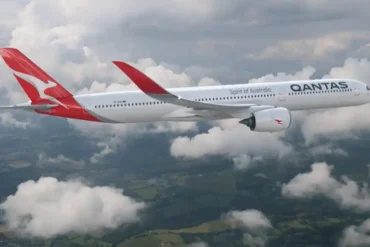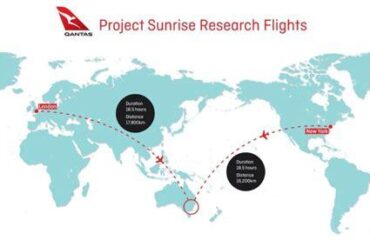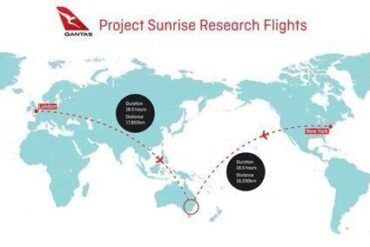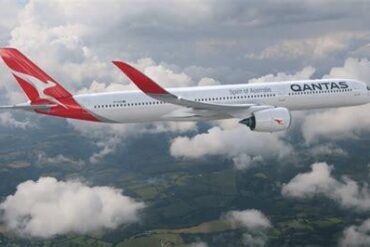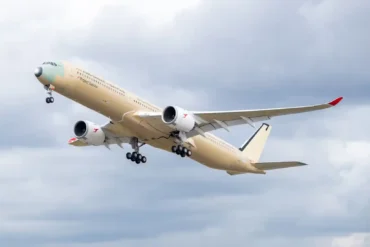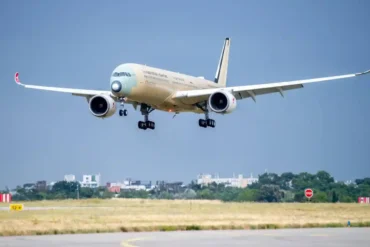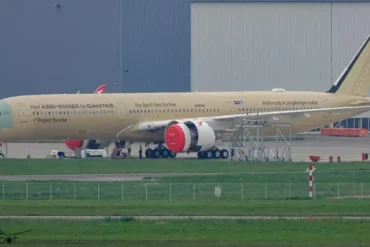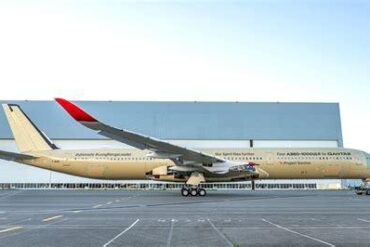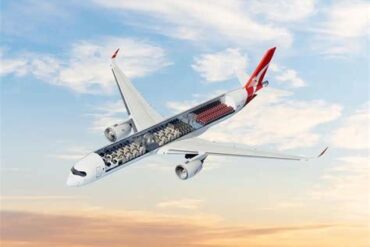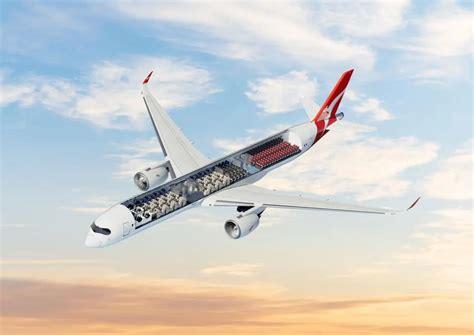
The ambition to connect the farthest corners of the planet without stopping has always lived at the edge of aviation’s technical limits. With Qantas Project Sunrise, that ambition has taken physical form in the Airbus A350-1000ULR, an aircraft that redefines what is possible—not by adding more passengers, but by deliberately carrying far fewer. The headline figure is striking: only 238 seats on an airframe capable of holding over 350. Yet behind that number lies a dense web of engineering trade-offs, economic gambles, and physiological realities that reshape the very concept of long-haul travel.
This is not simply a story about luxury cabins or record-breaking routes. It is a study in constraints—how fuel, weight, human endurance, and profitability collide inside a single aluminum and composite structure designed to stay airborne for nearly 22 continuous hours.
The Weight Equation That Dictates Everything
At the core of the A350-1000ULR’s design lies a brutal truth: range is bought with weight, and weight must be paid for somewhere else. To achieve its targeted 9,700 nautical miles (18,000 kilometers), the aircraft incorporates a massive rear center auxiliary fuel tank, adding roughly 20,000 liters (5,283 gallons) of additional fuel capacity.
This is not a marginal increase—it fundamentally alters the aircraft’s operational profile. That extra fuel weighs approximately 16 tonnes (35,274 pounds), and every kilogram added must be lifted into the air, sustained for nearly a full day, and carried across oceans without compromise.
The result is a cascading set of limitations. Even with a Maximum Takeoff Weight (MTOW) pushed to around 319 tonnes (703,274 pounds), the aircraft cannot simply carry everything at once. Passengers, cargo, catering, and fuel are all competing for the same finite weight envelope. Something has to give—and in this case, it is passenger volume.
Why 238 Seats Is Not a Choice—It’s a Requirement
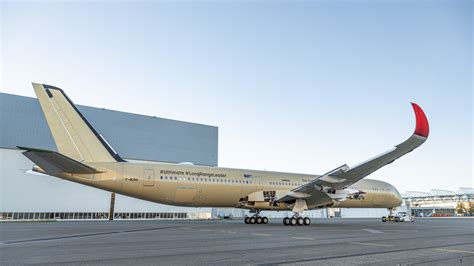
A standard A350-1000 typically accommodates 350 to 410 passengers, depending on airline configuration. Reducing that number to 238 is not a branding decision or a luxury upgrade—it is a mathematical necessity.
If Qantas attempted to fill the aircraft with 350 passengers while carrying the required fuel for a Sydney–London or Sydney–New York nonstop flight, the aircraft would simply exceed safe takeoff limits. The runway physics would not allow it. The engines would not compensate. The laws of aerodynamics would not negotiate.
Instead, the airline has effectively traded passenger volume for fuel range, ensuring that the aircraft can depart safely, climb efficiently, and sustain flight across nearly half the globe without refueling.
This decision transforms the aircraft into something fundamentally different: not a high-capacity airliner, but a precision long-range instrument.
A Cabin Designed Around Revenue Density, Not Passenger Density
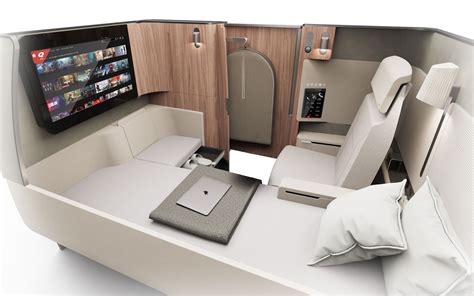
With fewer seats available, every square meter of cabin space becomes financially critical. The A350-1000ULR’s layout reflects a calculated shift toward high-yield passengers, where revenue per seat replaces total passenger count as the primary metric.
Qantas has structured the cabin into four distinct classes:
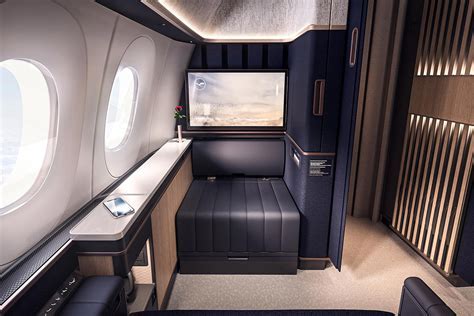
- First Class: 6 suites designed for maximum exclusivity
- Business Class: 52 seats forming the core revenue engine
- Premium Economy: A transitional tier balancing comfort and cost
- Economy Class: 140 seats, still more spacious than industry norms
This distribution ensures that over 25% of the aircraft is dedicated to premium seating, a deliberate strategy to offset the reduced total capacity. Every seat must generate more revenue than it would on a traditional long-haul flight, because the cost of operating a 22-hour mission remains extraordinarily high.
Lessons Learned From Earlier Ultra-Long-Haul Experiments
The A350-1000ULR does not exist in isolation. Its configuration reflects lessons learned from earlier ultra-long-range operations, particularly those that prioritized premium-only cabins.
Previous designs demonstrated that extreme range and high passenger density are incompatible. However, they also revealed a limitation: a fully premium cabin restricts accessibility and caps potential market size.
Qantas has taken a hybrid approach. By including a substantial economy section alongside premium offerings, the airline is attempting to broaden its customer base without sacrificing range. This introduces a delicate balance—one that depends heavily on careful weight distribution and passenger mix optimization.
The longer fuselage of the A350-1000 provides a structural advantage here. With additional cabin length, it becomes possible to spread weight more evenly, allowing for more passengers than earlier ultra-long-range variants while maintaining the same extreme reach.
The ‘Wellbeing Zone’: Sacrificing Seats for Survival
Perhaps the most radical feature of the A350-1000ULR is not found in its cockpit or fuel system, but in a space that generates zero direct revenue: the Wellbeing Zone.
Located between premium economy and economy cabins, this dedicated area replaces what would normally be several rows of seats—potentially accommodating 18 to 27 additional passengers. Instead, it is designed as a movement and recovery space, acknowledging a critical reality: the human body is not built for 22 hours of confinement.
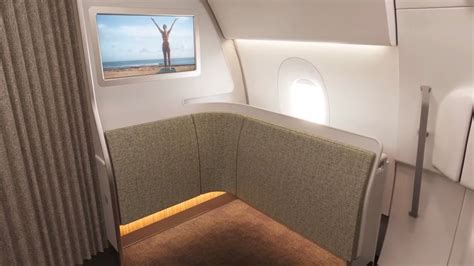
The zone includes:
- Structured surfaces for stretching and light exercise
- Hydration stations to encourage fluid intake
- Guided movement programs displayed on overhead screens
- Open space for circulation and posture relief
This is not a luxury feature—it is a physiological necessity. On ultra-long-haul flights, risks such as deep vein thrombosis (DVT), fatigue, and dehydration become operational concerns. Passenger well-being directly impacts not only comfort but also safety and overall flight viability.
By sacrificing revenue-generating seats, Qantas is making a long-term bet: that healthier passengers lead to a more sustainable ultra-long-haul model.
Engineering Reinforcements for Extreme Operations
Carrying additional fuel is only part of the challenge. The entire airframe must be reinforced to handle the increased stress associated with higher takeoff weights and longer flight durations.
Key structural modifications include:
- Strengthened landing gear systems capable of absorbing higher loads during takeoff and landing
- Reinforced wing structures, particularly in the wing box, to support additional lift requirements
- Enhanced aerodynamic surfaces, including modified flaps and winglets for improved efficiency at lower speeds
These changes ensure that the aircraft can operate safely even under maximum load conditions, such as departing from a hot runway in Sydney while fully fueled.

The engines—specifically the Rolls-Royce Trent XWB-97—play a crucial role as well. Designed for high thrust and efficiency, they provide the necessary power to lift the heavier aircraft while maintaining fuel efficiency over long distances.
A Strategic Rivalry: Efficiency vs Power
In the broader market, the A350-1000ULR represents one side of an emerging strategic divide in ultra-long-haul aviation.
One approach prioritizes efficiency and reduced payload, using lighter configurations and optimized aerodynamics to extend range. The other relies on sheer power and scale, lifting more passengers with larger wings and higher thrust engines.
The A350-1000ULR clearly aligns with the former philosophy. By filling the aircraft with fuel instead of passengers, it achieves extended range without dramatically increasing structural complexity or fuel burn per kilometer.
This approach results in a unique outcome: an aircraft that is physically large but operationally selective, designed to serve specific high-value routes rather than broad network coverage.
The Economics: A High-Stakes Balancing Act
From a financial perspective, Project Sunrise operates on a razor’s edge. Reducing the seat count to 238 dramatically increases the cost per available seat mile (CASM), placing immense pressure on ticket pricing and revenue generation.
To compensate, Qantas must rely on:
- Premium ticket sales, particularly in first and business class
- Time-value pricing, targeting passengers willing to pay more for nonstop convenience
- Operational savings, including reduced reliance on hub airports and fewer ground operations
The pricing strategy is critical. For the model to work, fares may need to be 20% to 30% higher than comparable one-stop routes. This positions the service as a time-saving premium product, rather than a mass-market offering.
At the same time, eliminating stopovers reduces certain costs—landing fees, refueling logistics, and additional crew requirements. These savings help offset the higher fuel consumption and lower passenger volume, but the margin for error remains thin.
Redefining Global Travel Patterns
The implications of Project Sunrise extend beyond a single aircraft or airline. By enabling nonstop connections between distant city pairs, the A350-1000ULR challenges the traditional hub-and-spoke model that has dominated global aviation for decades.
Instead of routing passengers through major hubs, airlines can offer direct point-to-point services, reducing travel time and simplifying itineraries. This shift has the potential to reshape global travel patterns, particularly for high-value business travelers.
However, this model is not universally applicable. It thrives in markets where:
- Demand for time-saving travel is strong
- Passengers are willing to pay a premium
- Route distances justify ultra-long-haul operations
In this sense, the A350-1000ULR represents a specialized solution, not a universal replacement for existing systems.
The Human Limit: The Final Frontier
Ultimately, the most significant constraint on ultra-long-haul flight is not fuel capacity or engine performance—it is the human body.
Spending nearly a full day in the air imposes physical and psychological challenges that cannot be ignored. Fatigue, dehydration, and limited mobility all affect passenger experience and health.
The A350-1000ULR acknowledges this reality through its design choices:
- Increased seat pitch in economy
- Dedicated movement spaces
- Enhanced cabin humidity and pressure systems
- Lighting designed to reduce jet lag
These features collectively aim to make ultra-long-haul travel not just possible, but tolerable—and even productive.
A New Definition of Efficiency
The A350-1000ULR forces a redefinition of what efficiency means in aviation. Traditionally, efficiency has been measured in terms of passengers carried per flight. In this new paradigm, it is measured in value delivered per passenger.
By carrying fewer people but offering greater convenience, time savings, and comfort, the aircraft challenges conventional metrics. It suggests that the future of long-haul travel may not be about maximizing capacity, but about optimizing experience and value.
Conclusion: The Price of Nonstop Ambition
The decision to limit the A350-1000ULR to 238 seats is not a compromise—it is the foundation of its capability. Every removed seat, every added liter of fuel, and every square meter of cabin space reflects a calculated trade-off in pursuit of a singular goal: connecting the world without interruption.
This aircraft does not attempt to be everything to everyone. It is a precision-engineered response to an extreme challenge, where physics, economics, and human endurance intersect.
In doing so, it reveals a deeper truth about aviation’s future: sometimes, progress is not about adding more—but about choosing what to leave behind.