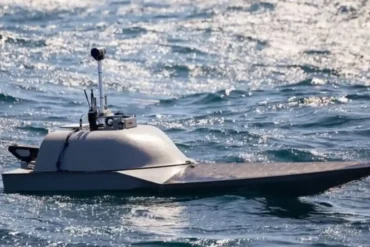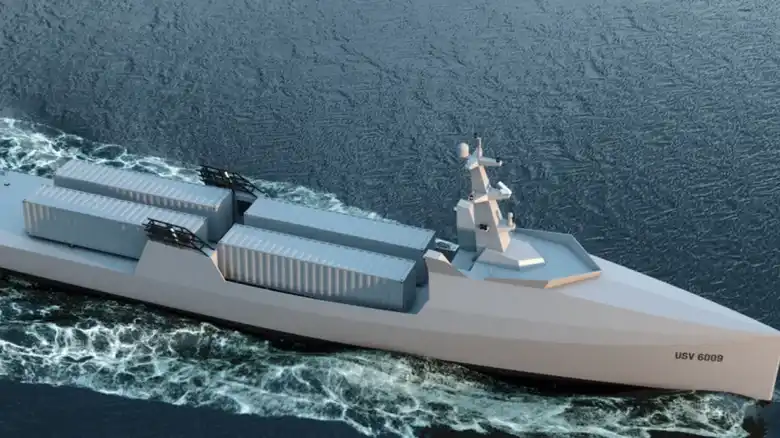
The architecture of naval power is quietly undergoing a transformation, and it is not happening on the decks of massive aircraft carriers or nuclear submarines. Instead, it is emerging in a new class of autonomous surface vessels designed to operate without human crews and, crucially, to be built at remarkable speed. The U.S. Navy’s Liberty Class ships, developed by Blue Water Autonomy, represent a strategic pivot toward scalable, efficient, and technologically adaptive maritime logistics.
At its core, this shift reflects a simple but powerful idea: warfighting effectiveness depends not only on firepower, but on supply chains. Ammunition, fuel, food, and medical supplies do not move themselves—until now, perhaps. By integrating autonomous cargo vessels into its fleet, the Navy is effectively outsourcing risk and labor to machines, allowing human personnel to focus on missions that demand judgment, adaptability, and resilience.
The Liberty Class is not merely an incremental upgrade. It is a rethinking of how ships are designed, constructed, and deployed. Built on the proven Damen Stan Patrol 6009 hull, these vessels leverage existing engineering to bypass the slow grind of traditional procurement cycles. This is naval innovation with a pragmatic twist: reuse what works, automate what doesn’t, and accelerate everything.
Engineering for Autonomy: Design Without Humans
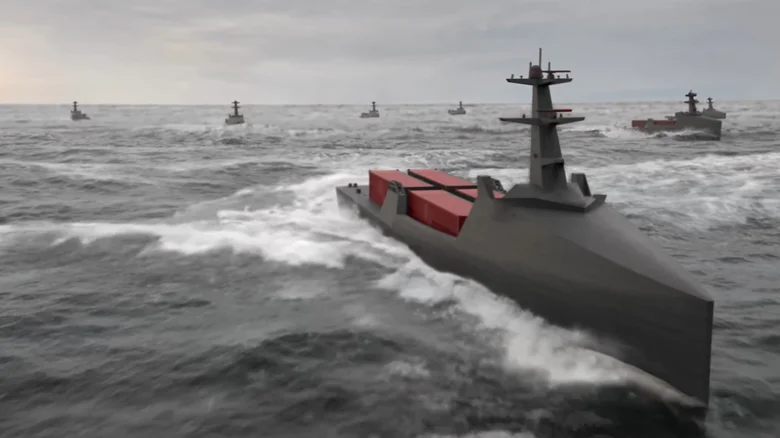
A ship without a crew sounds like science fiction until you examine the design logic. Remove humans, and an entire category of engineering constraints disappears. The Liberty Class eliminates heating, ventilation, air conditioning systems, crew quarters, and life-support infrastructure. What remains is a vessel optimized purely for function: cargo transport and endurance.
Each ship measures 190 feet in length, with a 30-foot beam and a displacement of roughly 850 tons. Its axe bow design—a sharply angled forward hull—enhances stability in rough seas, a critical feature for a vessel that cannot rely on human correction in real time. Stability, in this context, is not just comfort; it is survival.
Performance metrics reinforce the concept. With a top speed of 29 mph and a range of 11,500 miles, these ships can cross the Pacific Ocean autonomously. They can carry up to 165 tons of cargo, equivalent to four standard 40-foot containers, and remain operational for up to 90 days without intervention. That endurance transforms them into persistent logistical nodes, capable of supporting distributed naval operations across vast distances.
Rapid Production: Industrial Strategy Meets Naval Power
The most radical feature of the Liberty Class is not its autonomy—it is its manufacturing philosophy. Traditional warships take years, sometimes decades, to design and build. The Liberty Class aims to compress that timeline dramatically.
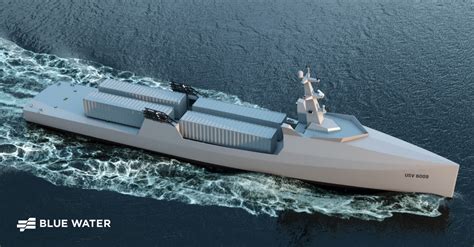
By licensing an existing hull design and relying on off-the-shelf components, Blue Water Autonomy sidesteps the costly and time-consuming process of bespoke naval engineering. The ships are constructed at Conrad Shipyard in Morgan City, Louisiana, where robotic assembly systems streamline production. The result is a projected output of 10 to 20 vessels per year, a pace that begins to echo industrial manufacturing more than traditional shipbuilding.
This approach introduces a subtle but profound shift in military thinking. Instead of treating ships as rare, high-value assets, the Navy can begin to view certain classes of vessels as rapidly replaceable and scalable tools. Quantity, in this case, becomes a form of resilience. Lose one ship, deploy another. The system absorbs shocks without collapsing.
Force Multipliers: Redefining Naval Logistics
Autonomous ships are often described as force multipliers, a term that risks sounding like jargon until you unpack it. A force multiplier increases the effectiveness of existing assets without requiring proportional increases in personnel or cost. The Liberty Class does exactly that.
By handling routine and high-risk transport missions, these vessels free up crewed ships and sailors for combat-focused roles. Imagine a scenario where ammunition resupply no longer requires a vulnerable, crewed vessel entering contested waters. Instead, an autonomous ship makes the journey, reducing risk to human life while maintaining operational tempo.
There is also a strategic advantage in distributed logistics. Rather than relying on a few large supply ships, the Navy can deploy many smaller autonomous vessels. This decentralization makes supply lines harder to disrupt, a crucial factor in modern conflicts where adversaries target infrastructure as aggressively as frontline units.
Echoes of History: The Legacy of Liberty Ships
The naming of the Liberty Class is not accidental. It is a deliberate nod to the Liberty Ships of World War II, which were the unsung heroes of Allied logistics. Between 1941 and 1945, the United States built over 2,700 Liberty Ships, sustaining global operations through sheer industrial output.
The comparison is not about identical capabilities but about philosophy. The original Liberty Ships were designed for mass production, sacrificing elegance for speed and utility. One vessel, the SS Robert E. Peary, was completed in just 4 days, 15 hours, and 29 minutes, a feat that still feels almost mythological.
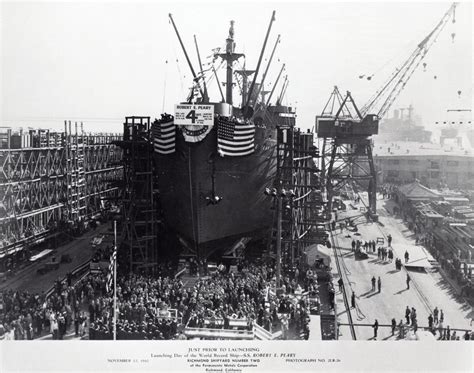
The modern Liberty Class cannot match that speed—autonomous systems demand complexity—but it channels the same spirit. In an era where technological sophistication often slows production, these ships attempt to reconcile advanced capability with industrial agility.
A Glimpse Into the Future Fleet
The emergence of autonomous ships raises deeper questions about the nature of naval warfare. If logistics can be automated, what comes next? Surveillance? Combat? The Liberty Class sits at the threshold of a broader transformation, where human decision-making increasingly orchestrates fleets of intelligent machines.
This is not a future of fully robotic navies—at least not yet. It is a hybrid ecosystem, where crewed and uncrewed vessels coexist, each optimized for different roles. The Liberty Class occupies a crucial niche in that ecosystem, proving that autonomy is not just viable but strategically advantageous.
There is a quiet elegance in this evolution. The most powerful navy in the world is not just building bigger ships or more advanced weapons. It is rethinking the fundamentals of how ships are built, deployed, and sustained. And in that rethinking lies a simple, almost philosophical insight: sometimes the fastest way forward is not to build more complexity, but to remove what is unnecessary and let the system breathe.