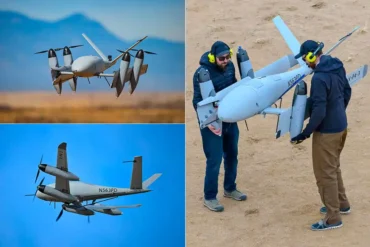
On May 8, 2025, a pivotal shift in military logistics took flight at New Jerusalem Airport, California, as the US Air Force, in partnership with MightyFly, conducted a groundbreaking demonstration of the Cento heavy cargo drone. This autonomous cargo operation, executed under a Phase II Small Business Innovation Research (SBIR) contract through the AFWERX program, highlighted the capabilities of next-generation aerial logistics powered by artificial intelligence, automation, and hybrid-electric propulsion.
The Cento: A Leap in Autonomous Aerial Transport
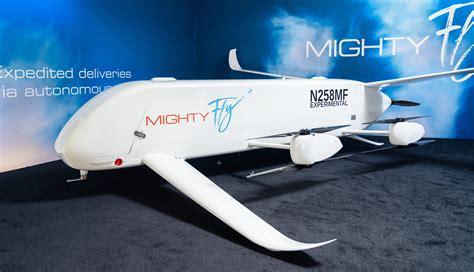
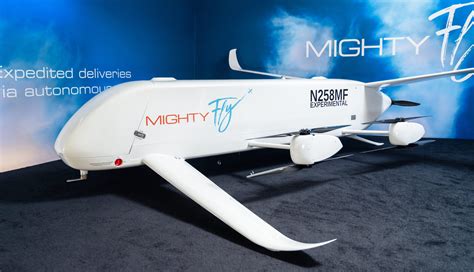
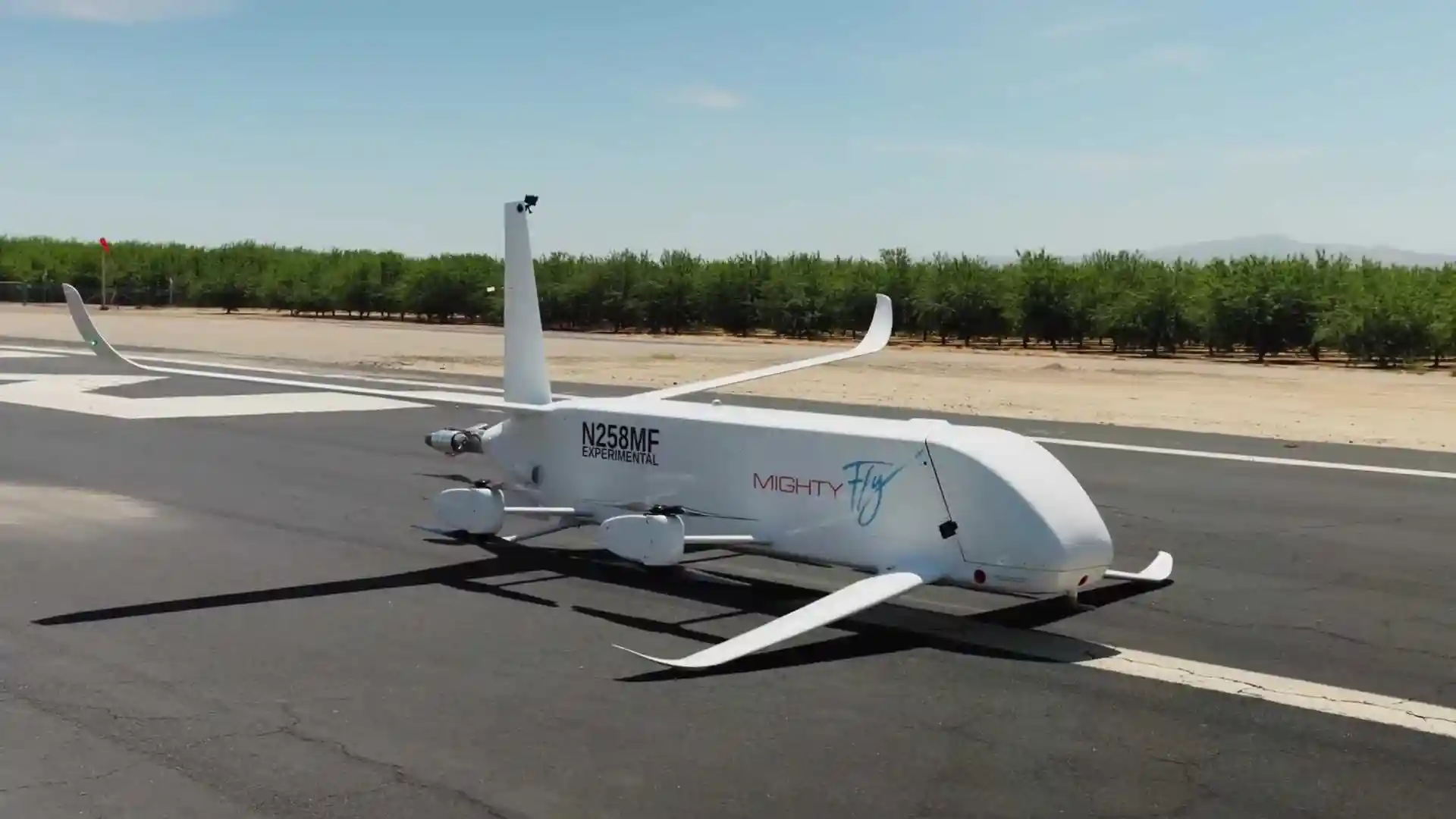
The MightyFly Cento, now in its third generation, is a hybrid-electric vertical takeoff and landing (eVTOL) aircraft designed to fulfill the pressing need for agile, autonomous cargo transport in military and civilian domains. With a length of 4.0 meters, wingspan of 5.1 meters, and a maximum takeoff weight of 249 kilograms, the Cento is engineered for performance, range, and automation.
At the heart of the aircraft lies a nine-motor propulsion system — eight fixed vertical lift fans for VTOL capability and a single pusher propeller for horizontal cruise. This configuration, backed by a combustion engine-driven hybrid system, ensures that the onboard batteries are continuously recharged mid-flight, significantly extending operational endurance. The aircraft can fly up to 966 kilometers, cruise at 240 km/h, and haul a maximum payload of 45 kilograms inside its 183 x 47 x 49 cm internal cargo bay.
But the real innovation lies not just in its specs, but in how it operates. During the Air Force demonstration, the Cento showcased its Autonomous Load Mastering System (ALMS) — an advanced software-hardware integration that autonomously handles loading, securing, monitoring, and ejecting cargo without human intervention. The demonstration involved two large boxes being loaded autonomously at origin, flown to an initial drop-off, and later delivered to a third location with zero operator input throughout the mission.
Strategic Value for the US Air Force and Beyond
This flight wasn’t a standalone stunt; it formed part of a strategic initiative by Air Mobility Command and Agility Prime, both of which are exploring autonomous airlift capabilities to reduce dependency on ground logistics and manual operations. The Cento’s performance illustrated its potential to function in highly dynamic and potentially contested environments where logistics chains are fragmented or vulnerable.
Military planners increasingly seek platforms that can deliver just-in-time, precision logistics without requiring significant infrastructure, runways, or refueling points. The Cento’s modular airframe, minimal ground footprint, and point-to-point autonomy offer exactly that. Its ability to land in areas no larger than two or three parking spaces, coupled with airport-independent operations, positions it as a highly versatile asset in tactical and strategic scenarios.
From Concept to Capability: The Road to Airworthiness
The Cento’s evolution has been swift and systematic. Initial autonomous flight tests began in December 2022, with the third-gen prototype unveiled by January 2024. By early 2024, the aircraft had received FAA Special Airworthiness and Certificate of Authorization (COA) approvals, allowing it to operate across a 595-square-kilometer corridor between New Jerusalem and Byron Airports up to 1,524 meters altitude. This corridor enabled Beyond Visual Line of Sight (BVLOS) testing, complete with a chase aircraft for safety validation.
Since March 2024, over 30 autonomous flights have been successfully conducted in this zone, focusing on long-range command and control, detect-and-avoid capabilities, and commercial readiness. These milestones are key to MightyFly’s ambition of securing FAA Part 135 air carrier certification, essential for full commercial cargo operations across U.S. and international markets.
A Vision Rooted in Innovation and Urgency
Founded in 2019 by Manal Habib, an MIT and Stanford-trained aerospace engineer, MightyFly has been mission-driven from day one. Habib’s background in drone control systems and commitment to addressing logistics inefficiencies led to the development of a platform that merges automation, range, and simplicity in one scalable solution.
The Cento is not just a drone — it’s a response to global logistics crises, supply chain disruptions, and a growing reliance on fast, flexible, and autonomous delivery models. The company is backed by high-profile venture firms including Draper Associates, Global Founders Capital, and At One Ventures, which signals strong investor confidence in its commercial and defense potential.
Commercial Logistics, Disaster Relief, and Medical Use Cases
While the Cento’s military potential is considerable, its design allows for broad dual-use applications. The same aircraft tested by the Air Force is also scheduled for proof-of-concept missions in Michigan, funded through a $150,000 grant from the Michigan Mobility Funding Platform. These trials, set for late 2025, will demonstrate autonomous logistics support for industries like automotive manufacturing, healthcare, and pharmaceuticals — sectors where just-in-time delivery and supply chain integrity are critical.
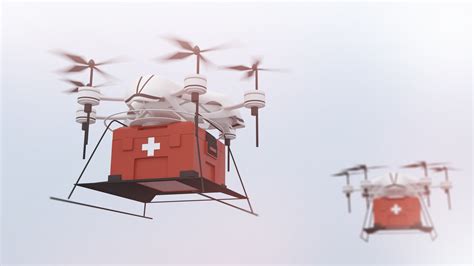
In disaster relief scenarios, where roads may be blocked and infrastructure compromised, Cento can deliver aid packages directly to affected areas without the delays tied to ground convoys or manned aircraft. In rural medical logistics, the platform can serve as a lifeline, connecting remote clinics to urban hospitals with same-day delivery of medicine, blood, or lab samples.
Redefining the Aerial Logistics Landscape
The drone logistics sector is crowded, with numerous startups and aerospace giants developing eVTOL platforms. However, MightyFly’s strategy diverges sharply from the pack. While many competitors build systems requiring human intervention, mid-route stops, or infrastructure-heavy logistics nodes, the Cento emphasizes end-to-end autonomy and minimal dependencies.
Its fully autonomous conveyor system eliminates the need for personnel at origin or destination. The hybrid engine sidesteps range limitations faced by pure-electric drones. And its cargo bay, capable of storing up to 212 USPS small packages, supports multi-stop delivery models without human oversight. These features collectively create a scalable, repeatable delivery network that could transform both military logistics and commercial supply chains.
Future Trajectory: Heavier Payloads and Global Expansion
The current 45-kg payload version is only the beginning. MightyFly is actively developing a 500-pound (227-kg) payload variant, aimed at scaling the platform’s relevance across industrial manufacturing, military logistics, and intercontinental humanitarian efforts. The larger model will enable even broader mission profiles — from full-sized engine parts to large-volume medical kits.
Simultaneously, the company is in talks with regulatory bodies outside the U.S. to bring the Cento to global markets, particularly in regions where logistical bottlenecks are common and infrastructure is scarce. Areas such as Southeast Asia, Sub-Saharan Africa, and Eastern Europe are likely early adopters for both civil and defense applications.
Conclusion: A Turning Point in Autonomous Military Mobility
The successful demonstration for the US Air Force marks more than a test flight — it signals a paradigm shift in how the military views cargo mobility. With platforms like the Cento, future battlefields may no longer rely solely on vulnerable convoys or expensive crewed aircraft for resupply. Instead, autonomous aerial logistics systems could provide rapid, resilient, and on-demand support directly to the front lines.
As MightyFly continues to refine the Cento, the fusion of autonomy, hybrid propulsion, and modular airframe engineering appears poised to disrupt not just how militaries fight wars, but how the world moves goods in the 21st century and beyond.