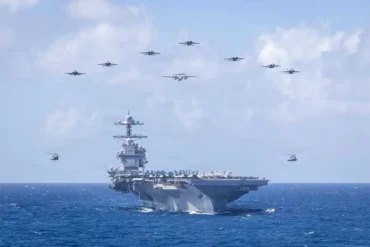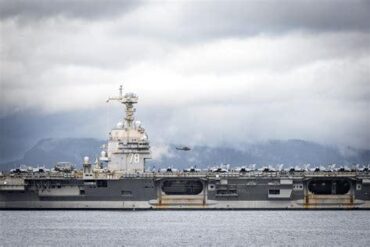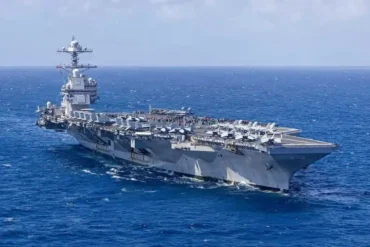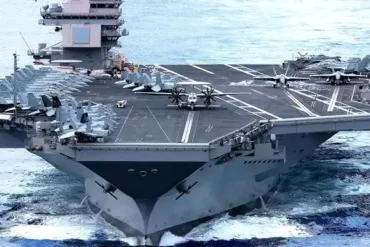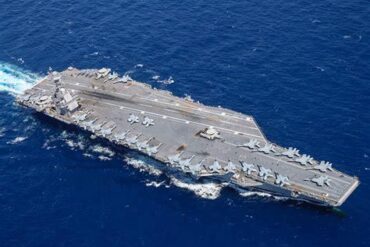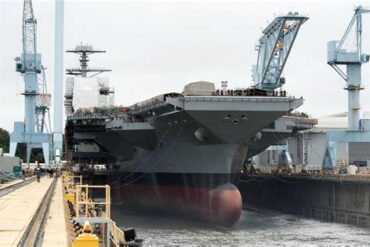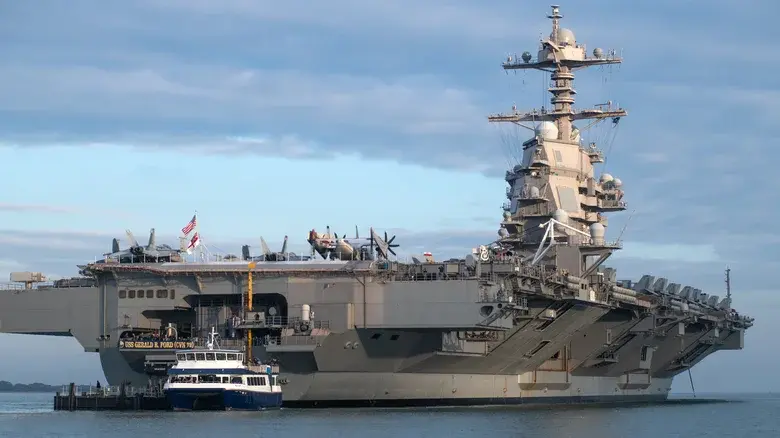
The USS Gerald R. Ford is already a symbol of technological dominance, but its next mission pushes the boundaries of what a warship can represent. Beyond its role as the world’s largest and most advanced aircraft carrier, it is now being positioned as a floating nuclear power plant, capable of supplying energy far beyond the flight deck. This transformation signals a shift in how naval assets can support both military infrastructure and civilian resilience in times of crisis.
Stretching over 1,100 feet, the Ford-class carrier is not merely an instrument of force projection; it is a self-contained energy ecosystem. Its twin A1B nuclear reactors, designed specifically for this class, deliver a level of power that eclipses previous generations. With an estimated 1,400 megawatts thermal output combined, these reactors provide roughly 25% more energy than those aboard Nimitz-class carriers, opening the door to entirely new operational roles.
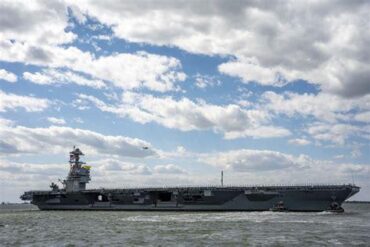
The U.S. Navy plans to test this capability at Naval Station Norfolk in Virginia, where the carrier will attempt to power the base directly from its onboard reactors. This is not a simple matter of connecting cables. It requires complex engineering solutions to safely convert, transfer, and stabilize nuclear-generated power for land-based consumption without disrupting critical systems onboard the ship.
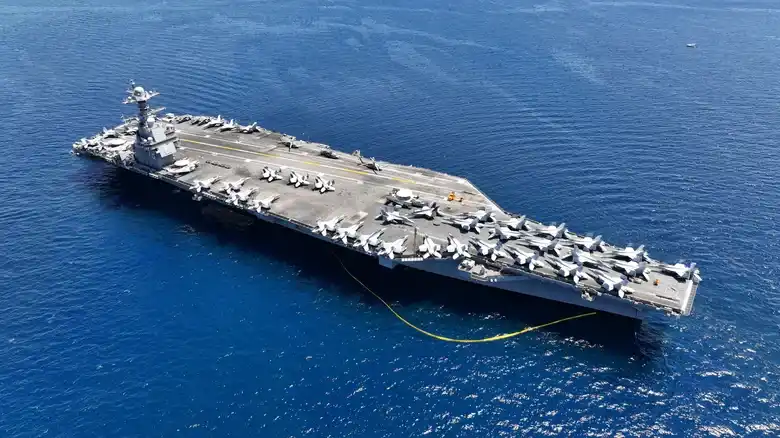
Why Turn a Supercarrier Into a Power Station
At first glance, using a multi-billion-dollar aircraft carrier as a floating generator may seem excessive. The underlying strategy, however, is rooted in preparedness and resilience. Modern military bases—and the cities around them—depend heavily on stable electrical grids. When those grids fail, whether due to natural disasters, cyberattacks, or military strikes, recovery becomes exponentially harder.
By enabling carriers like the USS Gerald R. Ford to supply power ashore, the Navy is effectively creating a mobile emergency energy reserve. In disaster scenarios, these ships could be deployed to restore electricity to crippled regions, stabilizing infrastructure while permanent repairs are underway. This transforms the carrier from a purely offensive asset into a critical humanitarian tool.
A Strategic Asset for Crisis Response
The implications extend far beyond military bases. During congressional discussions in 2026, naval leadership emphasized the broader applications of this capability. A Ford-class carrier could potentially provide electricity to hospitals, emergency services, and water treatment facilities, ensuring continuity during large-scale outages. Even more compelling is the possibility of using onboard energy systems to support freshwater production in drought-affected regions, leveraging desalination technologies powered by nuclear energy.
Such versatility positions the Ford-class as a multi-domain support platform, capable of responding to crises that are not strictly military in nature. As additional carriers like the USS John F. Kennedy enter service, the Navy could maintain a distributed network of deployable power hubs, ready to respond wherever they are needed most.
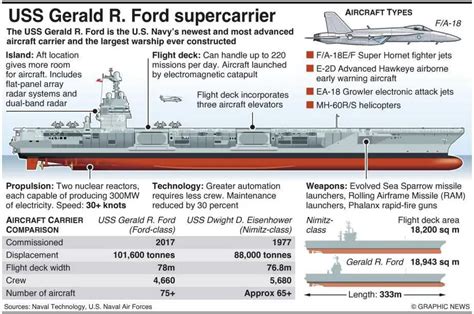
Engineering Challenges Behind the Concept
Turning a nuclear-powered warship into a land-based energy supplier is not without complications. The process involves power conversion, grid synchronization, and safety assurance at an unprecedented scale. The energy produced by the A1B reactors must be carefully managed to avoid surges or instability when connected to terrestrial systems.
Moreover, maintaining operational readiness while exporting power adds another layer of complexity. The carrier must balance its own aviation, defense, and onboard systems with external energy demands. This dual-role functionality demands rigorous testing, which is precisely why the Norfolk trial is so critical.
A New Chapter in Naval Innovation
The USS Gerald R. Ford may not yet carry the legacy of older carriers in terms of combat history, but its evolving role places it firmly in the spotlight of naval innovation. By demonstrating that a supercarrier can double as a floating nuclear power plant, the U.S. Navy is redefining what maritime power can achieve.
This initiative reflects a broader shift toward adaptive military assets—platforms that can pivot between combat operations and humanitarian support with minimal delay. If successful, the Ford-class carriers will not just dominate the seas; they will help sustain life on land when it matters most.