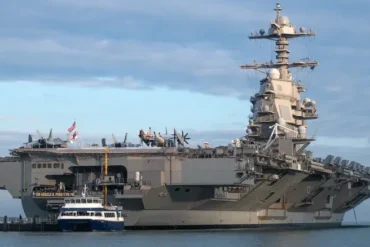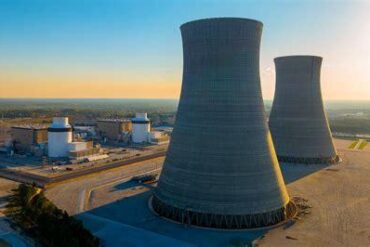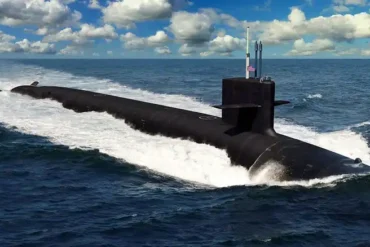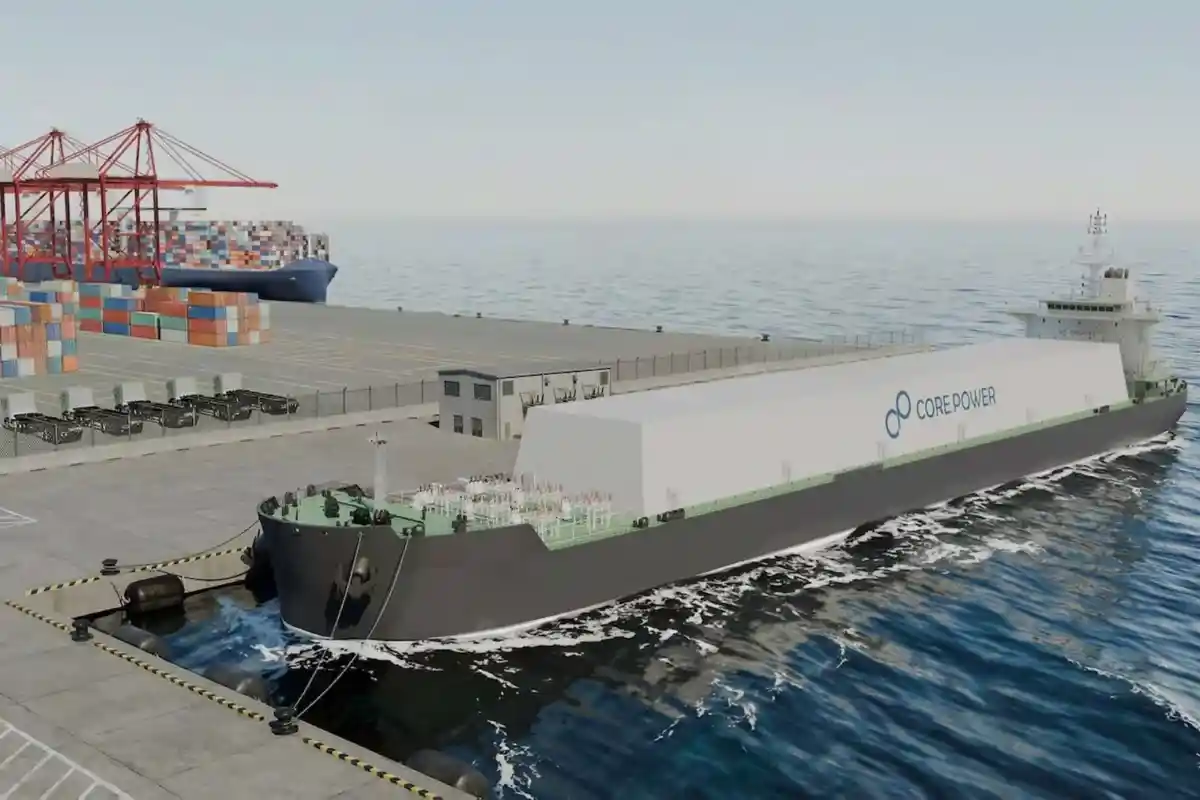
The U.S. Department of Defense is accelerating plans to deploy a 300-megawatt floating nuclear power plant at a domestic military installation by 2028, marking one of the most ambitious shifts in American defense energy strategy in decades. The proposal, reportedly under evaluation with UK-based Core Power, would position a large-scale reactor aboard a maritime platform moored at a U.S. base, delivering installation-level electricity while bypassing the conventional civilian nuclear licensing timeline.
The concept is not a laboratory experiment or boutique microreactor trial. At 300 MW of generating capacity, the plant would rival traditional land-based commercial units in output and dramatically exceed the scale of current microreactor initiatives. This is not about powering a single runway or a cluster of administrative buildings. It is about sustaining an entire operational ecosystem—airfields, shipyards, logistics depots, command centers, data hubs, and housing—through prolonged grid disruption or strategic stress.
Behind the urgency lies a structural shift in military power demand. Modern installations are no longer passive infrastructure. They are digitally dense operational nodes supporting AI-enabled command systems, cyber operations, intelligence processing, advanced radar arrays, and simulation-driven training networks. Electricity has become a strategic input, not merely a utility service.
Energy Resilience in the AI Era
The Pentagon’s evaluation reflects a growing recognition that electricity availability may define operational endurance in future conflicts. Civilian grids, even in the United States, are vulnerable to cyber intrusion, extreme weather, physical sabotage, and demand spikes driven by AI data centers and industrial electrification. When civilian transmission falters, military bases are not insulated from the consequences.
Traditional backup systems rely heavily on diesel generators. Those generators are effective in short bursts, but they depend on fuel logistics that can be disrupted by supply chain constraints or contested transportation corridors. In a prolonged emergency, diesel becomes a finite resource. A floating nuclear facility changes that calculus entirely. Nuclear reactors operate for extended fuel cycles measured in years, not days.
A 300 MW-class plant could power high-load data infrastructure continuously while maintaining essential services such as water treatment, air defense support systems, medical facilities, and maintenance depots. It would also support the expanding footprint of AI training clusters, which require sustained high-density compute environments that cannot tolerate voltage instability.
This is where scale matters. Microreactors in the 5–20 MW range provide localized resilience, but they do not transform installation-level energy independence. Three hundred megawatts approaches full base autonomy.
A Defense-Driven Licensing Model
One of the most consequential aspects of the proposal is regulatory structure. Civilian nuclear plants in the United States are licensed through the Nuclear Regulatory Commission (NRC), a process known for exhaustive environmental review and extended approval timelines. The Pentagon is exploring whether a reactor deployed on a military base could be overseen under Defense Department authority, potentially shortening fielding schedules.
This would not eliminate safety oversight. The U.S. military already operates naval nuclear propulsion reactors under rigorous internal regulatory regimes. However, shifting from a civilian to a defense-led approval framework represents a structural departure in how nuclear capacity might be deployed domestically.
The strategic tradeoff is clear: faster deployment in exchange for a model centered on national security prerogatives. For a project targeting 2028, timeline compression is not optional; it is foundational.
Why a Floating Platform Changes the Equation
The decision to explore a floating platform is not cosmetic. It carries operational, logistical, and political implications.
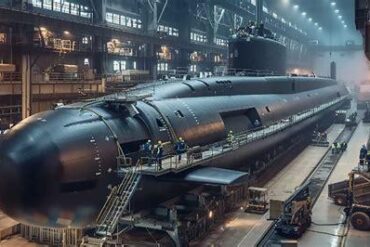
Floating reactors can be constructed in shipyards under controlled industrial conditions, then delivered to a prepared berth. This reduces dependence on local construction permitting and allows modular integration before arrival at the operational site. Mobility also provides flexibility. In theory, the platform could be redeployed to another waterside installation if strategic priorities shift.
That mobility, however, introduces defense considerations. A moored nuclear facility becomes a high-value maritime asset, requiring layered physical security, protected transmission links, maritime surveillance, and integration with installation-level air and missile defense systems. Security architecture must account for unmanned surface vessels, drone threats, insider risks, and sabotage scenarios.
Resilience cannot become a vulnerability.
Core Power and Industrial Partnerships
The industrial architecture behind the proposal underscores its seriousness. Core Power has been working with Japanese and South Korean shipbuilders, while also engaging with French nuclear group Orano and U.S. advanced reactor developer TerraPower. Reports indicate that the initial plant would likely rely on a pressurized water reactor (PWR) design.
That choice is deliberate. PWR technology is mature, widely understood, and deeply embedded in U.S. naval propulsion history. While advanced reactor designs promise efficiency gains and novel fuel cycles, a proven PWR reduces engineering uncertainty and accelerates deployment. When the operational goal is readiness by 2028, reliability outranks experimentation.
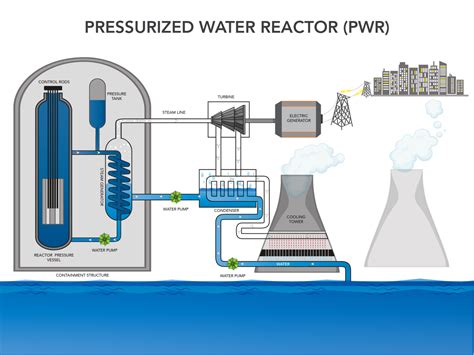
The emphasis on established reactor architecture suggests the Pentagon is prioritizing schedule certainty over technological spectacle. In defense acquisition, fielded capability often outweighs theoretical optimization.
Installation-Scale Power and Mission Assurance
Modern military bases resemble small cities. They include industrial manufacturing lines, aircraft maintenance hangars, secure data vaults, simulation complexes, housing districts, and medical centers. The energy intensity of these installations has increased steadily, particularly as electrification replaces legacy fuel systems and digital systems proliferate.
A persistent 300 MW nuclear source would enable:
- Continuous AI model training and operational deployment
- Stable radar and sensor network operation
- Electrified vehicle fleet expansion
- Sustainment of logistics and depot activity during grid failure
- Reduced reliance on fuel convoys in crisis scenarios
More importantly, it alters the endurance profile of a base under stress. Instead of operating in degraded emergency mode, an installation could maintain near-normal output for extended periods.
This has strategic implications. In contested scenarios, adversaries may seek to disrupt infrastructure far from front lines. If bases remain fully powered, operational tempo is preserved.
Strategic Competition and Maritime Nuclear Leadership
The initiative unfolds within a broader context of global nuclear maritime innovation. China has invested heavily in nuclear shipbuilding capabilities, including floating nuclear concepts for remote regions and maritime applications. Establishing a U.S. defense-backed floating reactor platform would shape regulatory norms, insurance standards, export controls, and allied adoption pathways.
First-mover advantage in maritime nuclear power could influence not only domestic resilience but also allied basing strategies. Ports capable of hosting secure nuclear platforms may gain strategic relevance.
This is not solely an engineering decision. It is industrial policy intertwined with national security.
Security and Community Considerations
Even under Defense Department authority, credibility will hinge on transparency and demonstrated safety performance. A floating nuclear reactor moored at a domestic base will attract scrutiny from local communities and state authorities. Emergency planning zones, environmental review, maritime traffic safety, and physical security protocols will all require careful articulation.
Defense jurisdiction does not negate public perception. The project’s success depends on proving that acceleration does not dilute standards.
Robust shielding, redundant cooling systems, hardened mooring structures, and protected transmission corridors will be central to public confidence. So will visible coordination with federal and state emergency agencies.
The 2028 Timeline and What Comes Next
The target date of September 2028 establishes an aggressive development arc. Achieving deployment within that window implies rapid contracting decisions, early site selection at a waterfront installation, and immediate initiation of design finalization.
Key indicators to watch include:
- Formal Defense Department contracting announcements
- Identification of a candidate base with port infrastructure
- Environmental and safety documentation releases
- Integration planning with installation microgrids
If realized, the project would represent one of the most significant shifts in U.S. military energy doctrine since the advent of naval nuclear propulsion. Energy would no longer be treated merely as a logistical input but as a decisive enabler of operational continuity and digital superiority.
The 300 MW floating nuclear power plant concept signals that the Pentagon views electricity as strategic infrastructure in the same category as runways, dry docks, and satellite networks. In an era defined by AI computation, cyber vulnerability, and contested logistics, uninterrupted power is not a convenience. It is operational leverage.
Whether Core Power ultimately delivers the first platform or another consortium assumes the role, the initiative marks a turning point. The question is no longer whether military installations require hardened, independent power. The question is how quickly such systems can be fielded at scale—and whether floating nuclear platforms become a permanent feature of America’s defense energy architecture.