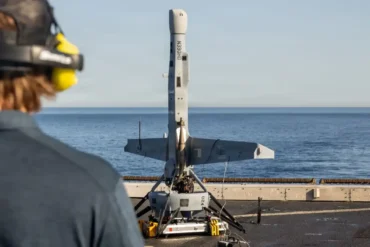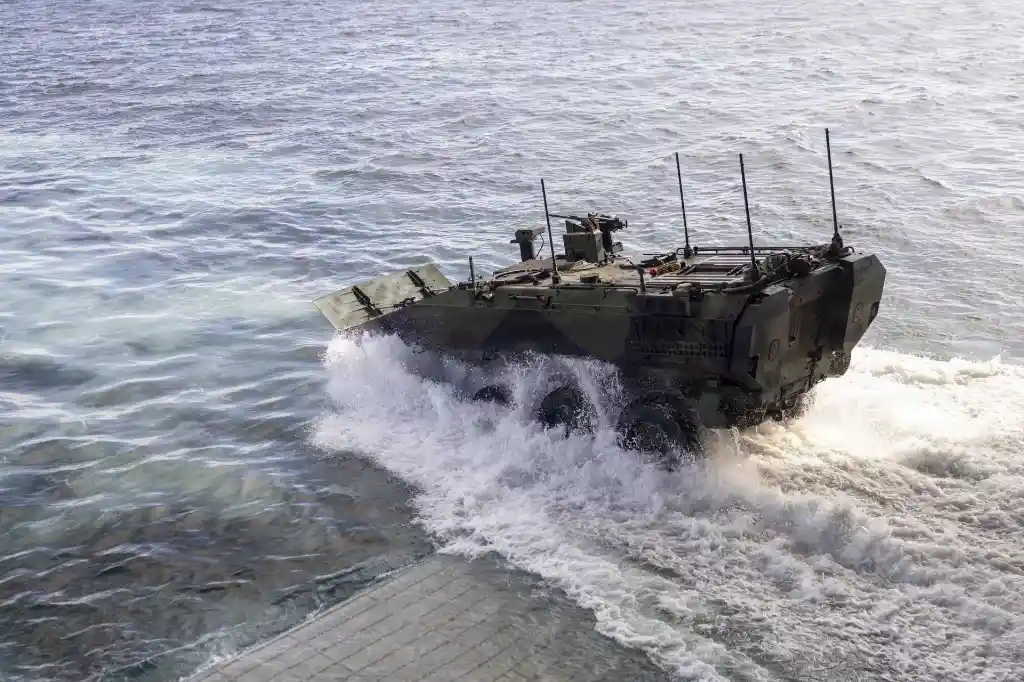
The U.S. Marine Corps has taken another decisive step in modernizing amphibious warfare, successfully deploying its new Amphibious Combat Vehicle–Personnel (ACV-P) from the Wasp-class amphibious assault ship USS Makin Island (LHD-8) during a live ship-to-shore operation off the coast of California. Conducted on January 23, 2026, the operation formed part of Quarterly Underway Amphibious Readiness Training (QUART) 26.2, a recurring exercise designed to validate combat readiness and Navy–Marine Corps interoperability under realistic maritime conditions.
This deployment was not a scripted demonstration for optics. It was a practical, at-sea evolution that tested how well newly fielded armored platforms integrate with existing amphibious shipping, command structures, and operational doctrine. For Marine planners and naval commanders alike, the event underscored a simple but consequential reality: the ACV is no longer a future capability—it is now an operational cornerstone of U.S. expeditionary warfare.
The operation was carried out by Marines from 3rd Assault Amphibian Battalion, 1st Marine Division, embarked aboard Makin Island. From the ship’s well deck, ACV-P vehicles entered the water, maneuvered through open ocean conditions, negotiated surf zones, and transitioned seamlessly onto land. Each phase of the evolution reflected the Marine Corps’ renewed emphasis on survivable, networked, and rapidly deployable ground combat power launched directly from the sea.
By executing this deployment during routine readiness training, the Marine Corps demonstrated that amphibious operations remain a living, evolving discipline rather than a Cold War relic. The ACV’s performance during QUART 26.2 showed how modernization efforts are reshaping the practical mechanics of ship-to-shore assault in an era defined by contested littorals and long-range threats.
Modern Amphibious Warfare Tested at Sea
Amphibious operations are among the most complex military maneuvers, requiring precise coordination between naval platforms, embarked ground forces, aviation assets, and command-and-control networks. QUART 26.2 exists to rehearse exactly that complexity. Conducted entirely at sea, the exercise ensured that Marines and Sailors remained proficient in the choreography of modern amphibious assault—launching armored vehicles, maintaining communications, and sustaining momentum from deck to beach.
In this context, the ACV-P’s deployment was particularly significant. Unlike legacy platforms that demanded extensive preparation or specialized conditions, the new vehicle demonstrated an ability to self-deploy from the ship, operate in realistic sea states, and deliver infantry ashore without reliance on landing craft for initial waves. This capability compresses timelines and reduces exposure during the most vulnerable phases of an amphibious landing.
The training event also reinforced the operational relationship between the U.S. Navy and Marine Corps. Amphibious warfare is inherently joint at the tactical level, and QUART exercises are designed to ensure that command relationships, communications procedures, and deck operations function smoothly under pressure. The successful deployment of the ACV-P illustrated that new ground platforms are being fielded with naval integration as a foundational requirement, not an afterthought.
Replacing a Cold War Icon With a Survivable Successor
The Amphibious Combat Vehicle program was born out of necessity. The AAV-7A1, introduced in the early 1970s, served the Marine Corps for decades and proved itself in multiple conflicts. Yet age and evolving threats exposed its limitations. Modern battlefields demand protection against mines, improvised explosive devices, precision fires, and sensor-driven targeting—conditions the AAV was never designed to endure.
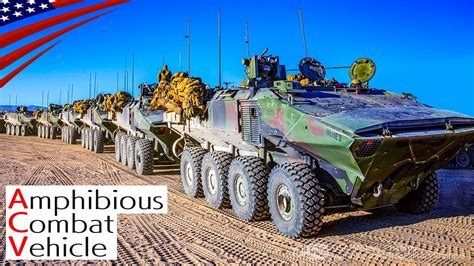
The ACV addresses these gaps with a clean-sheet approach to survivability and mobility. Built around a modern 8×8 wheeled armored vehicle design, it offers superior reliability and reduced maintenance demands compared to tracked predecessors. Wheeled mobility also improves on-road speed and operational range once ashore, allowing Marine units to maneuver deeper inland without immediate logistical burden.
Protection is where the ACV represents a generational leap. Advanced armor packages, underbody blast mitigation, and energy-absorbing seating significantly reduce the risk to embarked troops. Integrated situational awareness systems provide crews with a clearer understanding of their surroundings, improving decision-making in cluttered littoral environments where threats can emerge from any direction.
Engineering for Sea, Surf, and Shore
Unlike many armored vehicles adapted for amphibious use, the ACV was engineered from inception to operate in open water. Its water propulsion system allows it to maneuver independently in surf and shallow waters, maintaining control and stability during ship-to-shore movement. This design reduces dependence on landing craft during early assault phases, accelerating the flow of combat power from sea base to objective.
Power comes from a high-performance diesel engine paired with an independent suspension system, optimized for cross-country mobility once the vehicle transitions ashore. This combination allows the ACV to move fluidly from maritime to terrestrial operations without reconfiguration—a critical requirement for expeditionary forces operating under time and threat constraints.
Equally important is digital connectivity. The ACV integrates modern command, control, communications, computers, and intelligence (C4I) systems, enabling it to operate as part of a networked Marine Air-Ground Task Force. During amphibious landings, this connectivity ensures that infantry units remain linked to higher headquarters, fires, and adjacent elements, even while maneuvering through complex coastal terrain.
The ACV Family and the Central Role of the ACV-P
The ACV is not a single vehicle but a growing family of mission-tailored variants. The ACV-P serves as the backbone of this fleet, designed primarily to transport infantry safely from ship to shore and onward into inland objectives. With a three-person crew and capacity for up to 13 embarked Marines, it balances protection, mobility, and payload in a platform optimized for assault formations.
Armament is provided by a remotely operated weapon station, typically mounting a 12.7 mm heavy machine gun or 40 mm automatic grenade launcher. This allows the vehicle to deliver suppressive fire while keeping crew members under armor, a vital advantage during exposed amphibious approaches and initial landings.
Other variants expand the ACV’s mission set. The ACV-Command enhances communications and battle management for tactical headquarters. The ACV-Recovery provides maintenance and recovery support in austere environments. The ACV-30, equipped with a stabilized 30 mm cannon, adds direct-fire capability to amphibious and mechanized formations, increasing organic firepower during littoral and inland operations.
USS Makin Island: A Floating Launch Platform for Modern Assaults
Central to the January operation was USS Makin Island, a Wasp-class amphibious assault ship purpose-built to project Marine combat power from the sea. Its well deck supports the launch of amphibious vehicles and landing craft, while its expansive flight deck accommodates helicopters and short takeoff and vertical landing aircraft. This dual-axis capability allows commanders to blend surface and vertical assaults, complicating enemy defenses.
For the ACV-P, the ship’s well deck is more than a parking space—it is the gateway to the battlespace. The ability to launch armored vehicles directly from the ship shortens response times and reduces dependence on fixed infrastructure. In a crisis, Marines embarked aboard ships like Makin Island can maneuver, posture, and strike without waiting for access to ports or airfields.
Strategic Implications for Expeditionary Warfare
Exercises like QUART 26.2 are not routine box-checking events. They are strategic signals. By demonstrating the operational deployment of new amphibious vehicles, the Marine Corps reinforces its ability to conduct contested ship-to-shore operations, a capability that underpins U.S. deterrence and crisis response worldwide.
The ACV’s integration into fleet operations reflects broader Force Design initiatives aimed at improving survivability, lethality, and mobility in the maritime domain. As potential adversaries invest in long-range sensors and precision weapons, the ability to launch protected, networked forces directly from the sea becomes increasingly valuable.
The January deployment from USS Makin Island showed that this vision is no longer theoretical. Modern vehicles, trained crews, and capable ships are converging into a cohesive system designed for the realities of 21st-century conflict.
A Measured but Meaningful Transition
The successful use of the Amphibious Combat Vehicle during ship-to-shore operations off California marks a clear transition point for the U.S. Marine Corps. Legacy platforms are giving way to systems designed for survivability, integration, and adaptability. The ACV-P’s performance during QUART 26.2 demonstrated that amphibious warfare remains not only relevant, but refined for modern threats.
By pairing advanced armored vehicles with versatile amphibious assault ships, the Navy–Marine Corps team preserves a decisive edge in expeditionary operations. From humanitarian response to high-end conflict, the ability to project combat-ready forces from the sea remains a defining strength—now reinforced by a new generation of amphibious combat power.