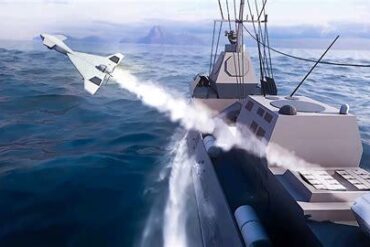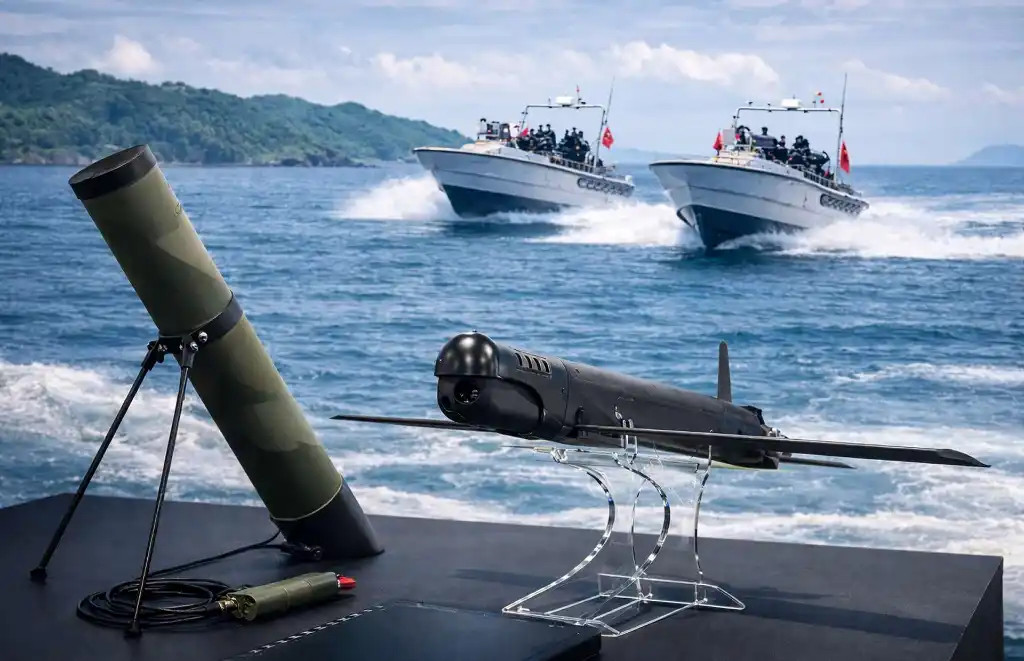
Taiwan has taken a pivotal step in reshaping its coastal defense capabilities with the successful maritime launch of the Chin Feng I loitering munition, marking a historic shift toward sea-based drone warfare aimed at countering potential amphibious invasions from China. The live-fire test was conducted by the Taiwan Marine Corps from an M96 fast boat off the coast of Zuoying Harbor on December 25, 2025, and is the first known instance of a sea-launched suicide drone from a manned platform in Taiwan’s arsenal.
A Tactical Shift Toward Littoral Mobility
The deployment of Chin Feng I from the fast and agile M96 fast boat demonstrates Taiwan’s intent to decentralize its strike capabilities, bringing mobility and unpredictability into its defense doctrine. Traditionally dependent on land-based missile and drone deployments, Taiwan is now placing strike assets directly in the littoral zone—precisely where Chinese amphibious operations would most likely unfold in a cross-strait conflict.
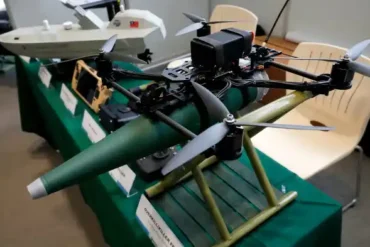
Designed and developed by the National Chung-Shan Institute of Science and Technology (NCSIST), the Chin Feng I is a tube-launched, AI-assisted loitering munition that can strike coastal and maritime targets with high precision. With a modest control range of around 8 kilometers and a 15-minute endurance, this “one-shot, one-kill” drone is ideal for quick-response interdiction of fast-moving or high-value enemy assets.
Technology Behind Chin Feng I: Precision in a Compact Form
At the core of the Chin Feng I is a fusion of electro-optical and infrared sensors, providing day-night operational capability under challenging coastal visibility conditions. The drone is launched from a pressurized tube, unfolding its wings mid-air and transitioning to electric motor propulsion. Operators build the flight path using a tablet interface, selecting waypoints and entering reconnaissance or attack modes.
Before impact, the system utilizes AI-powered object recognition to box potential targets on screen. Human operators retain the final decision, ensuring ethical and accurate target discrimination even in cluttered environments. Importantly, Chin Feng I features an optional proximity detonation mode, which allows the warhead to burst near a target instead of requiring a direct hit—essential in scenarios involving fast boats or dispersed personnel.
Why Sea-Launched Drones Change the Game for Taiwan
Integrating Chin Feng I onto the M96 platform adds a new tactical layer to Taiwan’s coastal defenses. The M96 is already integral to Taiwan’s amphibious operations, capable of transporting special forces, patrolling shorelines, and evading detection through its speed (up to 35 knots) and compact profile. With the added ability to launch precision drones, these vessels become multipurpose strike assets without compromising crew safety.
In a potential conflict, Taiwan’s Marines could use M96s to patrol narrow straits, island chains, and harbor chokepoints, unleashing Chin Feng I drones against:
- Amphibious landing craft
- Escort vessels
- Exposed command posts
- Fast attack boats
This creates a distributed kill web where loitering munitions can harass and weaken Chinese formations before they reach the beaches. The drones’ compactness and agility make them difficult to detect and eliminate, thus complicating enemy tactical planning and delaying landing operations.
Combat-Proven Versatility Through Modular Deployment
Chin Feng I is designed for flexibility. It has been integrated not just onto fast boats, but also tested from man-portable launchers, unmanned surface vessels (USVs), and even unmanned aerial vehicles (UAVs). This modularity enables Taiwan to adapt the weapon across multiple domains—air, sea, and land—thus preserving larger, more expensive missile systems for strategic targets.
NCSIST’s broader roadmap includes testing swarming tactics, where drones from UAVs and USVs coordinate strikes in waves to overwhelm enemy defenses. References to advanced energetic fragmentation and next-generation warhead formulations point to a focused effort on lethality maximization in Taiwan’s compact maritime defense architecture.
Precision Targeting in a Deceptive Battlespace
The Chin Feng I’s sensor fusion, paired with human-in-the-loop targeting, provides a powerful counter to deception tactics. In a heavily trafficked or electronically contested maritime environment—full of decoys, civilian vessels, and EW interference—the ability to visually verify and confirm targets gives Taiwan a crucial edge in target fidelity.
This is particularly important considering China’s known use of electronic warfare suites and decoys aboard its assault craft. The Chin Feng I allows Taiwanese operators to filter through noise and zero in on command vehicles, key personnel, or fast boats, maximizing strategic disruption with minimal collateral risk.
Embedding Drones in a Layered Defense Web
Taiwan’s defense policy increasingly revolves around layered, networked resistance designed to exhaust and delay an invading force. Chin Feng I represents the middle tier of this system:
- Large missile platforms (e.g., Hsiung Feng series) serve long-range, high-value strikes.
- Chin Feng I fills the medium-range, precision interdiction role.
- Small arms and close-range ATGMs anchor the beachhead and urban defense phase.
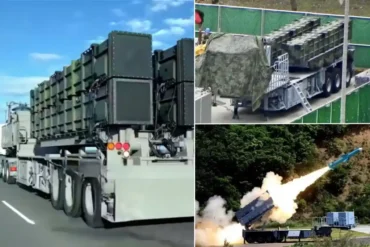
Such dispersion of firepower across boats, trucks, and unmanned systems prevents over-reliance on any single system and increases the survivability of Taiwan’s kill chains. It forces adversaries to consider threats from unpredictable bearings—including below radar altitude, at night, or from behind coastal structures.
Conclusion: Littoral Ambiguity as Deterrence
With the successful sea launch of the Chin Feng I, Taiwan has effectively blurred the lines between reconnaissance, strike, and defense in its maritime strategy. The test underscores a future where unmanned systems will be the first to engage in any cross-strait conflict, not only gathering intelligence but striking with surgical precision from hidden, mobile platforms.
In the event deterrence fails, Taiwan’s evolving doctrine seeks to turn its coastal geography into a force multiplier, exploiting every harbor, inlet, and island to delay, degrade, and deny enemy progress. Chin Feng I is not a silver bullet—but it is a sharp, smart arrow in Taiwan’s quiver, launched from the shadows of the sea.