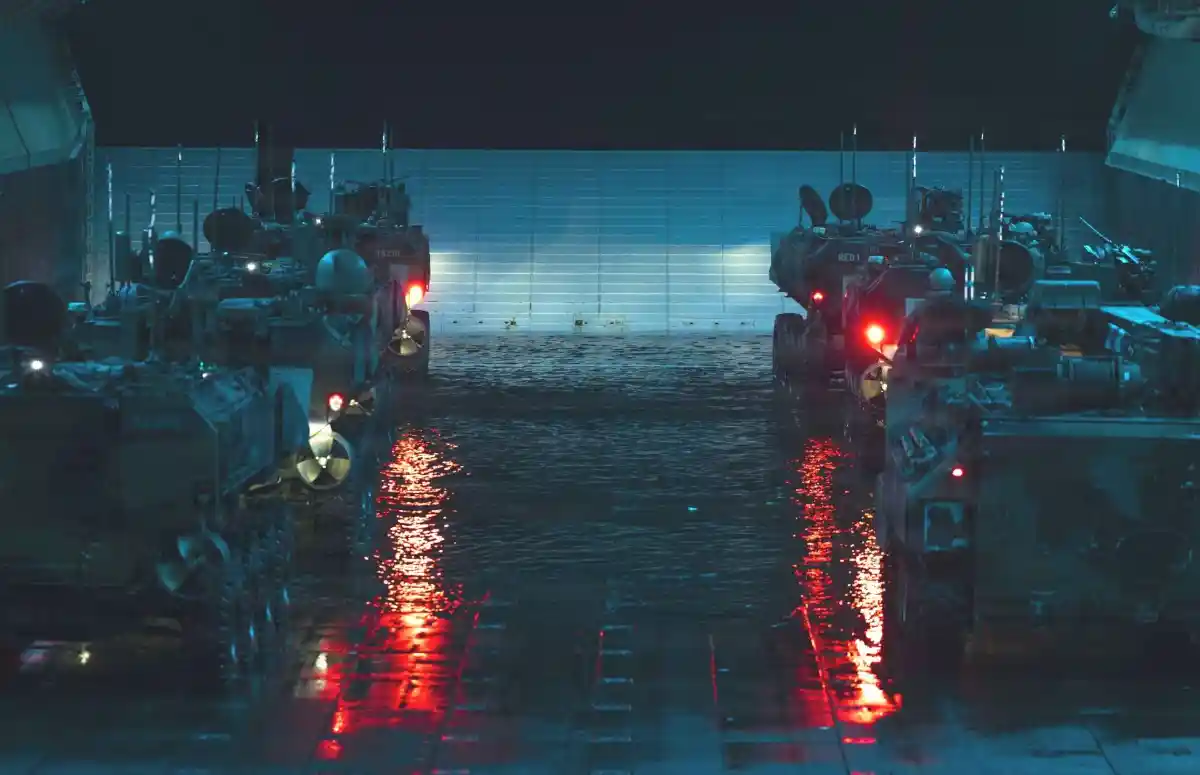
The U.S. Marine Corps has released new imagery revealing a rarely seen but increasingly central aspect of modern amphibious warfare: armored assaults launched from the sea under cover of darkness. Photographs captured during early February training show Marines carefully staging Amphibious Combat Vehicles inside the flooded well deck of USS Makin Island as the ship maneuvered off the California coast. Blue-white deck lighting, red safety reflections, and the sheen of seawater frame a scene that underscores how the Corps is reshaping ship-to-shore tactics for a world defined by sensors, missiles, and constant surveillance.
The exercise was part of Quarterly Underway Amphibious Readiness Training 26.2, a Navy–Marine Corps event designed to stress the fundamentals of amphibious operations before deployment workups intensify. At its core was a simple but demanding goal: prove that armored vehicles can be launched, controlled, and fought from the sea at night, when the margin for error narrows and coordination becomes paramount. The imagery makes clear that the most dangerous moments of an amphibious assault often occur long before Marines reach land, at the seam between ship and ocean.
Marines from 3rd Assault Amphibian Battalion, 1st Marine Division, are seen guiding their vehicles into position inside the well deck, engines idling as ballast water floods the compartment. In daylight, this choreography is already complex. At night, with visibility limited and spatial cues reduced, every signal, light, and command must be precise. The training reflects a deliberate push to make darkness an ally rather than a liability in future littoral fights.
Night Operations and the Modern Amphibious Problem
Amphibious warfare has always been about exposure. Ships closing the coast, vehicles entering the water, and troops concentrating at predictable points all present opportunities for an adversary. In an era of long-range anti-ship missiles, unmanned aerial surveillance, and coastal strike systems, those vulnerabilities have multiplied. The Marine Corps response has been to emphasize standoff, dispersion, and timing, with night operations playing a central role.
Training inside a darkened well deck forces crews to operate with strict light discipline, minimizing visual and infrared signatures while still maintaining safety. It also rehearses the kind of degraded conditions Marines may face if navigation aids are jammed or communications disrupted. By repeating these evolutions at sea, the Corps is building muscle memory for launches that must succeed even when technology is contested.
Amphibious Combat Vehicle: From Connector to Combat Platform
The vehicle at the center of this evolution is the Amphibious Combat Vehicle Personnel variant, known as the ACV-P. Designed to replace the legacy Assault Amphibious Vehicle fleet, the ACV-P is more than a transport. It is intended to be a true combat platform that can fight its way from ship to shore and continue inland without pause.
In its standard configuration, the ACV-P carries a crew of three and a 13-Marine infantry squad. Beyond personnel, it is designed to haul enough equipment and sustainment for roughly two days of operations, a detail that has outsized tactical importance. That endurance allows landing forces to disperse quickly after reaching shore, reducing dependence on immediate follow-on logistics and complicating enemy targeting.
The vehicle’s 8×8 wheeled architecture is optimized for open-ocean operations rather than sheltered waters. It is built to launch from amphibious ships positioned up to 12 nautical miles offshore, a distance aligned with modern threat envelopes. In the water, the ACV achieves speeds exceeding six knots, while on land it can reach highway speeds above 65 miles per hour. This dual performance ensures that once Marines clear the surf zone, they can maintain momentum and tempo inland.
Protected Firepower in the Surf Zone
A defining feature of the ACV-P is its remotely operated weapon station. Depending on mission requirements, the mount can be fitted with either a .50-caliber machine gun or a 40 mm Mk 19 automatic grenade launcher. Crucially, the system allows the gunner to operate under armor, maintaining suppressive fire while reducing exposure during the most vulnerable phases of the assault.
That protected firepower matters in the surf zone, where vehicles are slow, predictable, and exposed. The ability to engage threats without opening hatches or standing behind shields reflects lessons learned from decades of expeditionary operations. In night conditions, the integration of sensors and stabilized weapons further enhances the vehicle’s ability to fight through confusion and limited visibility.
USS Makin Island and the Well Deck as a Launch Platform
The setting for this training, USS Makin Island (LHD 8), is itself a symbol of transition. Although it is the final ship of the Wasp class, it introduced significant technological changes, including gas turbine propulsion and an electric drive system that replaced older steam plants. These upgrades have reduced fuel consumption and maintenance demands, translating into greater operational availability.
As an amphibious assault ship, Makin Island serves as the centerpiece of an Amphibious Ready Group. Its well deck can launch landing craft, air-cushioned vehicles, and amphibious armored platforms, while its flight deck supports a mix of tiltrotor, helicopter, and fixed-wing aviation. In exercises like QUART 26.2, the ship becomes a floating choreography of sailors and Marines, each evolution timed to support the next.
Operating the well deck at night amplifies both risk and payoff. Tight clearances, moving water, and heavy vehicles leave little room for error, but successful repetitions build confidence in the ship–shore team. The images released by the Marine Corps highlight this reality, showing vehicles lined up with minimal spacing, their outlines defined more by reflections than by form.
Integrated Training Before Deployment Pressure
QUART 26.2 concluded in late January 2026 and was deliberately framed as an integration event rather than a culminating exercise. Alongside ACV launches, the training included LCAC operations and aviation deck landing qualifications for MV-22B Ospreys, UH-1Y Venoms, AH-1Z Vipers, CH-53E Super Stallions, and MH-60R Seahawks. The intent was to rehearse the full spectrum of amphibious capabilities in a realistic but controlled environment.
The presence of the 13th Marine Expeditionary Unit and Amphibious Squadron 7 ensured that command-and-control relationships were exercised as well. Notably, Peruvian naval officers embarked to observe the training, reflecting a broader emphasis on interoperability with partner nations that share maritime security concerns.
A Glimpse of Future Ship-to-Shore Warfare
Taken together, the night well deck imagery offers more than dramatic visuals. It provides a window into how the Marine Corps is adapting its oldest mission to the realities of modern conflict. The combination of standoff launches, armored mobility, protected firepower, and low-visibility execution points toward an amphibious force designed to survive first contact in a contested littoral.
The Amphibious Combat Vehicle is central to that vision, not as a standalone solution but as part of a tightly integrated naval team. When paired with ships like USS Makin Island and trained through repetitive, demanding exercises, it enables Marines to move from sea to land with speed, protection, and purpose. In an era when the margin for surprise is thin, mastering the dark spaces between ship and shore may prove decisive.