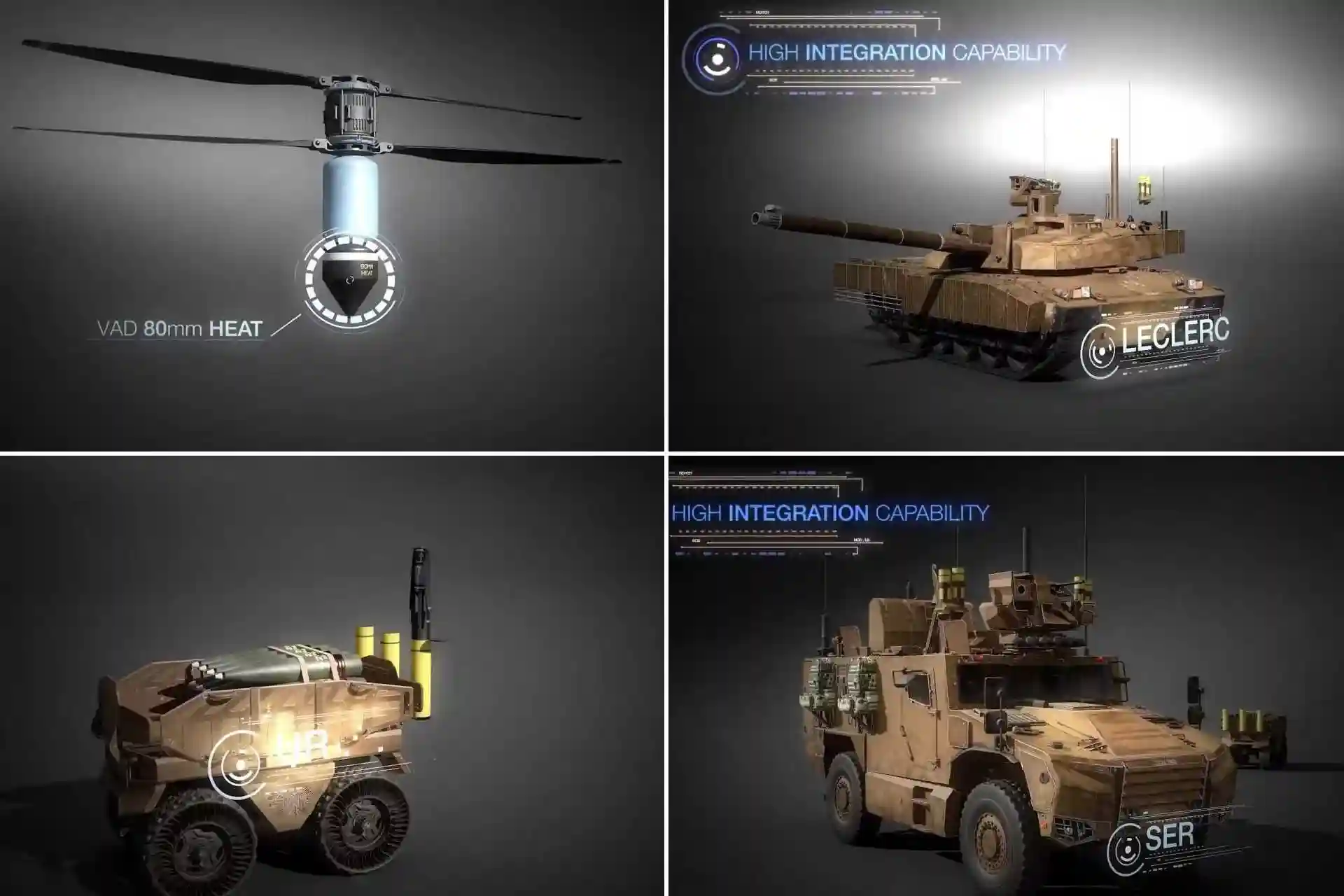
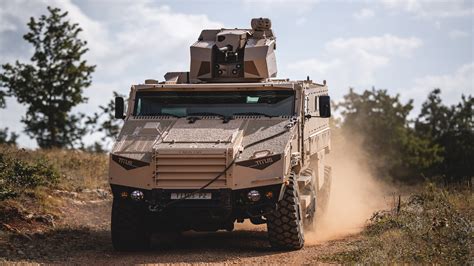
The modern battlefield is undergoing a profound transformation, driven by the rapid convergence of autonomy, precision strike capability, and decentralized decision-making. At the center of this shift stands KNDS France’s Mataris MT-10 loitering munition, a compact yet formidable system that promises to fundamentally alter how military vehicles engage threats. By embedding strike capability directly into platforms such as the Leclerc main battle tank, Serval 4×4 armored vehicle, and Titus internal security vehicle, France is pioneering a model where every vehicle becomes a self-contained combat node capable of detecting, deciding, and destroying targets independently.
This evolution signals more than just technological progress—it reflects a deliberate move toward compressing the kill chain, reducing reliance on external fire support, and enhancing survivability in high-intensity combat environments. The MT-10 is not merely an add-on weapon; it is a force multiplier that reshapes tactical doctrine at the maneuver level.
A Compact Drone with Outsized Battlefield Impact
Weighing just 3.8 kilograms, the MT-10 loitering munition is deceptively lightweight for the level of capability it delivers. Designed with a 10-kilometer operational range and 30-minute endurance, it provides a persistent aerial presence that extends far beyond the line of sight of conventional vehicle-mounted weapons. Its 550-gram fragmentation-incendiary payload is optimized to neutralize personnel and lightly armored vehicles, making it particularly effective in counter-ambush and urban combat scenarios.
Unlike traditional munitions, the MT-10 operates with real-time video transmission and man-in-the-loop control, ensuring that operators maintain full situational awareness throughout the mission. This capability enables precise target identification and minimizes collateral damage, a critical requirement in complex operational environments.
The drone’s jam-resistant datalink and ability to function in GNSS-denied environments further enhance its reliability. In an era where electronic warfare increasingly disrupts navigation and communications, this resilience ensures that the MT-10 remains operational even under intense jamming conditions.
From Detection to Destruction in Minutes
Traditional military engagements often involve a multi-layered process: reconnaissance units identify a target, relay information through command channels, and request fire support from artillery or air assets. This sequence can take several minutes—time that can mean the difference between success and failure in fast-moving combat.
The integration of the MT-10 collapses this process into a single, continuous loop executed by the vehicle crew. A target can be detected, verified באמצעות onboard video, and engaged within seconds to a few minutes, dramatically reducing latency.
This shift has profound implications. By eliminating the need for external coordination, units reduce their communication footprint, thereby lowering the risk of detection through signal interception. At the same time, the speed of engagement increases operational tempo, allowing forces to maintain constant pressure on adversaries.
Transforming Every Vehicle into a Strike Platform
The most revolutionary aspect of the MT-10 lies in its platform-agnostic integration. Demonstrations have shown the system deployed across a diverse range of vehicles, including heavy armor, light tactical vehicles, and even unmanned ground systems like the Ultro UGV. This universality creates a distributed strike network, where each unit contributes to a collective firepower grid without relying on centralized assets.
For the Serval armored vehicle, the MT-10 extends engagement capabilities from less than 1 kilometer to a full 10 kilometers, enabling crews to neutralize threats long before entering danger zones. In convoy operations, this translates into significantly enhanced protection against ambushes.
On the Leclerc tank, the addition of a vertical launch drone introduces a new dimension of warfare. Crews gain the ability to observe and strike beyond terrain obstacles, engaging hidden anti-tank teams without exposing the tank to direct fire. This capability effectively adds an aerial reconnaissance layer to one of the world’s most advanced main battle tanks.
Operational Flexibility and Tactical Precision
The MT-10’s design prioritizes flexibility, enabling a wide range of engagement scenarios. Its loitering capability allows operators to delay attacks until optimal conditions are achieved, while the abort-and-reengage function provides an additional layer of control. If a target becomes unsuitable or a higher-priority threat emerges, the drone can be redirected mid-mission.
This adaptability is particularly valuable in environments characterized by high target mobility. The drone’s continuous visual tracking enables effective engagement of moving targets, a task that often challenges conventional munitions.
Low acoustic signature further enhances its stealth, allowing the drone to approach targets with minimal detection risk. Combined with tube launch and vertical takeoff options, the system integrates seamlessly into various vehicle architectures without compromising mobility or operational tempo.
Munitions allant de 20 mm à 155 mm, munitions téléopérées, ou encore de systèmes de lutte anti-drones, la conception de solutions offensives nous permet d’en maitriser les mécanismes défensifs. #WeAreKNDS #MTO #CUAV pic.twitter.com/2bWv5hASIB
— KNDS France (@KNDS_France) March 16, 2026
A New Paradigm in Distributed Firepower
The introduction of the MT-10 reflects a broader doctrinal shift toward distributed lethality, where combat power is dispersed across multiple units rather than concentrated in specialized assets. Each equipped vehicle becomes a node in a decentralized strike network, capable of generating its own precision fires.
This approach significantly increases engagement density, as multiple units can conduct simultaneous strikes without competing for limited artillery or air support. In high-intensity conflicts, this translates into greater resilience and sustained offensive capability.
Moreover, the reduction in communication requirements enhances survivability in contested electromagnetic environments. With fewer transmissions needed to coordinate attacks, units are less vulnerable to detection and electronic warfare countermeasures.
Enhancing Survivability in Complex Environments
Modern battlefields are increasingly defined by urban and wooded terrain, where threats are concealed and engagement distances are short. The MT-10 addresses these challenges by creating a protective standoff buffer around maneuver units.
With an effective range exceeding typical anti-tank ambush distances—generally between 2 and 5 kilometers—the drone allows vehicles to neutralize threats before entering contested areas. Real-time video confirmation ensures accurate target identification, reducing the need for prolonged exposure.
This capability is particularly critical in countering anti-tank guided missile teams, which rely on concealment and surprise. By detecting and engaging such threats preemptively, the MT-10 enhances both survivability and mission success rates.
Integration Within a Multi-Range Strike Ecosystem
The MT-10 is part of the broader Mataris family of loitering munitions, which includes systems with extended ranges of 25 kilometers and up to 100 kilometers. Together, these platforms form a layered strike architecture, enabling coordinated engagements across tactical and operational depths.
At the lowest level, the MT-10 provides immediate, close-range precision strikes. Higher-tier systems extend reach into deeper enemy territory, creating a seamless continuum of firepower. The use of common interfaces and operational concepts simplifies training and facilitates integration into existing command networks.
This multi-tiered approach ensures that forces can adapt to a wide range of scenarios, from localized skirmishes to large-scale operations.
Industrial Scalability and the Rise of Consumable Precision Weapons
Beyond its tactical advantages, the MT-10 reflects an industrial shift toward mass-producible, expendable precision munitions. Its relatively simple design and scalability allow for production rates aligned with the demands of modern warfare, where attrition can be high.
By distributing these systems across a wide range of platforms, France enhances resilience against losses. Even if individual units are destroyed, the overall strike capability remains intact due to its decentralized nature.
This model mirrors trends seen in other advanced militaries but distinguishes itself through standardization and integration across heterogeneous fleets. The result is a cohesive system that maximizes efficiency while minimizing logistical complexity.
Redefining the Future of Ground Combat
The deployment of the Mataris MT-10 marks a decisive step toward a future where every military vehicle operates as an independent strike unit. By combining reconnaissance, decision-making, and precision engagement within a single platform, France is redefining the fundamentals of ground warfare.
This transformation is not merely incremental—it represents a structural evolution in how combat power is generated and applied. As adversaries adapt and electronic warfare intensifies, systems like the MT-10 will play a critical role in maintaining operational superiority.
In this emerging landscape, the ability to act quickly, independently, and with precision will determine success. The MT-10 ensures that French forces are not only prepared for this reality but positioned to lead it.