The grinding war in Ukraine has turned the modern battlefield into a transparent, lethal space where movement is observed, logged, and often destroyed within minutes. Unmanned aerial vehicles now dominate reconnaissance, target acquisition, and strike missions, forcing every ground platform to rethink how it survives under constant surveillance. In this environment, Russian armored units are adjusting long-standing tank doctrine, reshaping tactics that once relied on mass, momentum, and sustained fire into methods focused on speed, coordination, and fleeting exposure.
Russian Ministry of Defense reporting from late 2025 highlights how tank crews operating near Sladkoye in the Donetsk region have begun applying a paired maneuver tactic designed specifically to counter the omnipresence of drones. This shift reflects hard battlefield lessons learned since 2022, when tanks operating independently or lingering in exposed firing positions suffered heavy losses from FPV drones, loitering munitions, and artillery cued by aerial scouts. Instead of treating drones as an auxiliary tool, armored units are now structuring their movement and engagement cycles around continuous UAV support.
At its core, the new approach accepts a simple truth that now defines armored survival: any tank that stays still for too long becomes a target queue. Quadcopters and fixed-wing UAVs do not tire, do not blink, and do not forget coordinates. Once a tank is detected, it is often only seconds before FPV operators, anti-tank missile teams, or artillery batteries are alerted. Russian doctrine adjustments therefore focus less on overpowering the sensor network and more on denying it time to act.
Paired Tank Maneuvering Under Drone Overwatch
The paired maneuver tactic divides responsibility between two tanks operating as a tightly coordinated element. One vehicle remains positioned deeper in cover, using terrain masking and prepared positions to provide overwatch fire. This rear tank suppresses identified threats, delivers area fire against infantry positions, and remains ready to engage enemy armor or firing points revealed by drone observation. The second tank acts as the striker, advancing forward in short, aggressive dashes designed to deliver direct fire and then disengage before enemy drones can cue an effective response.
The key is rhythm. The forward tank does not push continuously; it surges, fires, relocates, and vanishes back into concealment. These movements are timed with live UAV feeds that confirm enemy positions, assess reaction time, and warn of emerging threats such as FPV launch points or anti-tank missile teams preparing to fire. By compressing the engagement window, crews aim to deny opponents the opportunity to coordinate multi-layered attacks.
This technique borrows elements from classic fire-and-maneuver doctrine but adapts it for a sky crowded with sensors. Where earlier tank tactics relied on armored protection to absorb hits, modern conditions reward those who minimize exposure altogether. The overwatch tank becomes less of a stationary gun platform and more of a flexible anchor, ready to shift positions as soon as its firing location risks being compromised.
Drones as the Central Nervous System of Armor
Unmanned aerial systems are no longer peripheral assets; they have become the central nervous system of Russian armored operations. Ministry of Defense descriptions emphasize continuous drone correction, meaning UAV operators are responsible not only for spotting targets but also for adjusting fire, monitoring enemy reactions, and providing immediate threat alerts. This real-time feedback loop shortens the decision cycle from detection to engagement, a crucial advantage in a battlespace where delays are often fatal.
Rostec, Russia’s state defense conglomerate, has reinforced this narrative by presenting tank-drone pairing as evidence that armor can still function effectively under constant aerial surveillance. According to Rostec commentary, drones allow tanks to operate with reduced visual scanning through optics, lowering crew workload and improving reaction speed. Instead of searching for threats, crews respond to curated information, acting on data filtered through UAV operators who see the battlefield from above.
This integration also alters how tanks coordinate with other arms. Artillery units, electronic warfare teams, and air defense elements are increasingly linked into the same drone-enabled network. When UAVs detect hostile FPV teams or missile positions, tanks can avoid the area entirely or request suppression before moving. The tank pair thus becomes one node in a broader sensor-shooter ecosystem rather than an isolated striking force.
Modernized Russian Tanks and Adaptation Under Fire
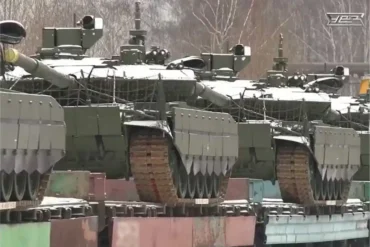
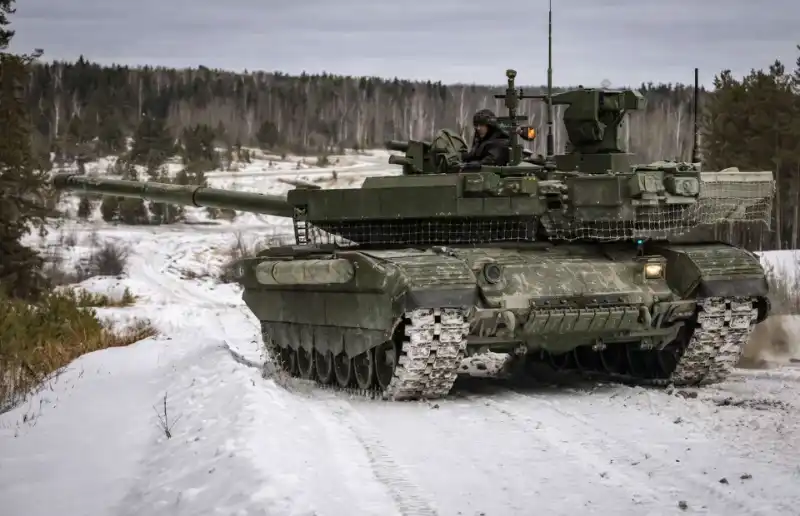
The platforms most often associated with these evolving tactics are Russia’s modernized main battle tanks, particularly the T-90M Proryv, T-80BVM, and T-72B3M. These vehicles retain the familiar 125 mm smoothbore main gun, allowing them to fire a wide range of ammunition suited for both anti-armor engagements and infantry support. High-explosive fragmentation rounds remain vital for destroying field fortifications and suppressing troops, while armor-piercing rounds and gun-launched guided missiles provide reach against enemy vehicles.
The T-90M, in particular, is frequently highlighted due to its improved fire-control systems, thermal sights, and remotely operated heavy machine gun. These features support the hit-and-run nature of paired maneuvers, enabling accurate fire during brief exposure windows. Stabilization improvements allow crews to fire effectively even during short halts, further reducing the time spent stationary.
Countering FPV Drones and Top-Attack Threats
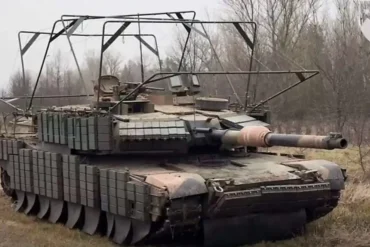
One of the most visible changes to Russian tanks in Ukraine is the proliferation of improvised and semi-standardized protective measures against FPV drones. Anti-FPV nets, slat armor extensions, and reinforced coverings around engine decks and turret roofs are now common sights. These additions are not intended to make tanks invulnerable but to disrupt the most common attack profiles seen in drone footage, particularly top-down strikes targeting thin armor zones.
Rostec has acknowledged that many of these modifications are driven directly by frontline feedback. Uralvagonzavod, the primary tank manufacturer, has described iterative upgrades based on observed damage patterns, focusing on rear arcs and roof protection where FPV drones often achieve catastrophic kills. Combined with electronic warfare equipment designed to interfere with drone control links, these measures aim to increase the odds that a tank survives an initial attack long enough to withdraw.
However, protection alone is not the solution. The paired maneuver tactic assumes that no armor package can fully counter the density of drones present. Survival depends on denying attackers the time and precision needed to exploit vulnerabilities. Every second a tank avoids being tracked is a second it cannot be effectively targeted.
Tactical Tradeoffs and Operational Risks
While the new approach offers clear advantages, it introduces its own risks. Dependence on drones creates vulnerabilities to electronic warfare, jamming, and counter-UAV fires. If the aerial feed is disrupted, tank crews lose their primary source of situational awareness, potentially leaving them blind in terrain already saturated with threats. Maintaining reliable communications between tanks, UAV operators, and supporting units becomes a critical requirement rather than a convenience.
There is also the challenge of coordination under fire. Paired maneuvers demand disciplined crews, precise timing, and trust in drone operators. A mistimed advance or delayed withdrawal can expose the forward tank to concentrated attacks. Training and experience therefore play an outsized role in determining whether the tactic succeeds or fails in practice.
Despite these challenges, Russian official messaging suggests confidence that the benefits outweigh the risks. By presenting tanks as agile, networked platforms rather than blunt instruments, the narrative seeks to demonstrate that armor can still shape the battlefield even when skies are crowded with hostile drones.
Implications for the Future of Armored Warfare
The evolution of Russian tank tactics in Ukraine reflects a broader transformation in ground combat. The age of armored columns advancing without persistent aerial oversight is effectively over. Any future force that expects tanks to survive must integrate them tightly with drones, electronic warfare, and rapid command-and-control systems. Heavy armor remains relevant, but only when paired with information dominance and disciplined movement.
This shift does not signal the end of the tank; instead, it marks a recalibration of its role. Tanks are becoming precision tools within combined-arms frameworks, delivering concentrated fire at critical moments rather than acting as ever-present spearheads. The paired maneuver near Sladkoye is one manifestation of this trend, shaped by the unforgiving realities of Ukraine’s drone-saturated front.
As the conflict continues, both sides are likely to refine similar concepts, experimenting with new ways to compress engagement timelines and outpace the enemy’s sensor network. What emerges from Ukraine is not a single winning tactic but a clear lesson: on a transparent battlefield, survival belongs to those who move fast, share information instantly, and vanish before the drones can close the loop.