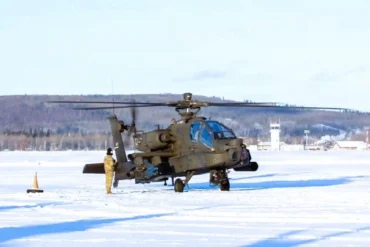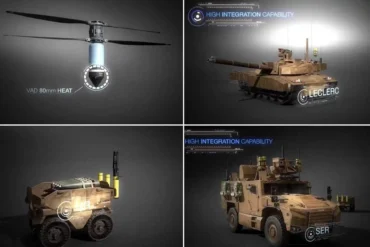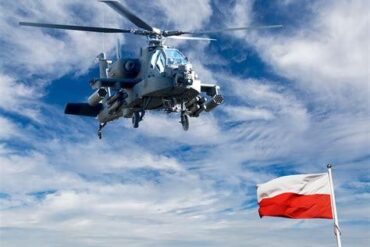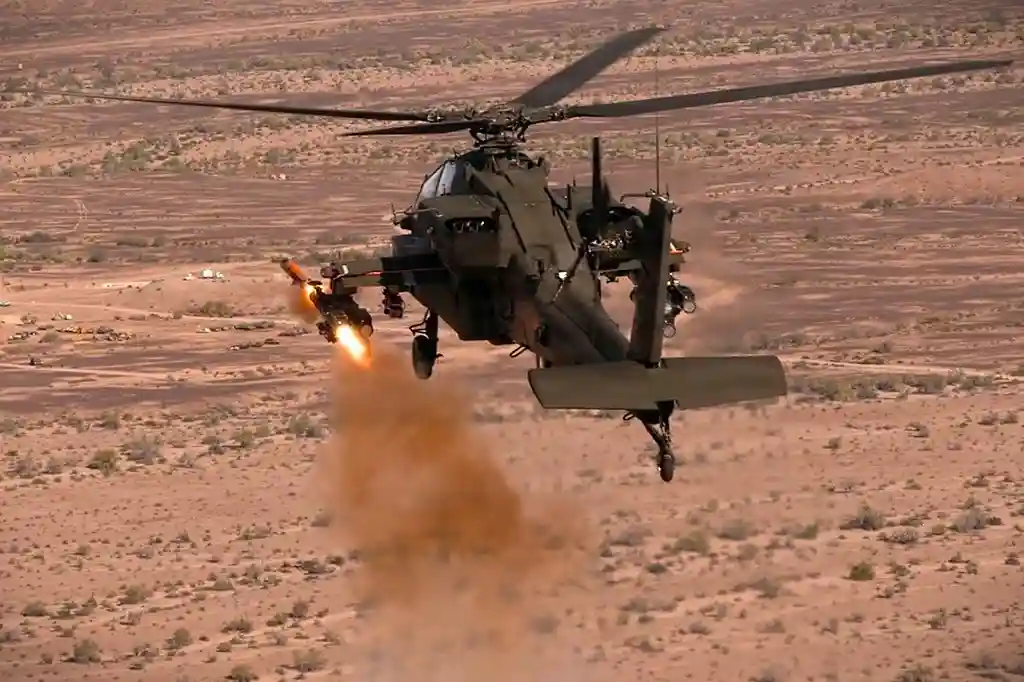
The battlefield is undergoing a decisive transformation, and the U.S. Army is accelerating that shift by redefining the combat role of one of its most iconic platforms—the AH-64 Apache attack helicopter. In a recent high-visibility test at Yuma Proving Ground, the Army demonstrated how crewed aviation can seamlessly integrate with uncrewed systems to extend sensing, targeting, and operational reach far beyond traditional limits. This evolution is not incremental; it represents a fundamental restructuring of how air-ground warfare is conducted in contested environments.
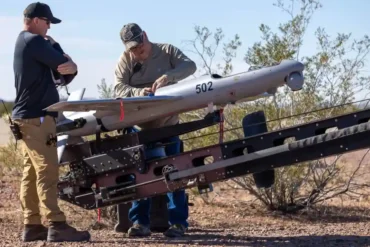
At the center of this development is the launch of the Altius 700, a medium-range launched effect drone, directly from an Apache helicopter. Conducted as part of the Cross Domain Fires Concept Focused Warfighting Experiment 26, the test underscores the Army’s commitment to building a networked, multi-domain combat architecture. This architecture integrates aviation, artillery, electronic warfare, and autonomous systems into a single, synchronized force capable of overwhelming modern threats.
Apache Helicopter Evolves into a Networked Combat Node
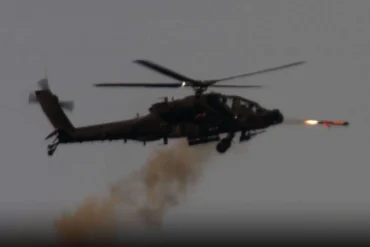
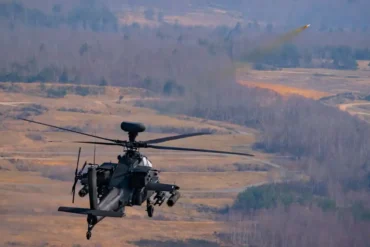
For decades, the Boeing AH-64 Apache has been synonymous with close combat attack, deep strike missions, and armed reconnaissance. However, modern warfare—characterized by layered air defenses, long-range precision fires, and electronic warfare saturation—demands more than firepower alone. Survivability and information dominance have become equally critical.
The recent test signals a major doctrinal shift: the Apache is no longer just a weapons platform. It is becoming a forward-deployed launch node for autonomous systems, capable of projecting sensing and targeting capabilities far beyond its onboard sensors. By deploying the Altius 700, the helicopter effectively extends its “eyes and ears” deep into contested territory without exposing itself to direct threats.
This transformation allows commanders to push decision-making advantage forward while keeping human crews at safer stand-off distances. Instead of flying into danger to identify targets, the Apache can now deploy drones to perform initial contact, reconnaissance, and even electronic warfare tasks.
Altius 700: The Backbone of Extended Sensing Operations
The Altius 700 represents a significant leap in autonomous aerial capability. Developed with modularity and endurance in mind, the system is designed to perform a wide range of missions critical to modern warfare.
Unlike smaller tactical drones, the Altius 700 offers:
- Extended operational range, reportedly reaching up to 460 kilometers
- Endurance of approximately 4–5 hours, enabling persistent surveillance
- Enhanced payload capacity, significantly greater than earlier variants like the Altius 600
- Multi-mission adaptability, including ISR (Intelligence, Surveillance, Reconnaissance), SIGINT, and electronic warfare
These capabilities allow it to function not just as a sensor, but as a force multiplier within a distributed network. Once launched, it can relay real-time data, identify targets, jam enemy communications, or act as a communications bridge between dispersed units.
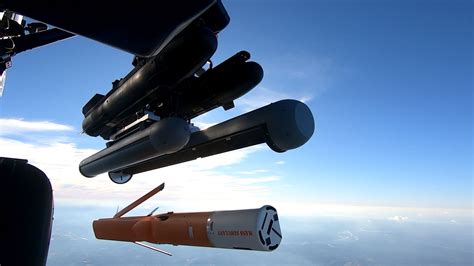
The integration of such a system into Apache operations effectively turns each helicopter into a mobile command-and-control extension, capable of influencing battlespace dynamics well beyond line-of-sight.
Realistic Combat Testing: From Hover to Forward Motion Launch
A key detail that elevates this test beyond a simple demonstration is the variety of launch profiles successfully executed. The U.S. Army confirmed that the Altius 700 was deployed both from a stationary hover and while the Apache was in forward motion.
This distinction is operationally critical. Hover launches validate safety and mechanical reliability, but in-motion launches simulate real combat conditions, where helicopters must maneuver dynamically under threat. Deploying drones during ingress, evasive maneuvers, or terrain masking scenarios ensures that the system is viable in high-intensity, contested environments.
The success of these profiles indicates that the Army is not merely testing hardware—it is refining the tactics, techniques, and procedures (TTPs) required to integrate launched effects into live combat missions. This level of maturity suggests the capability is moving rapidly toward operational deployment.
Cross-Domain Fires: The Future of Integrated Warfare
The experiment itself, conducted across multiple locations including White Sands Missile Range and Fort Sill, reflects a broader strategic vision: Cross-Domain Fires. This concept emphasizes the seamless integration of capabilities across land, air, cyber, and electromagnetic domains.
Rather than operating in isolated silos, modern forces are being structured as interconnected systems of systems. In this framework, the Apache and its launched drones become part of a larger sensor-to-shooter network, where data flows rapidly between platforms to enable faster and more precise engagements.
This approach allows the Army to compress the kill chain, reducing the time between target detection and engagement. It also enhances resilience, as distributed systems are inherently harder to disrupt than centralized ones.
Reducing Risk While Expanding Reach
One of the most profound implications of this capability is its impact on risk management in combat operations. Traditionally, gaining situational awareness required sending crewed platforms into potentially hostile airspace. With launched effects, that paradigm changes.
The Apache can now remain outside high-threat zones, deploying drones to:
- Conduct forward reconnaissance
- Identify and track targets
- Relay targeting data to artillery or other strike assets
- Perform electronic warfare tasks without exposing the helicopter
This shift significantly reduces the likelihood of first-contact losses, a critical factor in conflicts against near-peer adversaries equipped with advanced air defense systems.
Yuma Proving Ground: A Strategic Testing Environment
The choice of Yuma Proving Ground is no coincidence. The facility offers a unique combination of stable atmospheric conditions, controlled electromagnetic spectrum, and extensive instrumentation, making it ideal for testing complex, networked systems.
These conditions allow engineers and operators to replicate realistic combat scenarios while maintaining precise control over variables. As a result, systems like the Altius 700 can be evaluated not just for performance, but for interoperability within a broader combat ecosystem.
The range plays a critical role in bridging the gap between concept development and battlefield readiness, ensuring that new capabilities are thoroughly validated before deployment.
From Concept to Capability: The Army’s Development Trajectory
The Apache-launched Altius 700 test is part of a broader, carefully structured development pathway. Earlier milestones include:
- A 2023 demonstration validating launch, flight, landing, and recovery
- 2024 flight tests of the Launched Effects-Medium Range prototype system
These steps collectively indicate a deliberate progression from experimental validation to operational integration. The Army is not experimenting in isolation—it is building a scalable capability that will be embedded across formations.
This continuity suggests that launched effects will soon become a standard component of U.S. Army aviation units, rather than a niche or experimental tool.
Strategic Implications for Future Warfare
The integration of launched effects into Apache operations signals a broader transformation in military doctrine. Future conflicts—especially against technologically advanced adversaries—will be defined by information superiority, distributed operations, and rapid decision-making.
By combining crewed helicopters with autonomous systems, the Army is creating a force that is:
- More survivable, due to reduced exposure
- More flexible, with multi-mission drone capabilities
- More lethal, through faster and more accurate targeting
- More resilient, thanks to distributed network architecture
This evolution aligns with the broader trend toward manned-unmanned teaming (MUM-T), where human operators and autonomous systems collaborate to achieve superior outcomes.
A New Era for Apache and Air-Ground Combat
The successful deployment of the Altius 700 from an Apache helicopter marks a pivotal moment in the evolution of air-ground combat operations. What was once a platform defined by firepower is now becoming a central node in a distributed combat network, capable of sensing, deciding, and influencing the battlefield at unprecedented distances.
This is not merely an upgrade—it is a redefinition of battlefield roles. The Apache is transitioning from a frontline attacker to a multi-domain enabler, orchestrating effects across a complex and contested battlespace.
As the U.S. Army prepares for the realities of future conflict, this capability offers a clear advantage: the ability to see first, decide faster, and strike with precision—without unnecessary risk.