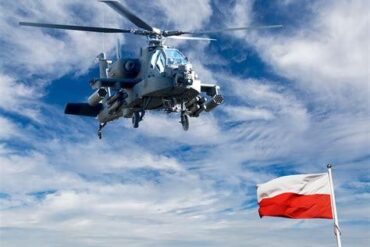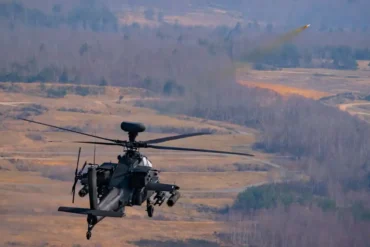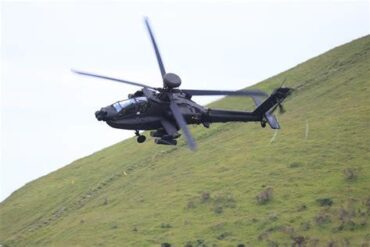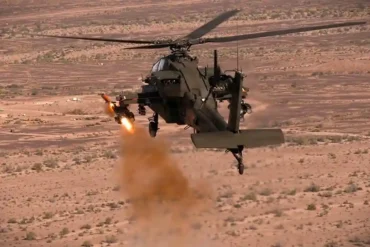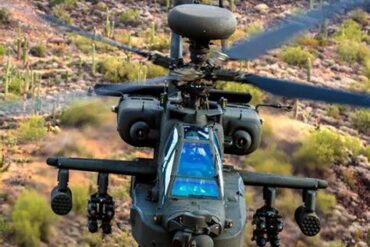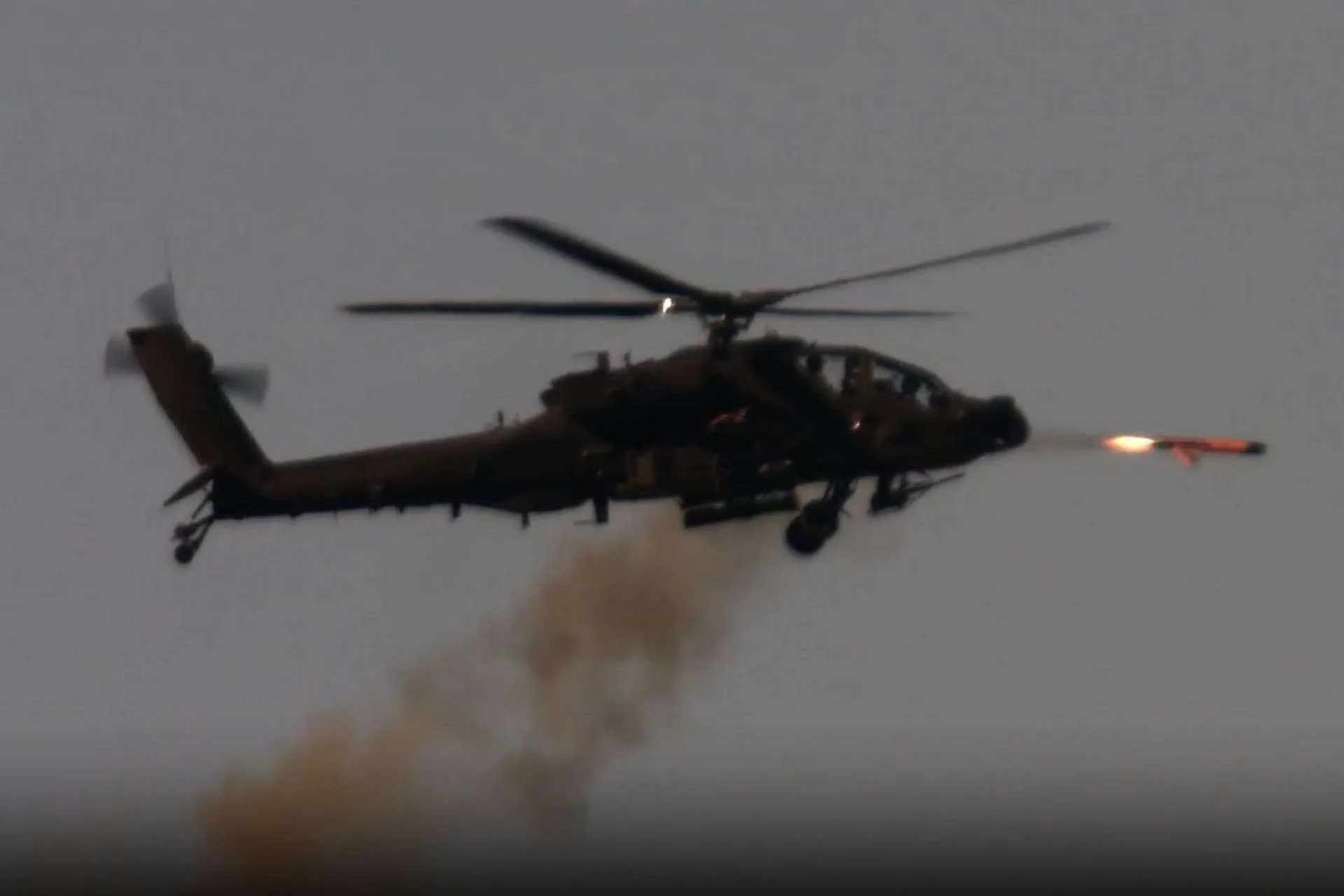
The battlefield is changing at a pace that makes even seasoned military planners raise an eyebrow. Air defenses are becoming denser, drones are multiplying like digital insects, and the traditional model of flying directly into contested airspace is steadily losing its appeal. Against this backdrop, the U.S. Army has demonstrated a significant new capability by launching an Air-Launched Effect (ALE) drone from an AH-64E Apache attack helicopter during the Cross Domain Fires 26 (CFWE 26) warfighting experiment at Yuma Proving Ground, Arizona.
This milestone represents more than a simple drone launch. It reflects a broader shift in how the Army intends to deploy its most iconic attack helicopter in the modern era. By enabling the Apache to release uncrewed systems capable of reconnaissance, communications relay, decoy operations, or even lethal strikes, the platform effectively extends its reach far beyond the helicopter’s physical presence in the sky.
The experiment demonstrated how deployable drone systems can dramatically expand the Apache’s sensing and strike range while reducing the aircraft’s exposure to increasingly lethal integrated air-defense networks. In practical terms, the helicopter no longer needs to fly directly into hostile territory to detect threats or designate targets. Instead, it can deploy small autonomous systems that venture ahead into the contested environment.
The implications stretch across modern military doctrine. Manned-unmanned teaming, once a futuristic concept discussed in defense think tanks, is quickly becoming an operational reality for frontline aviation units.
Air-Launched Effects: A New Layer of Battlefield Capability
The term Air-Launched Effects describes a family of modular systems designed to deliver a variety of battlefield functions once released from an aircraft or ground launcher. Rather than representing a single drone model, the concept includes an ecosystem composed of an air vehicle, mission software, payload modules, and support equipment.
For Apache crews, this translates into a compact drone launched from tubes or rails attached to the helicopter. Once deployed, the drone can perform several mission profiles simultaneously or sequentially depending on its payload configuration.
These capabilities include:
- Extended reconnaissance and surveillance
- Target identification and confirmation
- Communications relay for troops in difficult terrain
- Electronic warfare or decoy operations
- Delivery of lethal loitering munitions
The operational logic behind this concept is elegantly simple. Instead of the helicopter being the first detectable asset on the battlefield, a small expendable drone becomes the forward scout. If an enemy radar locks onto something, it may detect the drone rather than the aircraft that launched it.
That shift changes the geometry of air combat. The Apache becomes a command node controlling expendable assets rather than a single vulnerable platform attempting to do everything alone.
The Apache’s Evolution in the Age of Integrated Air Defenses
For more than three decades, the AH-64 Apache has been one of the most formidable attack helicopters ever built. Its lethal reputation stems from a combination of AGM-114 Hellfire missiles, a powerful 30-millimeter chain gun, and advanced targeting sensors mounted above the rotor system.
The helicopter’s mast-mounted sensor allowed crews to detect targets while hiding behind terrain, a tactic known as masking. This gave the Apache a critical advantage during conflicts ranging from the Gulf War to operations in Afghanistan and Iraq.
However, modern battlefields present a far more complicated challenge. Adversaries now deploy layered air-defense networks, combining radar-guided missiles, infrared tracking systems, and electronic warfare capabilities. These systems can detect and engage aircraft at longer ranges and with far greater precision than earlier generations.
Launching drones from the Apache fundamentally changes how the aircraft approaches these threats. Instead of creeping closer to the battlefield to find targets, the helicopter can remain at a safer standoff distance while its deployed drones perform reconnaissance and targeting.
The aircraft essentially becomes a mobile launch platform and command center, orchestrating multiple unmanned systems simultaneously.
Possible Drone Platforms Behind the Demonstration
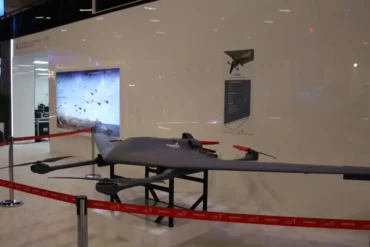
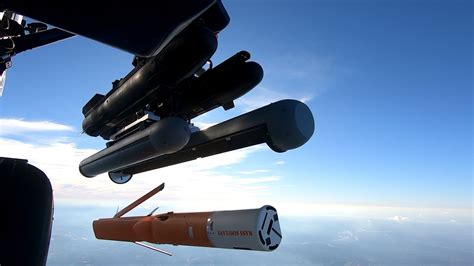
Although the U.S. Army has not publicly confirmed the exact drone used in the CFWE 26 experiment, analysts believe the system may belong to the ALTIUS family of launched drones, developed for multi-domain operations.
One frequently discussed candidate is the ALTIUS-700, a modular drone designed for launch from both ground and airborne platforms. The aircraft is small enough to be carried in tubes yet capable of impressive operational endurance.
Depending on its configuration, the drone can remain airborne for up to five hours, carrying sensors, communications equipment, or electronic warfare payloads. Some variants have also been developed as loitering munitions, meaning they can circle a target area and strike when an opportunity appears.
In practical battlefield terms, this allows Apache crews to deploy a swarm of drones performing different roles simultaneously. One drone may scan the terrain with electro-optical sensors while another relays communications between ground forces operating in mountainous terrain.
Meanwhile, a third drone could act as a decoy, intentionally revealing itself to enemy radar systems to expose the location of hidden air-defense units.
Loitering Munitions and the Future of Apache Firepower
Perhaps the most intriguing possibility in the launched-effects concept is the integration of loitering munitions—essentially drones designed to function as precision weapons.
These systems blur the line between missile and aircraft. After launch, they can patrol an area for extended periods, waiting for a high-value target to appear. Once the target is identified, the drone dives toward it and detonates.
Demonstrations of similar systems suggest ranges approaching 100 miles, with flight durations of roughly 75 minutes depending on payload weight and environmental conditions.
For the Apache, this capability represents a major shift in combat tactics. Instead of firing a missile immediately after detecting a target, the helicopter could launch a loitering munition and allow it to search autonomously for the most valuable target within a designated zone.
Such flexibility is particularly valuable in complex environments where enemy vehicles or radar systems may appear only briefly before relocating.
AH-64E Version 6.5 and the Technology Behind the Integration
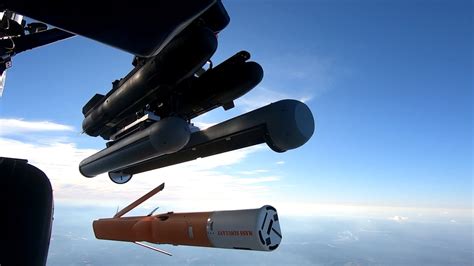
The successful drone launch during CFWE 26 aligns closely with the ongoing modernization of the Apache fleet through the AH-64E Version 6.5 upgrade program.
Modern combat aircraft increasingly rely on sophisticated digital architectures capable of integrating new systems rapidly. The V6.5 upgrade introduces improvements designed to support exactly this kind of capability expansion.
Key improvements include enhanced data connectivity and open-architecture software, allowing new sensors and mission applications to be integrated more easily. These upgrades ensure the helicopter can communicate seamlessly with both drones and broader battlefield networks.
Another major addition is the Active Parallel Actuation System, a flight-control enhancement designed to reduce pilot workload. When a helicopter crew must simultaneously fly the aircraft, manage sensors, coordinate with ground units, and control multiple drones, workload can quickly become overwhelming.
By automating some aspects of flight control and stabilization, the system allows pilots to focus on mission management rather than constant manual adjustments.
In essence, the Apache cockpit is evolving into a multi-domain command interface, enabling crews to coordinate a network of unmanned assets while maintaining situational awareness in a complex battlespace.
CFWE 26 and the Cross-Domain Battlefield
The Concept Focused Warfighting Experiment 26 is designed to explore exactly these types of multi-domain operational concepts. Rather than focusing on a single branch of the military, the exercise connects experiments across aviation, missile forces, and command-and-control networks.
The event links multiple test sites including:
- Yuma Proving Ground, Arizona
- White Sands Missile Range, New Mexico
- Fort Sill, Oklahoma
By synchronizing experiments across these locations, the Army can test how sensors, aircraft, artillery units, and digital command networks interact in real time.
Within this framework, the Apache’s launched drone becomes more than just an aviation tool. It acts as a sensor node feeding data into a larger kill web, where information collected by one platform can immediately guide weapons fired by another.
If a drone launched from an Apache detects a target, the information could potentially be passed to artillery units, missile batteries, or other aircraft in seconds.
That kind of connectivity transforms individual platforms into components of a much larger combat network.
Modernization Strategy After the Future Attack Reconnaissance Aircraft Cancellation
The demonstration also highlights a broader shift in U.S. Army aviation strategy following the cancellation of the Future Attack Reconnaissance Aircraft (FARA) program.
Rather than investing solely in an entirely new helicopter platform, the Army has increasingly emphasized incremental upgrades and unmanned system integration across existing aircraft fleets.
Air-Launched Effects represent one of the fastest and most flexible ways to extend reconnaissance and strike capabilities without developing a completely new manned aircraft.
Procurement planning reflects this growing priority. A U.S. government notice for the Medium Range Launched Effects program outlines a potential prototype award scheduled for October 2026, with deliveries projected between 2027 and 2031.
Funding estimates place the program in the range of $100 million to $200 million, indicating a moderate but strategically important investment in this emerging technology.
Keeping the Apache Relevant for Decades to Come
Despite its Cold War origins, the Apache remains one of the most heavily deployed attack helicopters in the world. The U.S. Army continues to rely on the platform for training, combat readiness, and public demonstrations.
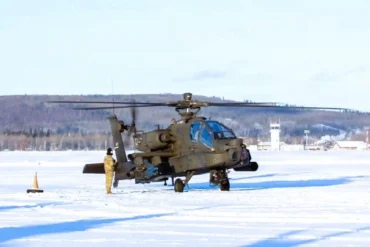
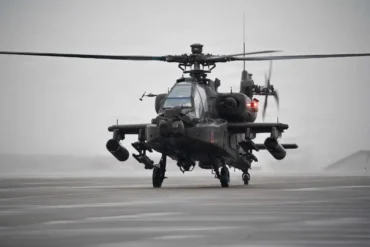
Just days before the CFWE 26 test, AH-64 Apaches from the 1st Cavalry Division stopped at Sugar Land Regional Airport in Texas while traveling to support a flyover during the Houston Livestock Show and Rodeo Armed Forces Appreciation Day.
Moments like this highlight a unique challenge facing military modernization efforts. The Apache fleet cannot be withdrawn from service for years while new technologies are developed. Instead, upgrades must be integrated into aircraft that remain continuously active.
Air-Launched Effects provide a relatively rapid pathway to modernization because they expand capabilities without fundamentally redesigning the aircraft itself.
The successful launch during CFWE 26 therefore marks more than a technical milestone. It signals a doctrinal evolution in how the Apache will operate in future conflicts.
Rather than charging directly into contested airspace, the helicopter may increasingly act as a controller of distributed autonomous systems, projecting power through networks of expendable drones.
If fully implemented across the fleet, this approach could allow the Apache to remain a central component of U.S. Army aviation well into the coming decades—adapted not just to survive the modern battlefield, but to shape it.