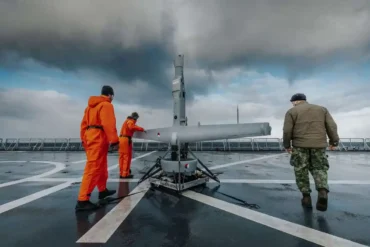
The U.S. Marine Corps has taken a decisive step toward redefining expeditionary reconnaissance by integrating the V-BAT vertical takeoff unmanned aircraft system into routine amphibious operations across the Pacific. Conducted aboard USS Portland (LPD 27) as part of the Boxer Amphibious Ready Group, the deployment marks a shift from experimental drone use toward normalized, shipboard employment in support of real-world maritime and littoral missions. For Marine commanders operating across vast distances and increasingly contested environments, the move signals a practical answer to the growing demand for persistent intelligence without overburdening manned aviation assets.
Operating in the U.S. 3rd Fleet area of responsibility, Marines with the 11th Marine Expeditionary Unit (MEU) have demonstrated the ability to launch, recover, and task the V-BAT as part of daily shipboard rhythms. This matters because amphibious forces are no longer preparing for permissive landings supported by uncontested airspace. Instead, they are training for dispersed operations where early detection, rapid targeting, and information dominance can determine whether a force survives long enough to maneuver.
The Pacific theater imposes unforgiving realities. Distances are immense, potential adversaries possess layered surveillance and long-range strike systems, and flight decks aboard amphibious ships are among the most crowded operational spaces in the U.S. Navy. Within those constraints, the Marines’ adoption of a compact vertical takeoff drone reflects a broader recalibration of how sensing, decision-making, and force protection are achieved at sea.
Amphibious Operations Demand Persistent Eyes Beyond the Horizon
Amphibious ready groups are built to be agile, but agility without awareness is a liability. Traditional ISR platforms, including helicopters and fixed-wing aircraft, remain indispensable, yet they are limited by availability, crew fatigue, and vulnerability in contested environments. The V-BAT addresses a specific operational gap: delivering long-endurance surveillance from ships that cannot spare deck space or sortie cycles for continuous manned flights.
During recent Pacific operations, the V-BAT was integrated into standard MEU training evolutions rather than isolated demonstrations. That distinction is critical. By embedding the system into daily operations, Marines and Sailors refine deck procedures, command-and-control integration, and information flow under realistic conditions. The result is not just a new sensor, but a new habit of employment that aligns with distributed maritime operations.
The choice of USS Portland, a San Antonio-class amphibious transport dock, is equally telling. These ships serve as connective tissue between sea control and power projection, carrying Marines, aircraft, and landing craft while supporting command-and-control functions. Adding an organic, ship-launched ISR platform extends the ship’s sensing reach without altering its core mission profile.
V-BAT Design Tailored for Constrained Naval Environments
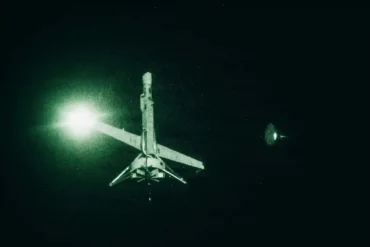
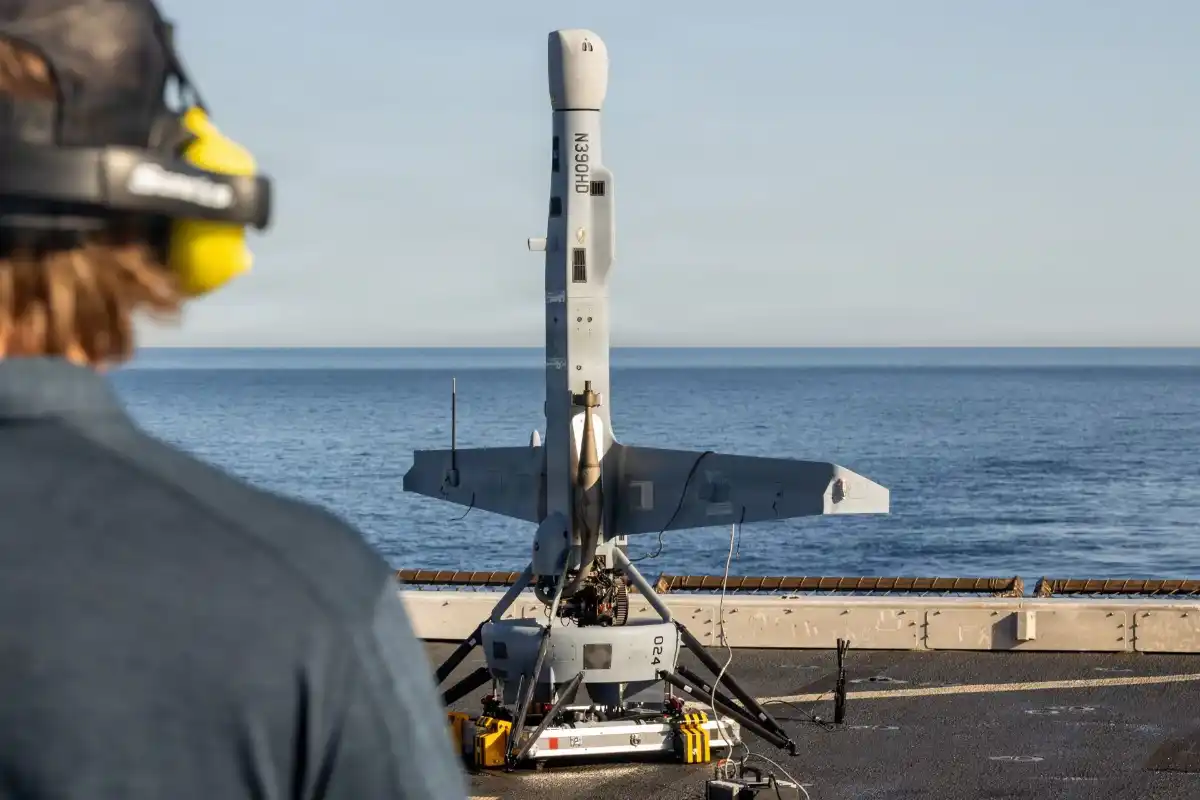
The V-BAT unmanned aerial system, developed by Shield AI in collaboration with Martin UAV, is defined by its distinctive ducted-fan VTOL architecture. This design allows the aircraft to lift vertically from a small deck footprint, transition smoothly into efficient fixed-wing flight, and return for vertical recovery without catapults, arresting gear, or specialized infrastructure.
In practical terms, the system can operate from an area as small as 6 by 6 meters, a decisive advantage aboard amphibious ships where every square meter is contested by helicopters, MV-22 Ospreys, and logistics movements. Measuring approximately 2.74 meters in length with a 2.96-meter wingspan, the V-BAT is compact enough for flexible stowage while still delivering performance far beyond that of short-range quadcopters.
The aircraft’s 288cc two-stroke electronic fuel injection engine supports both JP-8 heavy fuel and gasoline-oil mixes, aligning with naval logistics realities. Fuel flexibility may sound mundane, but in forward-deployed environments it translates directly into resilience. The ability to sustain operations without specialized fuel chains enhances the MEU’s endurance and reduces friction during prolonged deployments.
Endurance and Performance Built for Maritime ISR
Where the V-BAT distinguishes itself is endurance. With publicly stated capabilities of up to 10 hours of flight time at approximately 45 knots with a standard payload, the system provides persistent coverage that reshapes how commanders think about surveillance windows. A single launch can support extended monitoring of sea lanes, littoral approaches, or areas of interest ashore without repeated recoveries and relaunches.
Performance figures reinforce this role. The aircraft’s maximum dash speed of around 157 km/h and cruise speed near 98 km/h allow it to reposition efficiently while prioritizing time on station. This balance is essential for maritime ISR, where targets may be fleeting but patterns often reveal themselves only through sustained observation.
For the 11th MEU, endurance means fewer trade-offs. Helicopters can be preserved for assault support, logistics, or casualty evacuation while the V-BAT quietly maintains situational awareness. In a contested environment, that separation of roles enhances survivability and operational tempo.
Modular Payloads Expand Mission Flexibility
The V-BAT’s value extends beyond endurance through its modular payload architecture. Rated to carry payloads up to 11.3 kilograms, the system supports a range of sensors tailored to mission requirements. Standard electro-optical and infrared (EO/IR) payloads provide day-and-night imaging, enabling target identification, route reconnaissance, and force protection.
More advanced options significantly broaden the mission set. Synthetic aperture radar (SAR) enables wide-area surveillance and detection through clouds or adverse weather, a critical capability in the Pacific’s variable maritime climate. Hyperspectral sensors offer specialized mapping and analysis, while electronic warfare and signals intelligence (EW/SIGINT) payloads allow the aircraft to detect, classify, and potentially disrupt hostile emitters.
For amphibious forces, this flexibility transforms a single airframe into a multi-role asset. Instead of deploying separate platforms for reconnaissance, maritime domain awareness, and electronic support, commanders can tailor payloads to evolving threat conditions. That adaptability aligns with modern expeditionary doctrine, which emphasizes versatility over platform proliferation.
Simplified Control Enhances Shipboard Safety
Shipboard aviation is unforgiving, and complexity is the enemy of safety. The V-BAT is typically operated by a single operator using a Kutta Tech Ground Control Station, featuring a moving-map interface and point-and-click tasking. Autonomous flight modes manage vertical takeoff, transition, cruise, and recovery, reducing operator workload during the most demanding phases of flight.
Communications architecture includes a 2.4 GHz video downlink and 900 MHz spread-spectrum modems for command and control. This balance supports real-time situational awareness while maintaining robust links in maritime environments where electromagnetic conditions can shift rapidly.
Automation is not about removing humans from the loop, but about keeping them focused on decisions rather than mechanics. During recoveries on a moving deck, autonomous stabilization and precise vertical landing profiles reduce risk to personnel and equipment, a critical consideration during high-tempo operations.
Integrating ISR into the Amphibious Kill Chain
The operational significance of V-BAT integration lies in how it feeds information into the broader amphibious kill chain. Persistent ISR enables earlier detection of surface contacts, identification of potential threats, and more informed decision-making by Navy and Marine commanders. In scenarios where distributed forces must operate with minimal signatures, timely intelligence can mean the difference between maneuver and exposure.
The Pacific operating environment amplifies this requirement. As regional actors expand anti-access and area-denial architectures, amphibious forces must sense without revealing, observe without escalating, and prepare responses without relying solely on large, visible assets. A small, ship-launched UAV provides precisely that balance.
The presence of DOW contractors during recent operations reflects the realities of fielding new systems. Early integration phases often require specialized technical expertise to refine maintenance, deck procedures, and electromagnetic discipline. Over time, these lessons are absorbed into organic MEU skill sets, reducing reliance on external support while accelerating operational maturity.
Strategic Implications for Indo-Pacific Operations
The normalization of V-BAT operations aboard USS Portland signals more than a tactical enhancement. It reflects a strategic adaptation to an Indo-Pacific security environment defined by surveillance competition and information density. By embedding organic ISR at the amphibious task force level, the Marine Corps is strengthening its ability to operate inside contested spaces while preserving flexibility.
For allies and partners, this development offers a glimpse into future coalition operations where distributed, interoperable sensing platforms contribute to shared maritime awareness. For potential adversaries, it reinforces a clear message: U.S. expeditionary forces are evolving their reconnaissance and targeting methods to remain credible, resilient, and unpredictable.
As amphibious forces continue to balance presence, deterrence, and readiness across the Pacific, the V-BAT’s integration into routine operations underscores a simple truth. In modern maritime conflict, endurance, adaptability, and information superiority are as decisive as firepower. The Marines’ quiet addition of a compact vertical takeoff drone to their daily toolkit may prove to be one of the most consequential shifts in how amphibious warfare is practiced in the years ahead.