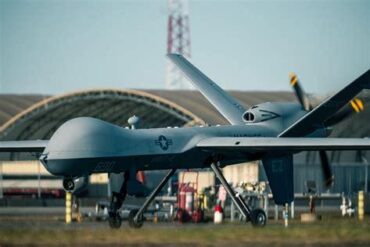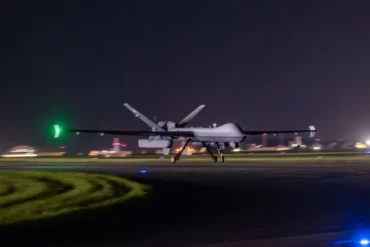
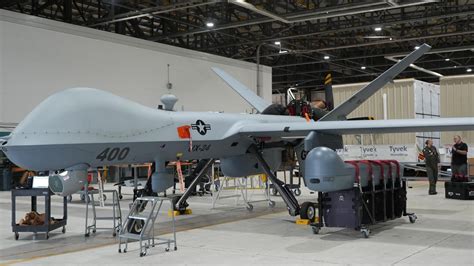
The U.S. Marine Corps has reached a pivotal milestone in its modernization of unmanned aerial capabilities with the upgraded MQ-9A Reaper, a platform that now integrates advanced electronic warfare and communication pods designed to extend reach and resilience in the vast and contested Indo-Pacific theater. The announcement came on August 12, 2025, when the Naval Air Systems Command (NAVAIR) confirmed the first successful flight of a Reaper equipped with the SkyTower II and RDESS/SOAR pods, marking an important step toward Initial Operational Capability (IOC) expected later this year.
The Flight Test and System Integration
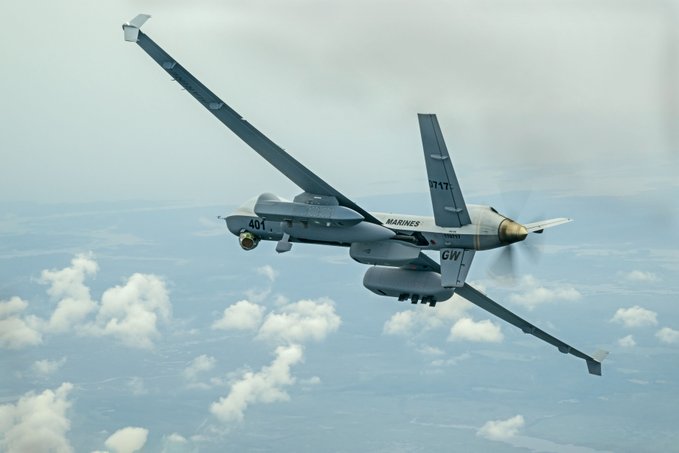
The test was conducted with Air Test and Evaluation Squadron (UX) 24, which has been spearheading the integration campaign since early 2025. In February, UX-24 confirmed the installation and power-on tests of the SkyTower II pod, and the August flight demonstrated full integration alongside the RDESS/SOAR pod. An official image released by NAVAIR showed the aircraft flying with the SkyTower II pod and an external fuel tank mounted under the left wing, the RDESS/SOAR pod under the right wing, and a third unidentified payload mounted on the centerline. While NAVAIR did not disclose the exact date of the test, the timing underscores the steady progression toward operational readiness.
SkyTower II: The Digital Quarterback
The SkyTower II pod, developed by GALT under NAVAIR’s middle-tier acquisition framework, transforms the MQ-9A into a vital airborne networking node. Acting as a “digital quarterback,” it enhances data-sharing, communications relay, and multi-domain connectivity across joint and allied forces. For the Marine Corps, this capability is essential to executing modern Intelligence, Surveillance, and Reconnaissance (ISR) concepts, where speed of information and secure communications determine mission success. The system is slated for operational deployment in 2026 with Marine Unmanned Aerial Vehicle Squadron (VMU) 3, based in Kaneohe Bay, Hawaii, reinforcing the unit’s role in reconnaissance and surveillance missions across the Pacific.
RDESS/SOAR: Expanding the Electronic Support Mission
The RDESS/SOAR pod, co-developed by General Atomics and L3Harris, expands the MQ-9’s mission set into electronic support and signals intelligence. Having already seen service on some U.S. Air Force MQ-9s since 2021, the system can detect, collect, and geolocate signals of interest at standoff ranges, providing vital early warning and situational awareness. According to Marine Corps Commandant General Eric M. Smith, the pod also possesses the ability to replicate and retransmit detected signals, creating tactical deception opportunities. While details remain classified for operational security, this functionality underscores the growing role of unmanned aircraft in electronic warfare and spectrum dominance.
MQ-9A Reaper Capabilities and Endurance
Derived from the Predator B and developed by General Atomics Aeronautical Systems, the MQ-9A Reaper is a turboprop-powered multi-mission unmanned aircraft capable of both ISR and strike operations. Powered by the Honeywell TPE331-10 engine, the aircraft offers:
- Endurance: Over 27 hours, extendable to 34 hours with the Extended Range (ER) configuration.
- Altitude: Operational ceiling up to 50,000 feet.
- Payload Capacity: 3,850 pounds, including 3,000 pounds on external hardpoints.
- Speed: Up to 240 knots.
The aircraft’s modular architecture allows integration of diverse payloads, from the MTS-B electro-optical/infrared system and Lynx multimode radar to SIGINT, maritime surveillance radars, and laser designators. This flexibility ensures that the MQ-9A can shift seamlessly from maritime domain awareness and network extension roles to precision strike and target acquisition missions.
Strategic Role in the Indo-Pacific
The Indo-Pacific theater presents unique operational challenges: vast distances, dispersed islands, and the presence of peer competitors employing advanced anti-access/area denial (A2/AD) systems. To counter these threats, the Marine Corps is integrating the upgraded MQ-9A into support of the Marine Littoral Regiment (MLR). The aircraft’s missions will include:
- ISR-T (Intelligence, Surveillance, Reconnaissance, and Targeting)
- Maritime Domain Awareness (MDA)
- Airborne Network Extension (ANE)
- Airborne Early Warning (AEW)
- Electronic Support (ES)
By combining long endurance, advanced sensors, and electronic support payloads, the MQ-9A strengthens the Marine Corps’ ability to operate inside contested zones while supporting distributed operations across expeditionary advanced base operations (EABO).
Operational History and Future Deployment
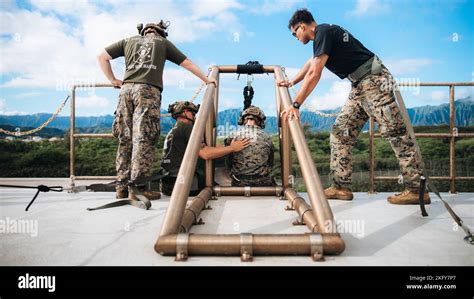
The MQ-9A had already proven its value when it achieved Initial Operational Capability with VMU-3 on August 2, 2023, demonstrating its role in maritime and coastal surveillance. The new integration with SkyTower II and RDESS/SOAR builds on that foundation, enabling the platform to serve as both a persistent surveillance tool and an electronic warfare asset. With the first operational deployment scheduled for 2026 in Hawaii, the Marine Corps will have a force multiplier capable of providing long-range ISR, electronic deception, and resilient communications across the Pacific.
NAVAIR emphasized that this first flight is more than a technical achievement—it represents the convergence of ISR, electronic warfare, and communications into a single platform. In the words of one NAVAIR program lead, the Reaper’s upgraded role bridges the gap between legacy ISR platforms and future unmanned systems, ensuring that the Marine Corps maintains its edge in contested environments.
A Step Toward Multidomain Superiority
The integration of SkyTower II and RDESS/SOAR reflects a broader Department of Defense strategy to modernize existing platforms rather than waiting for entirely new systems to arrive. By equipping the MQ-9A with cutting-edge networking and EW tools, the Marine Corps gains a near-term advantage in multidomain operations. As the 2026 deployment approaches, the Reaper will stand as a key enabler of joint force integration, bridging Navy, Marine Corps, and allied capabilities in the Indo-Pacific.
In a region where connectivity, persistence, and survivability define operational success, the upgraded MQ-9A Reaper ensures that the U.S. Marines are prepared not only to monitor the battlespace but also to shape it through electronic warfare and resilient command-and-control.