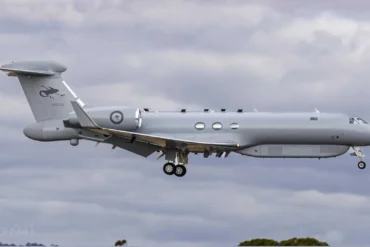
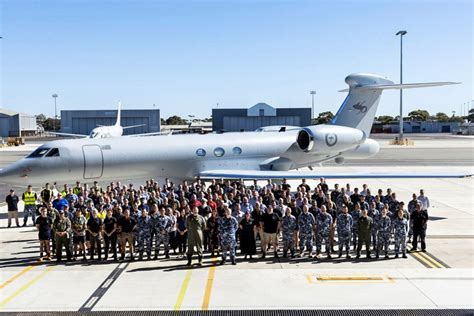
Australia has quietly crossed a strategic threshold. With the arrival of its first MC-55A Peregrine at RAAF Base Edinburgh in South Australia, the Royal Australian Air Force has inducted one of the most capable airborne electronic warfare and intelligence aircraft ever fielded in the region. This is not a ceremonial fleet addition. It is a decisive shift in how Australia senses, understands, and contests the electromagnetic battlespace across the Indo-Pacific.
The aircraft touched down on January 22 after a trans-Pacific delivery route that aviation watchers tracked in real time. The journey—spanning Davis-Monthan AFB, Hickam, Wake Island, and Andersen AFB in Guam—was symbolic. Each stop underscored the aircraft’s strategic alignment with allied infrastructure and its role in a wider coalition architecture. For Australia, the landing marked the transition of the MC-55A from concept to operational reality.
At its core, the Peregrine is about information dominance. In modern warfare, controlling airspace is no longer enough; controlling the electromagnetic spectrum is what decides who sees first, understands faster, and acts with precision. The MC-55A is designed to do exactly that—persistently, quietly, and at scale.
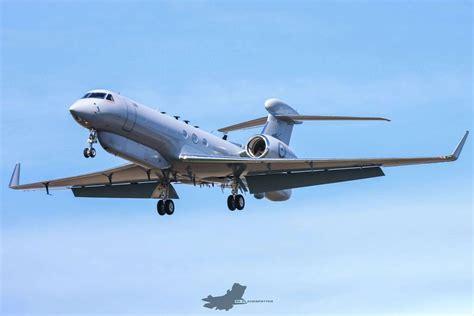
The MC-55A is a heavily modified Gulfstream G550, a business jet whose long endurance, high ceiling, and electrical power capacity make it an ideal platform for advanced mission systems. But the resemblance ends with the airframe. Everything else—sensors, antennas, processors, and communications—has been purpose-built to operate in contested environments where signals are denied, distorted, or deliberately deceptive.
From Business Jet to Strategic Intelligence Platform
The transformation of the G550 into the MC-55A represents a broader trend in modern airpower: leveraging high-performance commercial platforms to host military-grade electronic warfare systems. This approach delivers speed, altitude, and endurance without the cost and complexity of bespoke airframes. In the Peregrine’s case, it also delivers discretion. The aircraft can operate at 51,000 feet for up to 15 hours, surveying vast oceanic and littoral regions without drawing attention.
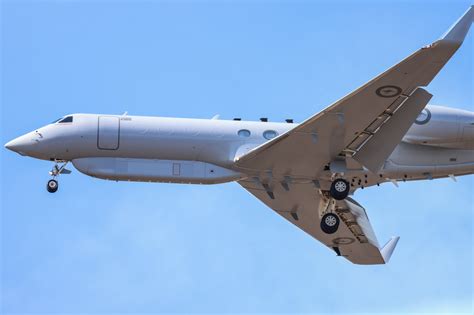
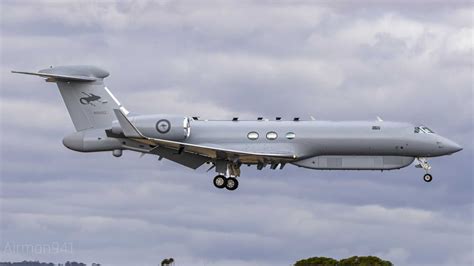
Visually, the MC-55A is unmistakable to trained eyes. Its fuselage is dense with antennas. A prominent ventral “canoe” fairing houses additional sensors, while a dorsal satellite communications array and a large satcom shroud atop the vertical stabilizer signal its role as a high-bandwidth data node. Beneath the tail, an electro-optical/infrared turret provides optical surveillance, particularly valuable over the expansive maritime approaches surrounding Australia.
Unlike the G550-based Conformal Airborne Early Warning (CAEW) variants used elsewhere, Australia’s MC-55A does not feature cheek-mounted radar arrays. Instead, its mission emphasis is electronic attack and intelligence collection. Open-source assessments suggest the aircraft integrates AESA-based systems optimized for long-range electronic attack, combined with highly sensitive receivers capable of detecting, classifying, and geolocating emissions across the spectrum.
This is not about radar alone. The Peregrine’s strength lies in its ability to fuse signals intelligence, electronic intelligence, and communications intelligence into a coherent operational picture—then distribute that picture in near real time to other platforms.
Project AIR 555 and a Billion-Dollar Capability Leap
The MC-55A program is the centerpiece of Project AIR 555, one of the Australian Defence Force’s most ambitious intelligence and electronic warfare initiatives. The program traces its origins to 2017, when the U.S. State Department approved Australia’s request to acquire up to five modified aircraft. In 2019, Canberra confirmed the purchase of four MC-55As, awarding a contract valued at over $1 billion to L3Harris.
That contract goes far beyond airframes. L3Harris is responsible for delivering an integrated mission system encompassing next-generation EW suites, advanced sensors, secure communications, and sophisticated onboard and ground-based data processing. The goal is not just collection, but rapid exploitation—turning raw signals into actionable intelligence at operational tempo.
The first aircraft’s arrival comes nearly four years after the Peregrine was first sighted rolling out of Gulfstream’s Savannah, Georgia facility in May 2022. The extended timeline reflects the complexity of integrating cutting-edge electronic warfare capabilities, much of which remains classified. What is publicly visible, however, suggests a platform designed to evolve, with modular systems and software-driven upgrades that will keep it relevant well into the 2030s.
What the MC-55A Actually Does in Combat Terms
Electronic warfare is often described in abstract language, but its effects are concrete. The MC-55A is designed to interfere with, deny, degrade, deceive, or exploit an adversary’s use of the electromagnetic spectrum. That includes radar systems, communications networks, datalinks, and navigation aids.
In peacetime, the Peregrine’s mission is persistent surveillance. It conducts electronic order-of-battle mapping, identifying what systems are operating, where they are located, and how they behave. This baseline knowledge is critical. In crisis or conflict, it allows commanders to detect deviations—new emitters, altered patterns, or attempts at deception.
In a contingency, the aircraft’s electronic attack capabilities come to the fore. By jamming or spoofing enemy sensors, the MC-55A can blind air defense networks, disrupt command chains, and create windows of opportunity for kinetic forces. Importantly, it does this without firing a shot, offering non-kinetic options that are politically and operationally flexible.
The Peregrine’s endurance and altitude mean it can operate well outside the reach of many threats while still influencing events hundreds of kilometers away. This standoff capability is particularly valuable in the Indo-Pacific, where distances are vast and forward basing options can be limited.
A Force Multiplier in Australia’s ISR Ecosystem
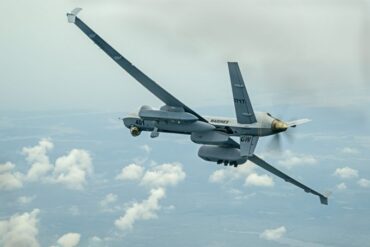
Australia already operates an impressive suite of intelligence and surveillance platforms, including the P-8A Poseidon, E-7A Wedgetail, AP-3C Orion, and the MQ-4C Triton unmanned system. The MC-55A does not replace any of them. It multiplies their effectiveness.
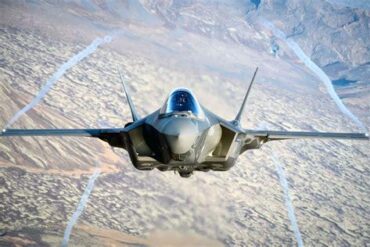
By acting as a high-altitude sensor and data relay, the Peregrine connects airborne, maritime, and ground assets into a single networked force. Real-time data from its sensors can be fed directly to F-35A Lightning II fighters, EA-18G Growlers, naval surface combatants, and ground commanders. This shortens the sensor-to-shooter timeline and enables multi-domain operations where actions in one domain are informed by effects in another.
Australian defence officials have described the MC-55A as a “critical enabler” for fifth-generation warfare. Its ability to fuse multiple inputs across the spectrum enhances situational awareness not just for Australia, but for its allies and partners. In coalition operations, that shared awareness is often the difference between coordination and confusion.
There is also strong speculation that the Peregrine will play a role in manned-unmanned teaming, particularly with Australia’s MQ-28 Ghost Bat collaborative combat aircraft. While unconfirmed, the concept is logical: a high-altitude intelligence node directing or supporting autonomous systems operating closer to contested zones.
Strategic Context: Why the Peregrine Matters Now
The timing of the MC-55A’s arrival is not accidental. The Indo-Pacific security environment has grown more contested, more congested, and more complex. China’s expanding military footprint, including increased naval activity and defense cooperation agreements in the South Pacific, has sharpened Canberra’s focus on situational awareness.
Incidents involving unsafe intercepts, live-fire exercises near Australia and New Zealand, and aggressive maneuvers in international waters have underscored the need for persistent, independent intelligence. Australia’s regular freedom-of-navigation operations and surveillance flights in the South China Sea require platforms that can operate confidently in contested electromagnetic environments.
The MC-55A provides exactly that. Its reach extends from the Indian Ocean to the Pacific, offering coverage over critical sea lines of communication and regional flashpoints. Even in the absence of conflict, the Peregrine strengthens deterrence by making adversary actions more visible and less deniable.
Beyond Hardware: Information as a Strategic Weapon
What ultimately sets the MC-55A Peregrine apart is not any single sensor or antenna, but its role in treating information itself as a weapon system. By collecting, processing, and disseminating data faster than an adversary can react, the aircraft shifts the balance before the first missile is ever launched.
In a hypothetical high-end conflict, the Peregrine’s ability to jam, deceive, and disrupt could neutralize enemy advantages without escalating immediately to kinetic exchanges. In lower-intensity scenarios, it provides policymakers with clarity, reducing the risk of miscalculation and surprise.
Australia’s investment in the MC-55A is therefore about more than regional monitoring. It is about ensuring that, in an era defined by contested information, Australia retains the ability to see clearly, decide quickly, and act decisively alongside its allies.
As additional MC-55As enter service and the fleet reaches full operational capability, the Peregrine will quietly become one of the most influential assets in the Royal Australian Air Force inventory. It will rarely be seen and almost never discussed in detail. Yet its presence will be felt across the spectrum—electromagnetic, strategic, and geopolitical.
In modern warfare, silence can be as powerful as firepower. With the MC-55A Peregrine, Australia has just acquired a master of that silence.