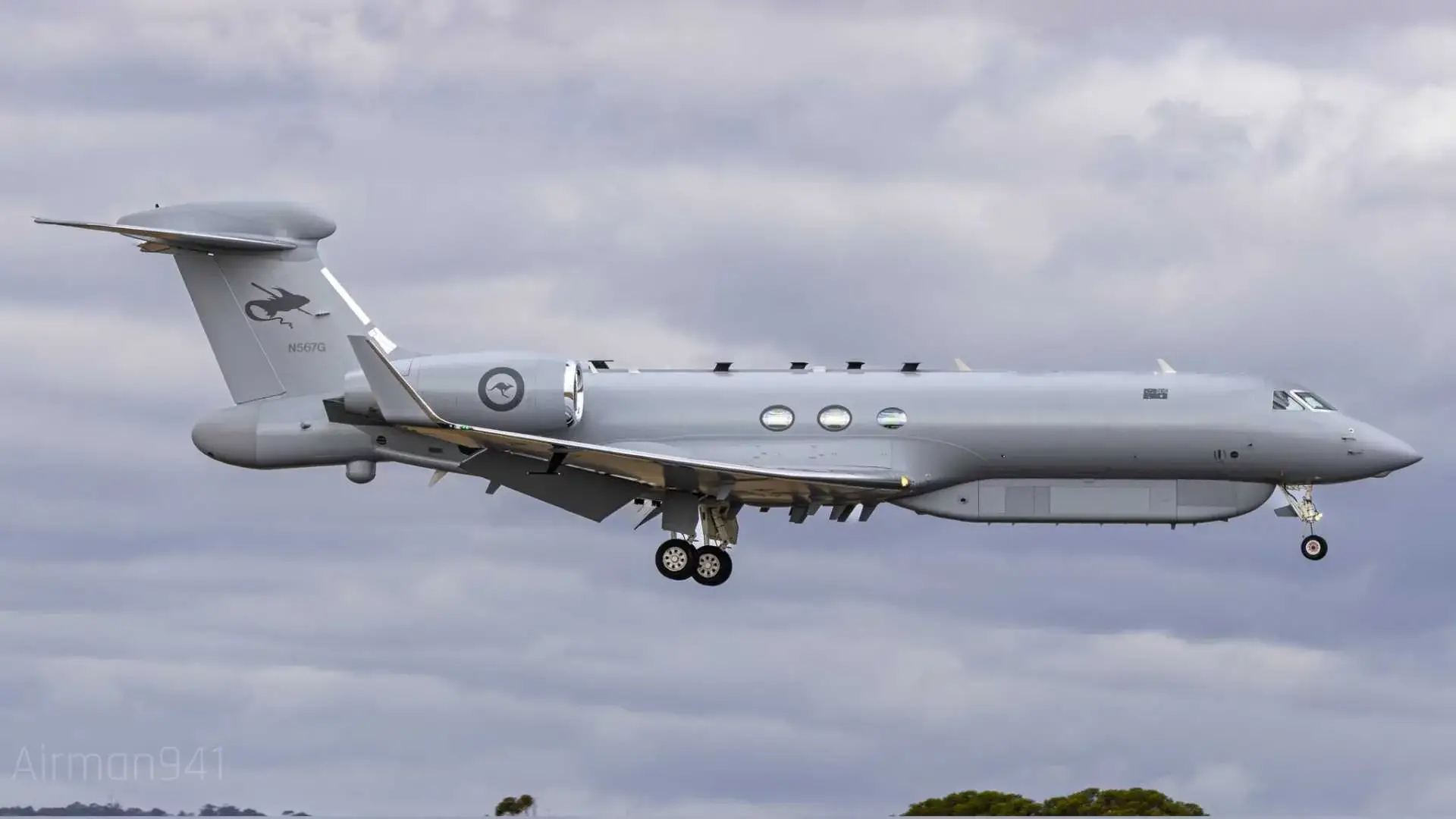
Australia has taken another significant step in strengthening its airborne intelligence capabilities with the arrival of its second MC-55A Peregrine intelligence, surveillance, reconnaissance, and electronic warfare (ISR/EW) aircraft. The aircraft landed at RAAF Base Edinburgh in South Australia on March 12, 2026, marking a critical milestone in the Royal Australian Air Force’s effort to expand its ability to monitor the electromagnetic environment across the vast Indo-Pacific region.
The MC-55A Peregrine represents a highly specialized intelligence platform designed to collect, analyze, and distribute signals intelligence (SIGINT) and electronic intelligence (ELINT) across enormous operational distances. Its arrival reflects Australia’s growing emphasis on networked, multi-domain intelligence operations, particularly as regional security dynamics continue to evolve.
The aircraft completed a multi-stage ferry flight that began in the United States, highlighting the global collaboration involved in the program. Departing Greenville Majors Airport in Texas on March 9, 2026, the Peregrine traveled across the Pacific with stops at Hickam Air Force Base in Hawaii and Andersen Air Force Base in Guam before completing its final leg to Australia. During the journey, the aircraft reportedly carried a six-person crew while operating under the callsign SAME55.
Australia Expands Its Dedicated Airborne Intelligence Fleet
The newly delivered aircraft is the second of four MC-55A Peregrine platforms planned under Project AIR 555 Phase 1, a program designed to provide Australia with a sovereign airborne intelligence capability. The first aircraft arrived earlier in the year, on January 22, 2026, and both will eventually operate with No. 10 Squadron of the Royal Australian Air Force.
This capability fills a critical gap left by the retirement of modified AP-3C Orion maritime patrol aircraft, which previously performed signals intelligence missions. While the Orions served the RAAF for decades, advances in electronic warfare, communications technology, and sensor systems demanded a far more capable platform.
The Peregrine fleet will therefore function as Australia’s primary airborne electronic intelligence asset, capable of operating at long distances and detecting signals from radar systems, communication networks, and electronic warfare equipment.
The Strategic Logic Behind Project AIR 555
Project AIR 555 emerged from a strategic recognition that control of the electromagnetic spectrum has become as decisive in modern warfare as control of the air or sea. Radar networks, encrypted communications, missile guidance systems, and electronic countermeasures all emit signals that can be detected, analyzed, and exploited by sophisticated intelligence platforms.
In June 2017, the United States Department of State approved the potential sale of modified Gulfstream G550 aircraft equipped with ISR and electronic warfare systems to Australia through the Foreign Military Sales (FMS) framework. The estimated value of the deal at that stage was approximately $1.3 billion.
Two years later, in March 2019, the Australian government formally confirmed the acquisition of four aircraft under a program valued at A$2.46 billion. That investment covers not only the aircraft themselves but also:
- Advanced mission system integration
- Ground intelligence processing infrastructure
- Training facilities and personnel preparation
- Long-term maintenance and sustainment support
The program is managed with the U.S. Air Force acting as acquisition and testing authority, while L3Harris Technologies serves as the primary contractor responsible for aircraft modification and mission system integration.
Transforming the Gulfstream G550 into an Intelligence Platform
At its core, the MC-55A Peregrine is based on the Gulfstream G550, a long-range business jet known for its reliability, endurance, and high-altitude performance. Yet the transformation from executive transport aircraft to intelligence platform is profound.
The base aircraft measures 29.4 meters in length, features a 28.5-meter wingspan, and has a maximum takeoff weight of 41,277 kilograms. Powered by two Rolls-Royce BR710 C4-11 turbofan engines, each producing approximately 15,385 pounds of thrust, the aircraft can cruise between Mach 0.80 and Mach 0.85.
These engines allow the Peregrine to reach an impressive service ceiling of 51,000 feet, well above most commercial air traffic and far beyond the range of many ground-based threats. Combined with a maximum range of roughly 12,500 kilometers, the aircraft can conduct surveillance missions lasting more than 15 hours.
Such endurance makes it ideal for monitoring vast maritime spaces across the Indian Ocean, South China Sea, and Western Pacific, where distances between operational bases are enormous.
Specialized Sensor Systems and Structural Modifications
Turning the G550 into the MC-55A Peregrine required extensive structural modifications to house the aircraft’s sophisticated sensor systems. The most visually distinctive feature is a large canoe-shaped fairing mounted beneath the fuselage, which contains arrays of electronic intelligence sensors and antennas designed to capture radio frequency emissions across a wide spectrum.
Additional antennas are distributed across the aircraft’s fuselage, wings, and dorsal surfaces, forming an integrated network capable of detecting signals from multiple directions simultaneously. At the rear of the aircraft, a bulbous tail cone houses further electronic sensors, while a satellite communications antenna mounted along the upper fuselage allows the aircraft to transmit collected intelligence in real time.
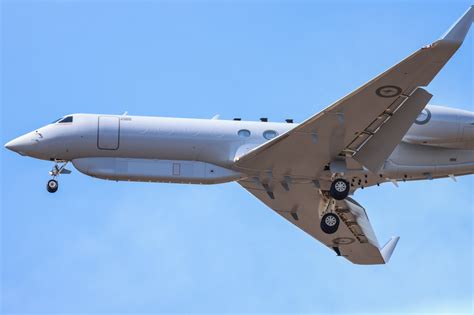
These modifications require major internal upgrades as well. High-powered sensors and processing systems demand enhanced electrical generation capacity, improved cooling systems, and advanced mission computing infrastructure capable of processing massive volumes of electronic data during flight.
The result is an aircraft that is outwardly similar to the Gulfstream G550 but internally resembles a flying intelligence laboratory.
Multi-Intelligence Collection Across the Electromagnetic Spectrum
The Peregrine’s core mission is to collect and analyze intelligence across the electromagnetic spectrum, which includes everything from long-range radar emissions to encrypted military communications.
Its onboard systems are designed to capture three key categories of intelligence:
- Signals Intelligence (SIGINT) – interception and analysis of electronic signals from military systems
- Electronic Intelligence (ELINT) – detection and identification of radar systems and electronic emitters
- Communications Intelligence (COMINT) – interception of voice and digital communications
Electronic support measures allow the aircraft to detect radar emissions, determine the type of radar system in operation, and estimate its location. Communications receivers can intercept transmissions across HF, VHF, and UHF frequency bands, enabling analysts to map communications networks and command structures.
Mission computers onboard the aircraft process this information during flight, generating geolocation data that identifies the origin of electronic signals. Analysts can then construct a detailed electronic order of battle, mapping radar coverage, communications nodes, and electronic warfare systems operating within a region.
A Key Node in Australia’s Networked ISR Architecture
Operationally, the MC-55A Peregrine is not designed to work alone. Instead, it functions as a sensor node within a broader intelligence and surveillance network that includes aircraft, naval vessels, satellites, and ground-based command systems.
The aircraft will operate from RAAF Base Edinburgh, which has become one of Australia’s most important intelligence hubs. The base already hosts several advanced surveillance platforms, including the Boeing P-8A Poseidon maritime patrol aircraft and the MQ-4C Triton high-altitude unmanned surveillance drone.
Working together, these platforms create a layered intelligence system capable of monitoring vast stretches of ocean and airspace. The Peregrine contributes unique capabilities by focusing specifically on electromagnetic signals and electronic emissions, information that cannot be captured by optical or radar sensors alone.
Integration with Allied Combat Systems
One of the aircraft’s most important roles is linking intelligence with operational combat systems. The MC-55A can transmit processed intelligence to other platforms through secure data links, enabling rapid responses to emerging threats.
For example, radar detection data gathered by the Peregrine can be transmitted to:
- F-35A Lightning II fighter aircraft
- E-7A Wedgetail airborne early warning aircraft
- EA-18G Growler electronic attack aircraft
This network allows allied forces to coordinate operations in real time. A radar site detected by the Peregrine could be jammed electronically by Growlers, monitored by Wedgetail command aircraft, or targeted by strike platforms if necessary.
The aircraft can also share intelligence with naval surface combatants and amphibious ships, supporting maritime operations across the Indo-Pacific.
Expanding Operational Reach Across the Indo-Pacific
Although the Peregrine fleet will be based primarily at RAAF Base Edinburgh, Australia has planned forward operating infrastructure that will allow the aircraft to deploy closer to operational areas.
Key locations include:
- RAAF Base Darwin in the Northern Territory
- RAAF Base Townsville in Queensland
- Cocos (Keeling) Islands in the eastern Indian Ocean
These locations provide strategic access to the Indian Ocean, Southeast Asia, and the Pacific, enabling the aircraft to monitor maritime approaches to Australia and key regional sea lanes.
Forward deployment capability significantly extends the aircraft’s reach, allowing surveillance missions to cover vast geographic areas without requiring extremely long transit flights.
Building a New Era of Electronic Intelligence Capability
The delivery of the second MC-55A Peregrine represents more than the addition of another aircraft to Australia’s inventory. It marks the gradual construction of a modern airborne intelligence ecosystem capable of supporting national and coalition operations across one of the world’s most strategically important regions.
With four aircraft planned for the fleet, each expected to receive Royal Australian Air Force serial numbers beginning with the A51 prefix, the Peregrine program will steadily expand the country’s ability to monitor electronic activity across thousands of kilometers of ocean and airspace.
As training programs advance and operational tactics evolve within No. 10 Squadron, the aircraft will increasingly integrate with Australia’s wider defense network and allied systems operated by partners such as the United States and the United Kingdom.
In an era when information dominance and electromagnetic awareness often determine the outcome of military operations, the MC-55A Peregrine gives Australia a powerful tool to observe, understand, and respond to the invisible signals that shape modern warfare.