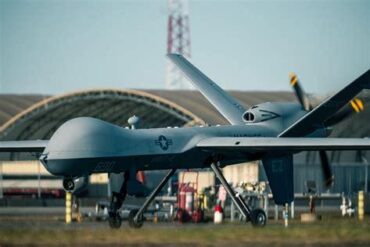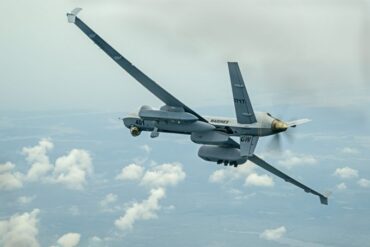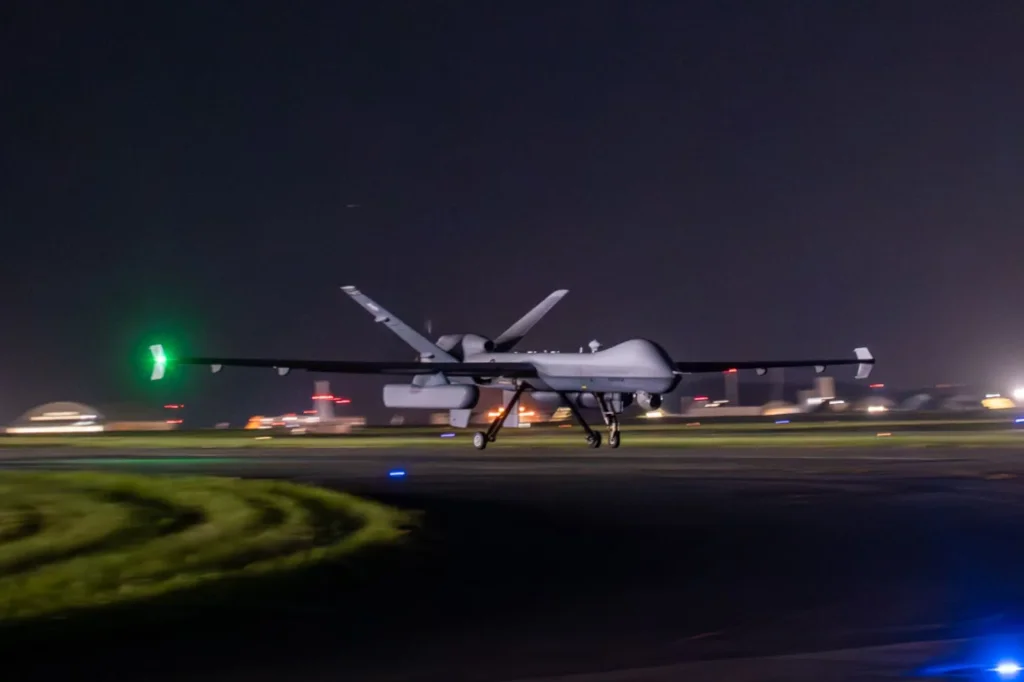
The recent MQ-9 Reaper launch and recovery from a shortened taxiway at Kadena Air Base, Japan marks a pivotal shift in how U.S. unmanned aviation can be deployed across the Indo-Pacific. The mission, executed by the 319th Expeditionary Reconnaissance Squadron under Project Lima BEAN, demonstrated that the Air Force’s premier Medium Altitude Long Endurance drone can operate effectively even when traditional runways are compromised or unavailable. This evolution aligns directly with the Air Force’s Agile Combat Employment strategy, enabling dispersed, unpredictable, and resilient operations in regions where infrastructure may be under threat.
The aircraft’s 8 October sortie proved the practicality of launching an MQ-9 from Taxiway Lima, a surface far shorter than conventional runways typically required by MALE-class platforms. Once airborne, the local crew passed control to remote operators in the continental United States via satellite link, showcasing the seamless integration of forward-based launch teams with stateside mission crews. This construct reduces forward presence, limits exposure to adversary strikes, and preserves high-value assets while retaining persistent ISR and precision-strike capability.
The test also validated the MQ-9’s ability to function within a constrained environment without sacrificing mission scope. With a 20-meter wingspan, a Honeywell TPE331-10 turboprop, and endurance exceeding 24 hours, the platform remains a cornerstone of the U.S. ISR and precision-engagement ecosystem. Its MTS-B multispectral targeting system, laser designator, EO/IR suite, and Ku-band satellite connectivity allow the Reaper to deliver intelligence and kinetic effects across thousands of miles.
Agile Combat Employment and the Rise of Dispersed Unmanned Operations
Agile Combat Employment (ACE) represents the Air Force’s move toward flexibility, survivability, and distributed lethality. Instead of concentrating fleets on a handful of large air bases, ACE distributes aircraft across a web of smaller hubs, temporary sites, or improvised airstrips. The MQ-9’s proven ability to use a shortened taxiway significantly expands potential launch points throughout the island chains, reducing predictability and complicating adversary targeting plans.
First Lieutenant Wesley Fulford, an MQ-9 pilot with the 319th ERS, has emphasized that the unit is deliberately employing “nonstandard procedures in the effort of building standard procedures.” This approach reflects the dual emphasis on experimentation and repeatable operational doctrine, enabling the Air Force to define how small teams can support MQ-9 operations far from major infrastructure.
The Kadena test highlights a future in which the MQ-9 can be launched from austere or damaged surfaces, refueled and rearmed rapidly by compact teams, and dispatched again on ISR or strike missions with minimal delay. These capabilities are increasingly vital in a theater where anti-access, area-denial (A2/AD) threats grow more sophisticated.
Operational Impact in the Indo-Pacific Theater
China’s expanding missile inventory, including ballistic and cruise systems designed to disable runways early in a conflict, places a premium on U.S. ability to operate from unexpected or hardened points. Demonstrating that Reapers can launch from taxiways directly challenges adversary assumptions about U.S. basing predictability. Instead of relying on a handful of easily targeted runways, the U.S. can now distribute its ISR and precision-strike assets across numerous nodes.
Once airborne with AGM-114 Hellfire missiles, GBU-12, or GBU-38 guided bombs, the MQ-9 maintains its reputation for persistent observation and responsive precision engagement. These qualities become even more valuable when detachments employ strict emission control practices, delaying adversary detection and enhancing survivability.
Rewriting Procedures for the Next Generation of Remote Airpower
For the 18th Wing, Project Lima BEAN is more than a technical demonstration—it is a blueprint for a new mode of unmanned operations. Teams are refining procedures for taxiing, securing short surfaces, coordinating ground defenses, and transferring control between forward operators and remote cells. The goal: enable MQ-9 detachments to relocate within hours, establish temporary operating points, execute missions, and shift again before adversary surveillance can react.
The trial underscores an ongoing transformation in U.S. posture across the Indo-Pacific. By embracing distributed unmanned operations, the U.S. enhances deterrence, strengthens alliances, and signals readiness to operate even under sustained pressure. The taxiway launch at Kadena shows that key platforms like the MQ-9 are no longer tied to predictable basing models but instead form part of a flexible, resilient architecture designed for the challenges of modern conflict.