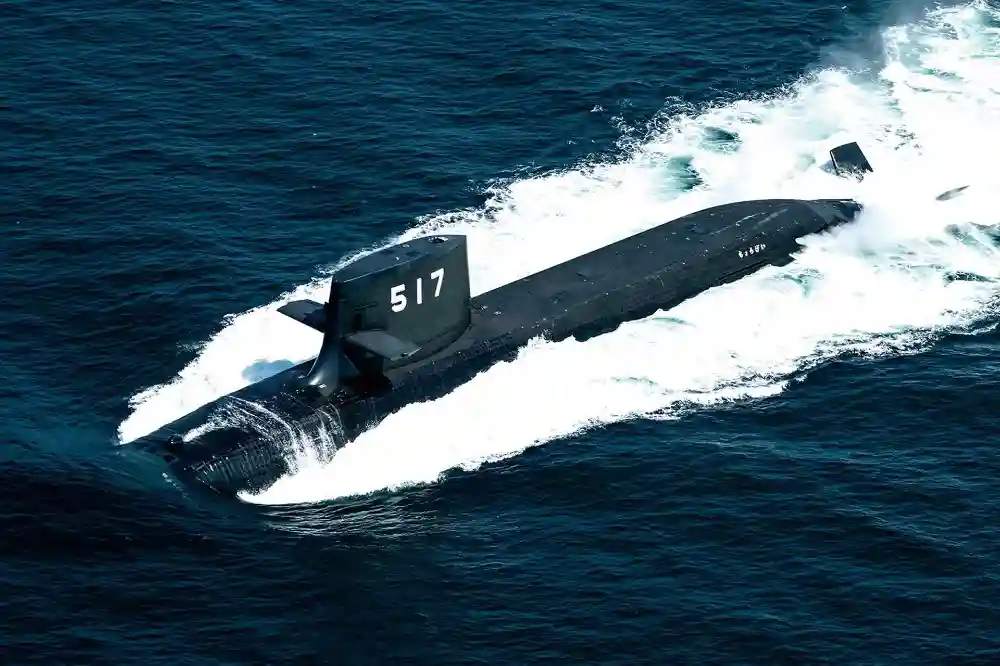
Japan has officially expanded the operational strength of its submarine fleet with the commissioning of JS Chōgei (SS-517), the fifth vessel in the advanced Taigei-class diesel-electric submarine program. The submarine was formally handed over to the Japan Maritime Self-Defense Force (JMSDF) on March 10, 2026, during a ceremony at the Mitsubishi Heavy Industries (MHI) shipyard in Kobe, marking another milestone in Japan’s ongoing modernization of its underwater warfare capabilities.
The entry of JS Chōgei into service reflects Tokyo’s broader strategy to enhance stealth, endurance, and surveillance capabilities across the Indo-Pacific maritime domain. As regional naval competition intensifies and submarine activity increases in surrounding waters, the Taigei-class has emerged as a key component of Japan’s future undersea defense posture.
With a program cost estimated at 64.8 billion yen (approximately $443 million), the submarine was funded under Japan’s Fiscal Year 2021 defense budget and will now operate from Yokosuka Naval Base as part of Submarine Division 2 of Submarine Flotilla 2. From this strategic location, the vessel will conduct patrols and maritime security operations across the increasingly contested waters of the Indo-Pacific region.
A New Generation in Japan’s Submarine Evolution
The Taigei-class submarines represent the next evolutionary step in Japan’s conventional submarine development, succeeding the highly regarded Sōryū-class fleet that has formed the backbone of JMSDF undersea forces since 2009.
Japan designed the Taigei class to integrate new propulsion systems, advanced sonar arrays, and improved acoustic stealth technologies, reflecting decades of experience in submarine engineering. These upgrades aim to increase the survivability and operational flexibility of Japanese submarines during extended patrols in both shallow coastal environments and deep ocean waters.
The naming convention of the class follows a longstanding tradition within Japanese naval history. Submarines in the series carry the suffix “gei,” meaning whale, symbolizing the power and quiet endurance associated with the massive marine mammals. The class name Taigei translates to “Big Whale,” while Chōgei means “Long Whale.”
JS Chōgei is the third vessel in Japanese naval history to carry the name. Earlier ships bearing the designation included a transport vessel of the Imperial Japanese Navy and later a submarine tender, linking the modern submarine with a lineage stretching back through Japan’s maritime heritage.
Industrial Collaboration and Production Strategy
The Taigei program is being built through a dual-shipyard production model, shared between Mitsubishi Heavy Industries and Kawasaki Heavy Industries, both located in Kobe. This approach allows Japan to maintain continuous submarine construction capacity, preserve highly specialized industrial expertise, and reduce production gaps that could otherwise erode technical knowledge.
The commissioning sequence of the class reflects this carefully managed industrial pipeline. The lead submarine JS Taigei (SS-513) entered service in March 2022, followed by JS Hakugei (SS-514) in March 2023 and JS Jingei (SS-515) in March 2024.
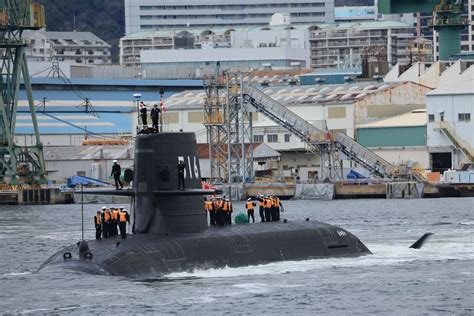
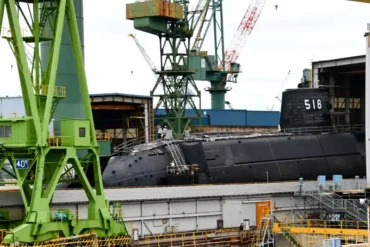
The fourth submarine, JS Raigei (SS-516), was launched in October 2023 and is expected to enter operational service in 2025 after completing sea trials. Meanwhile, JS Sōgei (SS-518) is currently under construction at Kawasaki Heavy Industries, and an additional submarine, SS-519, is being assembled by Mitsubishi Heavy Industries.
In total, eight submarines are currently planned for the class, although defense planners have indicated that the final number could increase depending on future security requirements in the Indo-Pacific.
Dimensions and Structural Design of the Taigei-Class
The JS Chōgei submarine measures approximately 84 meters in length, with a beam of 9.1 meters and a draught of 10.4 meters. The vessel has a standard displacement of around 3,000 tonnes, slightly larger than the earlier Sōryū-class submarines, which displaced roughly 2,950 tonnes.
Despite this modest increase in size, the submarine retains a highly optimized design for underwater operations. Its hull follows a cylindrical cigar-shaped configuration, a design philosophy adopted by Japanese submarines beginning with the Oyashio-class and refined through successive generations.
This shape prioritizes hydrodynamic efficiency and stable submerged cruising, enabling quieter operations and improved endurance during long patrols.
The stern of the submarine incorporates an X-shaped rudder configuration, replacing the traditional cross-shaped arrangement used on earlier vessels. This design provides several advantages, including greater maneuverability in confined waters and a reduced risk of damage when operating near the seabed.
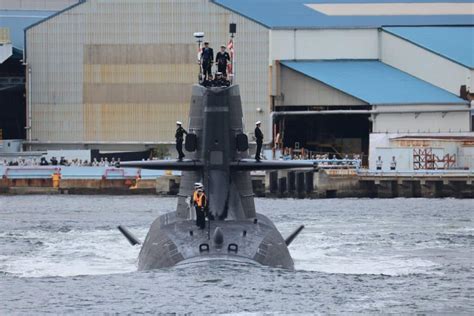
High-strength steel is used throughout the pressure hull, while specialized acoustic-absorption materials reduce sound reflections and mechanical noise, helping the submarine maintain a low acoustic signature, a critical factor in submarine survivability.
Lithium-Ion Battery Propulsion Revolution
One of the most significant technological advances incorporated into the Taigei-class is the adoption of lithium-ion battery technology as the submarine’s primary energy storage system.
Unlike traditional lead-acid batteries, lithium-ion cells provide higher energy density, faster charging capability, and longer operational endurance. These improvements allow the submarine to remain submerged for extended periods without needing to surface or snorkel to recharge its batteries.
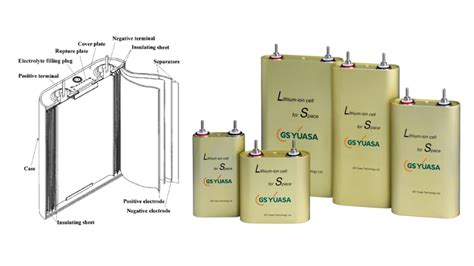
Japan became the first nation in the world to deploy lithium-ion batteries operationally in conventional submarines, beginning with the final two Sōryū-class boats, JS Ōryū (SS-511) and JS Tōryū (SS-512). The Taigei class builds upon that experience with further improvements to power management and battery integration.
The propulsion system of JS Chōgei includes two Kawasaki 12V 25/31 diesel engines, which generate electricity to recharge the batteries when the submarine operates near the surface using a snorkel mast. The improved diesel engines are more powerful than those used on earlier units and work alongside a newly developed snorkel system designed to increase energy generation efficiency.
Combined, the propulsion system produces approximately 6,000 horsepower, enabling submerged speeds exceeding 20 knots, an impressive performance figure for a diesel-electric submarine.
Advanced Sonar and Sensor Systems
Modern submarine warfare revolves around information — detecting adversaries before being detected. To achieve this, the Taigei-class integrates an extensive suite of next-generation sensors and processing systems.
At the core of the submarine’s combat system is the OYX-1 information processing system, which works alongside the ZQX-12 tactical display system and the ZQQ-8 sonar suite. These technologies allow operators to analyze acoustic signals with greater accuracy and speed.
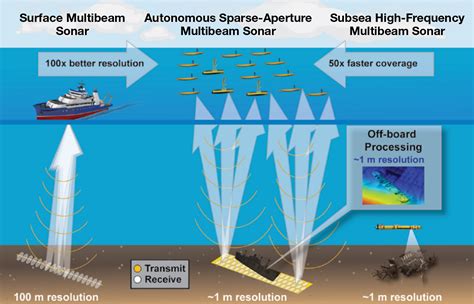
The sonar configuration combines multiple sensor types distributed across the hull and surrounding waters. The system includes bow-mounted sonar arrays, flank sensors along the sides of the submarine, and a towed array sensor deployed behind the vessel.
By combining these different acoustic perspectives, the submarine can detect surface ships, submarines, and other underwater objects even in complex environments shaped by temperature gradients, ocean currents, and seabed reflections.
Electronic warfare capabilities are provided by the NZLR-2 electronic support measures system, which detects radar and communication emissions from other vessels. When operating at periscope depth or on the surface, the submarine can also employ the ZPS-6H radar system.
Another significant feature is the installation of a non-penetrating periscope developed by Mitsubishi Electric. Unlike traditional periscopes that physically penetrate the pressure hull, this system transmits digital imagery to displays inside the control room, enhancing both safety and flexibility.
Weapons Systems and Combat Capabilities
The Taigei-class submarines are equipped with a versatile arsenal designed to engage both surface ships and underwater threats.
Their primary weapon is the Type 18 heavyweight torpedo, a modern Japanese torpedo that replaces the earlier Type 89 model. The Type 18 incorporates improvements in propulsion, target tracking, and onboard processing, giving it enhanced accuracy against fast or maneuvering targets.
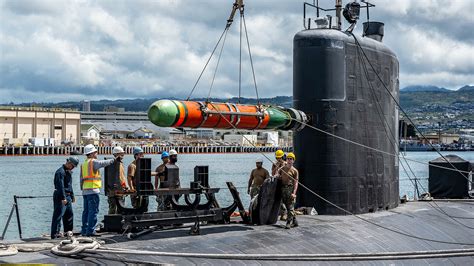
In addition to torpedoes, JS Chōgei can launch the UGM-84L Harpoon Block II anti-ship missile through its torpedo tubes. These missiles provide the submarine with a stand-off strike capability against surface vessels at ranges of approximately 248 kilometers, allowing engagements beyond the visual horizon.
Defensive systems are also installed to counter incoming threats. The submarine carries torpedo countermeasure launchers that deploy acoustic decoys. These devices mimic the sound signature of the submarine’s propeller, drawing enemy torpedoes away from the real vessel.
Japan is also pursuing a new submarine-launched cruise missile derived from the Type 12 surface-to-ship missile, with an expected range of around 1,500 kilometers. If integrated into future submarines, this weapon would significantly expand Japan’s long-range maritime strike capabilities.
Construction Timeline of JS Chōgei
The development of JS Chōgei followed a carefully structured construction process that stretched across several years.
The submarine’s keel was laid on April 19, 2022, at the Mitsubishi Heavy Industries shipyard in Hyogo Prefecture. Over the following two years, shipyard engineers completed the vessel’s structural assembly and installed major onboard systems.
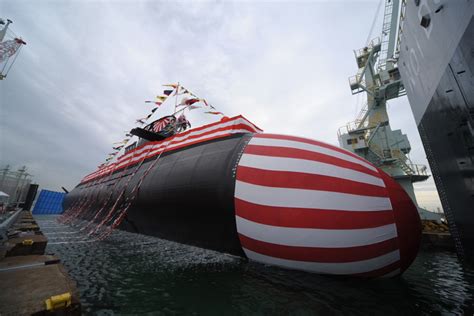
The submarine was launched on October 4, 2024, marking the transition from assembly to outfitting and testing. During this stage, engineers installed combat systems, propulsion equipment, and sensors before beginning harbor tests and sea trials.
Sea trials play a critical role in submarine development. During these tests, crews evaluate navigation systems, propulsion performance, acoustic signatures, sonar functionality, and combat system integration under real operating conditions.
After successfully completing these evaluations, the submarine was formally delivered to Japan’s Ministry of Defense and entered operational service in March 2026.
Crew Design and Integration of Female Sailors
JS Chōgei operates with a crew of approximately 70 personnel, and its internal layout includes design adjustments reflecting recent policy changes within the Japan Maritime Self-Defense Force.
In recent years, Japan lifted restrictions that had previously limited the assignment of female personnel aboard submarines. As a result, the Taigei-class design incorporates features to accommodate mixed-gender crews.
Dedicated sleeping spaces for female sailors have been integrated into the vessel’s accommodation areas through the installation of partitioned sections within crew quarters. Additional privacy measures, such as curtains along corridors leading to shower facilities, were included during the design stage.
These adjustments were not retrofitted after construction but instead incorporated directly into the architecture of the submarine, reflecting evolving personnel policies within Japan’s defense forces.
Strategic Importance in the Indo-Pacific Maritime Environment
The commissioning of JS Chōgei comes at a time when the Indo-Pacific region is experiencing a rapid expansion of naval capabilities, particularly in the undersea domain.
Submarines remain one of the most strategically influential assets in modern naval warfare due to their ability to operate undetected, gather intelligence, and strike adversaries without warning. For an island nation like Japan, maintaining a technologically advanced submarine fleet is essential for protecting maritime trade routes, monitoring surrounding waters, and deterring potential threats.
The Taigei-class is expected to become a central pillar of Japan’s submarine fleet over the coming decades, gradually replacing older platforms while enhancing stealth, endurance, and detection capabilities.
With additional units under construction and further technological innovations under development, the Taigei program reflects Japan’s determination to maintain a highly capable and modern undersea force capable of operating across the vast maritime spaces of the Indo-Pacific.