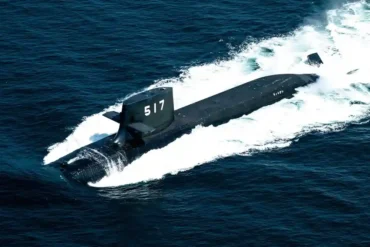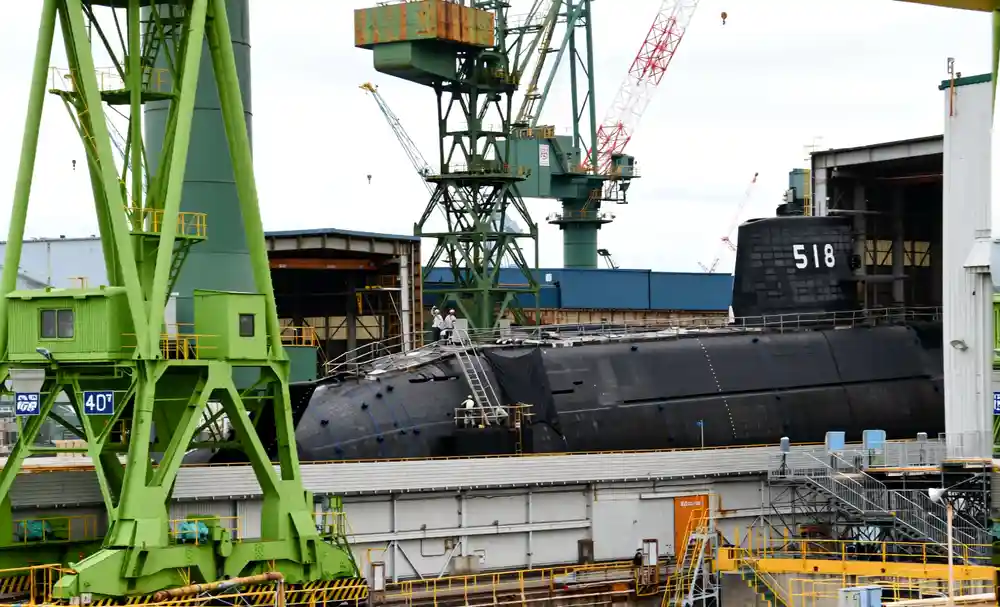
Japan’s Maritime Self-Defense Force is poised to launch the sixth Taigei-class diesel-electric submarine in a ceremony scheduled for 14 October at Kawasaki Heavy Industries’ Kobe Shipyard. The hull, likely designated SS-518, will further expand Tokyo’s quietly growing undersea fleet in a region where submarine activity is fast becoming a core element of strategic competition. This launch marks another incremental but meaningful shift in Japan’s submarine capability, particularly at a moment when Chinese and Russian naval movements in the East China Sea and the surrounding undersea domain are becoming more assertive.
The launch window, narrowly slated between 11:50 and 12:05 local time, underscores the disciplined cadence with which Japan is rolling out its submarine program. Vice Admiral Matsumoto Tamotsu has been named as the presiding officer, reinforcing institutional continuity and signaling the importance Tokyo attaches even to routine milestones. The ceremony alternates between Kawasaki’s and Mitsubishi Heavy Industries’ yards—a rhythm that ensures Japan can sustain production capacity while smoothing out logistics and training demands.
Advancing Submarine Endurance: Lithium-Ion Batteries Over AIP
While the hull form and basic configuration of the Taigei class remain closely aligned with its Sōryū-class predecessors—at roughly 84 meters in length, about 9.1 m beam, a crew complement near 60, and surfaced displacement near 3,000 tonnes—the real advance lies under the skin. By replacing the older air-independent propulsion (AIP) systems with high-capacity lithium-ion batteries, Japan trades static endurance for superior submerged performance. These batteries enable higher sustained underwater speeds, allowing the submarine to remain submerged longer, reduce or eliminate snorkeling intervals, and reposition more rapidly with lower exposure.
This shift is not cosmetic: in contested waters—especially around the first island chain—frequent snorkeling or periscope exposure spells vulnerability. A sub that can move silently and remain hidden while sprinting between patrol areas enhances both deterrence and tactical flexibility. In effect, the Taigei class redefines the endurance-versus-mobility tradeoff by leaning into mobility and lower detection risk.
Sensors, Combat Systems and Signature Reduction
To support its ambitions, the sixth hull will carry a sensor and combat system suite that balances maturity and stealth. The ZQQ-8 series sonar is expected to form the core of its undersea sensing, complemented by ZPS-6H surface search and navigation radar. An optronic mast and advanced electronic-warfare suite link back to data-processing architectures such as OYX-1 and ZQX-12, allowing fusion of tracks from sonar, ESM, and surface sensors. These incremental but cumulative enhancements aim to reduce platform signature and compress latency in tactical decision loops.
While official disclosures remain limited, the integration focus seems clear: faster correlation and track updates, lower emissions during passive operations, and increased agility in contested waters. By reducing time spent in sensor-hungry or sonar-intensive states, the Taigei class improves survivability in a denser undersea domain.
Armament and Tactical Role: Flexible Lethality in Critical Waters
The Taigei-class maintains a conventional but potent armament fit. With six 533 mm HU-606 torpedo tubes, the submarine can deploy Type 89 or Type 18 heavyweight torpedoes. In addition, it retains the option to fire UGM-84 Harpoon anti-ship missiles while submerged, giving it reach in blue-water interdiction even against surface targets. The JMSDF’s policy of not disclosing loadouts is expected, but what matters strategically is the mix flexibility: this platform can shift between chokepoint ambush posture (e.g. in straits like Bungo or Tsugaru) and open-sea interdiction missions. In the East China Sea or Philippine Sea, these capabilities complicate enemy calculations of threat envelopes and force dispositions.
But the real tactical transformation lies in the tempo. With lithium-ion systems, the submarine can sprint or reposition without waiting long recharge intervals, reducing the predictability that plagues AIP or conventional battery subs. It can shadow surface groups more fluidly, reposition between likely contact zones, or shift from barrier patrol to tasking toward surface action groups without risking exposure.
Force Structure Strategy: Building a Hardened Submarine Fleet
Japan’s submarine arm is expanding methodically. JS Raigei (SS-516) was commissioned in March 2025, with SS-517 expected to follow soon. The goal remains at least eight Taigei units, phased in while simultaneously retiring older Oyashio-class hulls. Alternating construction between Mitsubishi Heavy Industries (MHI) and Kawasaki Heavy Industries (KHI) ensures steady throughput and spreads technical risk across industrial bases. Over time, Tokyo plans for nearly 22 operational submarines total—allowing fleet depth, training rotation, and maintenance flexibility. Each new hull introduced subtly shifts adversary planning: the same underwater corridors become more contested as quieter, higher-mobility subs enter the mix.
With SS-518 launching this autumn, the JMSDF signals it is more than plugging slots—it is shaping a cumulative deterrent logic. In a region where undersea advantage is as much about presence and unpredictability as sheer numbers, inserting one more capable boat into the mosaic sends ripple effects through Chinese and Russian operational calculus.
Strategic Implications: Undersea Deterrence in a New Era
The timing of SS-518’s launch is hardly coincidental. It comes against the backdrop of increased People’s Liberation Army Navy (PLAN) transits through the Miyako Strait and episodic deployment of the Russian Pacific Fleet in adjacent littorals. The frequency and depth of submarine and surface deployments near the first island chain are trending upward. A modern, stealthier Japanese SSK presence raises the operational cost of those passages for adversaries and complicates antisubmarine warfare (ASW) planning.
In a broader sense, Japan’s approach to submarine force structure is implicitly cumulative. It neither bets everything on a single “game-changer” class nor rushes large-scale deployment before maturity. Instead it layers modern hulls gradually, forcing potential adversaries to bias for worst-case intercept risk over time. By doing so, Tokyo shifts deterrence calculations when East Asian naval competition is already intensifying.
The launch of Taigei-class SS-518 is not dramatic in itself. It is quiet, disciplined, and incremental. But months and years from now, that incrementalism may translate into a tighter vice around strategic chokepoints, deeper monitoring of submarine pathways, and more constrained freedom for opposing fleets. In this evolving undersea domain, Japan is playing the long game—and with each new capable boat, it tilts the undersea balance just a little further.
The launch in Kobe on 14 October will not just be a ceremony. It will be a signal: that Japan’s submarine arm is continuing apace, modernizing steadily, and preparing to hold undersea ground across strategic waters. Adversaries will watch, and planners in Tokyo and allied capitals will slot one more capable asset into the silent, unseen chessboard beneath the waves.