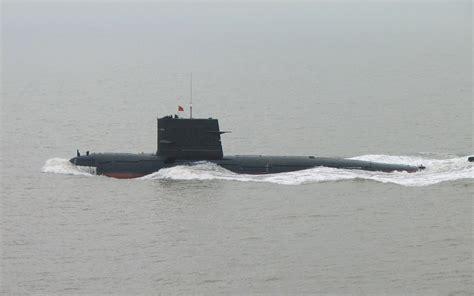
China has decisively shifted the tempo of the global undersea arms race. For the first time in modern naval history, China has overtaken the United States in nuclear submarine production rate and total launch tonnage over a five-year period, marking a strategic inflection point with profound implications for maritime power in the Indo-Pacific and beyond. The development signals not merely industrial acceleration but a calculated restructuring of the global balance beneath the oceans.
Between 2021 and 2025, China launched 10 nuclear-powered submarines totaling approximately 79,000 tons, compared to seven U.S. submarines totaling 55,000 tons in the same timeframe. That reversal stands in sharp contrast to the 2016–2020 period, when the United States maintained a clear production advantage. The numbers themselves tell a compelling story, but the deeper transformation lies in how China achieved this surge — and what it intends to do with it.
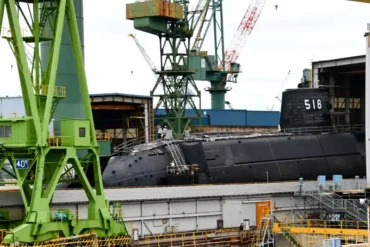
The expansion is centered at Bohai Shipbuilding Heavy Industry Co. (BSHIC) in Huludao, northern China, a facility that has quietly become one of the most strategically consequential shipyards on Earth. Once trailing American output, Bohai underwent significant infrastructure expansion between 2019 and 2022, adding a second production hall and modernizing modular assembly processes. Satellite imagery now shows multiple submarine hulls under simultaneous construction — an unmistakable indicator of industrial scaling and production maturity.
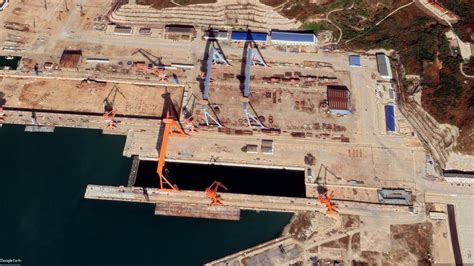
China’s Nuclear Submarine Output: From Incremental Growth to Strategic Surge
The shift from incremental progress to sustained production rhythm reflects more than shipyard efficiency. It demonstrates alignment between political direction, industrial capacity, and long-term naval doctrine under President Xi Jinping’s directive to elevate the People’s Liberation Army Navy (PLAN) into a true blue-water force.
China achieved what analysts describe as a “1+2 production rhythm” in both 2024 and 2025 — one ballistic missile submarine (SSBN) and two attack or guided-missile submarines (SSN/SSGN) per year. That mirrors the U.S. Navy’s own publicly stated shipbuilding goal for the late 2020s. In practical terms, Beijing has matched Washington’s planned nuclear submarine production tempo years ahead of schedule.
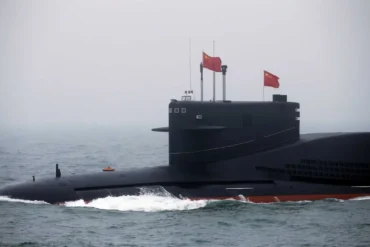
During this period, China launched additional Type 094 Jin-class ballistic missile submarines, strengthening its sea-based nuclear deterrent, alongside multiple Type 093B Shang III-class nuclear attack submarines equipped with vertical launch systems (VLS). The integration of VLS marks a pivotal capability leap, enabling submarines to deploy advanced anti-ship and land-attack missiles directly from submerged positions.
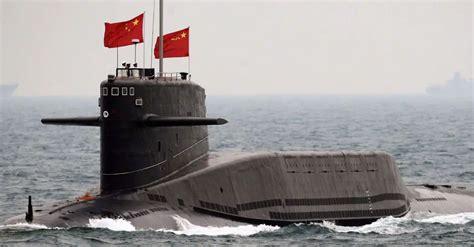
The Evolution of China’s Nuclear Triad at Sea
The Type 094 SSBN fleet forms the maritime leg of China’s expanding nuclear triad — alongside land-based intercontinental ballistic missiles and strategic bombers. Upgraded variants are now associated with the JL-3 submarine-launched ballistic missile, which significantly extends strike range. In operational terms, this means China could theoretically target portions of the continental United States from comparatively protected waters such as the South China Sea.
While Western analysts continue to assess Chinese submarines as less acoustically silent than U.S. counterparts, sheer survivability improves when patrol zones remain closer to defended maritime perimeters. Range extension through missile upgrades partially compensates for lingering stealth disparities.
Looking ahead, the next-generation Type 096 ballistic missile submarine is expected to begin production before the decade concludes, with service entry projected in the late 2020s or early 2030s. Parallel development of the Type 095 nuclear attack submarine signals further qualitative ambition. Satellite imagery in February 2026 revealed what appears to be the first visible fitting-out phase of a Type 095 hull at Huludao, suggesting the program is transitioning from design to material reality.
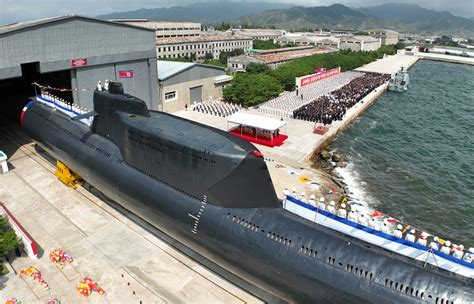
Industrial Capacity vs. Technological Sophistication
The United States Navy retains undeniable qualitative advantages. American submarines — including the Virginia-class attack submarines and the forthcoming Columbia-class ballistic missile submarines — are larger, technologically dense, and engineered with unmatched acoustic stealth. These attributes make them exceptionally capable but also slower and more expensive to construct.
The Columbia-class program, intended to replace aging Ohio-class SSBNs, is already running at least a year behind schedule. The first boat, USS District of Columbia, is projected for delivery in 2028. Meanwhile, production strain and workforce bottlenecks continue to challenge American shipbuilding infrastructure.
Public testimony before Congress has underscored the issue: delays, cost overruns, and industrial inefficiencies are not isolated anomalies but systemic concerns. As older Los Angeles-class attack submarines retire, the total number of U.S. attack submarines is projected to decline to 47 by 2030, creating what analysts describe as the “valley” period in submarine force levels.
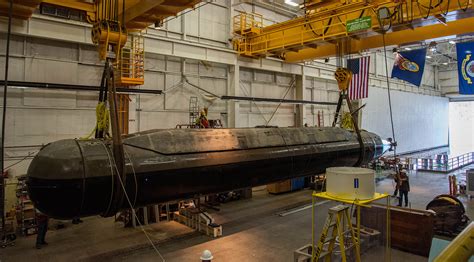
China’s advantage, therefore, lies not yet in acoustic supremacy but in industrial velocity. Production inputs — financial, labor, and technological — remain opaque. What is visible, however, is sustained output acceleration.
The World’s Largest Navy Is Still Growing
China already possesses the world’s largest navy by total hull count. Estimates indicate over 370 battle-force ships currently operational, with projections suggesting the fleet could expand to 435 ships by 2030. That includes surface combatants, amphibious assault ships, aircraft carriers, auxiliaries, and both conventional and nuclear submarines.
By contrast, the U.S. Navy operates fewer battle-force ships numerically, though each vessel generally carries greater individual capability. The distinction is critical: naval warfare balances quality, quantity, readiness, and alliance structures.
China maintains approximately 12 operational nuclear-powered submarines as of early 2025 — six ballistic missile submarines and six nuclear attack submarines — alongside 46 conventionally powered boats. The United States fields 65 nuclear submarines, including 14 ballistic missile submarines and 51 attack submarines. Purely by numbers, Washington retains superiority. By production trajectory, Beijing is closing the gap.
Strategic Implications for the Indo-Pacific
The undersea dimension is decisive in any future Taiwan contingency or broader Indo-Pacific confrontation. Submarines provide stealth strike capability, sea-denial leverage, and intelligence collection capacity unmatched by surface fleets. In modern naval conflict, submarines frequently determine escalation thresholds before surface combatants even enter engagement range.
China’s expanding undersea fleet enhances its ability to contest chokepoints such as the First Island Chain and extend deterrence deeper into the Western Pacific. Simultaneously, the United States benefits from an alliance network that includes Japan, South Korea, Australia, India, and the Philippines — partnerships that complicate any purely numerical assessment.
Naval warfare is not arithmetic alone. Experience, training cycles, integrated battle networks, and logistical endurance shape outcomes. The U.S. Navy’s decades of sustained global deployments provide operational seasoning that the PLAN is still accumulating. Yet industrial scale often precedes doctrinal maturity.
Quantity Versus Quality: A Strategic Equation in Motion
Analysts broadly agree that Chinese submarine designs likely still trail U.S. and European boats in acoustic discretion and sensor sophistication. However, the strategic equation evolves when output rates accelerate and modernization cycles compress.
History offers perspective. Naval superiority is rarely static. Britain once ruled the waves; the United States inherited that mantle through industrial mobilization in the mid-20th century. Today, China is applying similar industrial principles — scale, speed, and centralized prioritization — to undersea warfare.
If production rhythms continue, projections suggest the PLAN could surpass the U.S. Navy in total submarine numbers by the mid-2030s. Whether that translates into battlefield superiority depends on variables extending beyond ship counts: command integration, electronic warfare resilience, anti-submarine detection networks, and alliance interoperability.
The trajectory is unmistakable. The nuclear submarine production race has entered a new phase, defined not by incremental parity but by competitive acceleration. China’s ascent beneath the ocean surface is no longer hypothetical; it is measurable in steel, displacement tonnage, and hull launches.
Strategic balances are not overturned overnight. They erode, adjust, and reconfigure as industrial foundations shift. Beneath the waves of the Pacific, that shift is already underway.