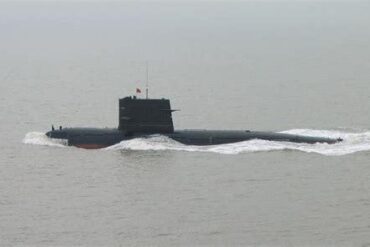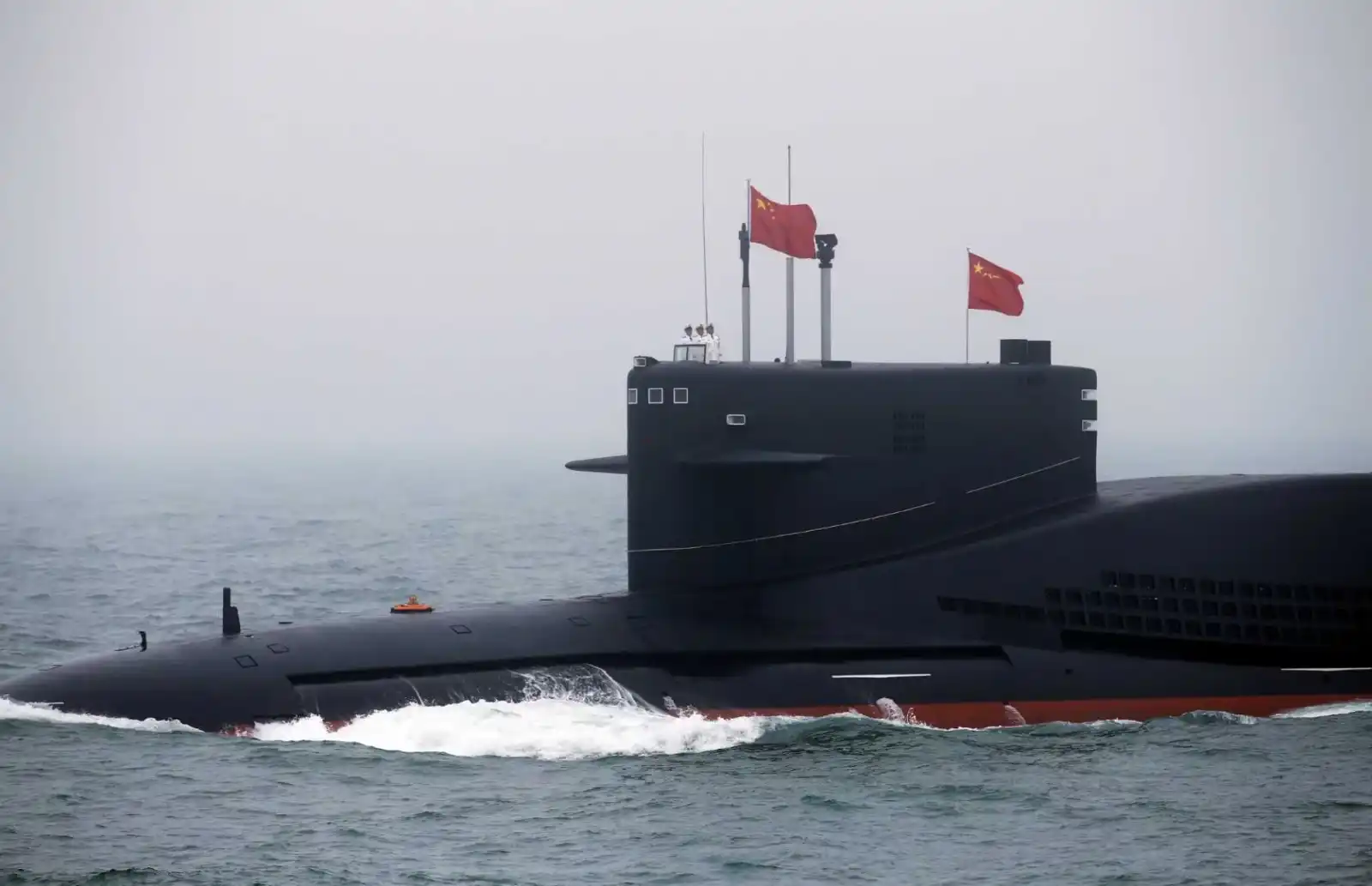
Satellite imagery has revealed that China is preparing to launch its first Type 095 nuclear-powered attack submarine, a next-generation undersea platform that signals a decisive shift in the strategic geometry of the Western Pacific. The submarine, also known as the Type 09V, has been observed at the Bohai Shipbuilding Heavy Industry Corporation facility in Huludao, Liaoning Province, where it was moved into a launch bay in early February. The timing is not incidental. It comes amid sustained Chinese naval expansion and growing concern in Washington that the long-standing American edge in submarine warfare is narrowing faster than anticipated.
Between 2021 and 2025, China launched ten nuclear-powered submarines totaling approximately 79,000 tons—outpacing the United States, which launched seven submarines totaling about 55,000 tons in the same period. Shipbuilding output is not the sole determinant of naval dominance, but in the realm of undersea warfare, production tempo translates directly into patrol density, deterrent credibility, and crisis leverage. The Type 095 is not just another hull entering the water; it is a declaration that China intends to contest the underwater domain with increasing sophistication.
A New Generation of Chinese Undersea Power
The Type 095 represents a marked evolution beyond the earlier Type 093 Shang-class nuclear attack submarines. Measuring an estimated 110 to 115 meters in length, with a beam between 12 and 13 meters, the submarine is assessed to displace between 9,000 and 10,000 tons submerged. This makes it significantly larger than its 7,000-ton predecessor, suggesting expanded internal volume for improved propulsion systems, sensors, and weapons integration.
One of the most visually striking changes is the adoption of an X-tail stern configuration, replacing the traditional cruciform rudders used on earlier Chinese nuclear submarines. This arrangement enhances maneuverability and hydrodynamic efficiency, particularly during complex underwater movements. It also represents the first time China has implemented such a stern layout on a nuclear-powered submarine, aligning its design philosophy more closely with advanced Western and Russian undersea platforms.
The sail appears devoid of external control planes, indicating a likely shift toward retractable hull-mounted bow planes rather than fairwater-mounted planes. This change reduces drag and acoustic signature, critical factors in submarine survivability. In undersea warfare, silence is survival, and design refinements increasingly revolve around reducing detectable noise signatures.
Vertical Launch System and Expanded Strike Capability
Imagery shows an open compartment behind the dorsal sail consistent with the installation of a vertical launch system (VLS). Analysts assess that the submarine could accommodate up to 18 VLS cells, potentially configured for anti-ship and land-attack cruise missiles such as the YJ-18. This would exceed the 12-cell configuration found on the preceding Type 093B variant, marking a substantial leap in strike flexibility.
The integration of a larger VLS array transforms the Type 095 from a traditional hunter-killer submarine into a potent guided missile attack platform capable of projecting conventional firepower deep into contested waters. In a Taiwan contingency scenario, such submarines could launch long-range anti-ship missiles from concealed positions, complicating U.S. naval maneuver planning between Guam and the Taiwan Strait.
Submarine-launched anti-ship missiles possess a structural advantage: they can be fired from positions closer to target fleets while remaining hidden beneath the surface. Modern anti-ship missiles typically outrange a surface fleet’s organic anti-submarine warfare envelope, compressing reaction times and forcing adversaries to operate under persistent threat.
Propulsion, Acoustic Signature, and Hull Architecture
Separate Chinese assessments suggest the Type 095 likely employs a pumpjet propulsor instead of a conventional skew-back propeller. Pumpjets enclose the propeller blades within a ducted system, reducing cavitation—the formation of vapor bubbles that generate detectable noise at high speeds. This technology is already used in advanced Western submarines, including the U.S. Navy’s Virginia-class.
The submarine’s high waterline and extensive red-painted lower hull suggest reduced reserve buoyancy compared to earlier Chinese submarines, indicating a possible single-hull or hybrid-hull design rather than the full double-hull configuration historically favored by China. A single-hull layout increases usable internal volume relative to external dimensions, though it demands more precise hydrodynamic shaping and structural integrity.
The wider beam also raises the possibility that the Type 095 shares baseline design compatibility with the anticipated Type 096 ballistic missile submarine, expected later this decade. If true, this would reflect an industrial strategy centered on modularity and shared components, enhancing production efficiency while accelerating fleet expansion.
Huludao: The Industrial Engine of Expansion
China’s submarine momentum is not limited to a single class. The Huludao shipyard has undergone significant expansion, transforming into a high-capacity nuclear submarine construction hub. The Eastern Assembly Hall now contains 12 assembly slots, each measuring 144 meters in length, while the Southern Assembly Hall provides eight larger slots measuring 157.5 meters in length and 32.5 meters in width.
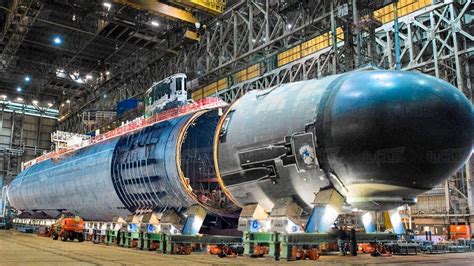
In theory, these facilities can accommodate up to 20 nuclear submarine hulls simultaneously, a scale of infrastructure that underscores Beijing’s long-term undersea ambitions. Since May 2022, new nuclear attack submarines have been launched annually, with production reaching a 1+2 rhythm in 2024–2025—one ballistic missile submarine and two attack submarines per year. This matches the U.S. Navy’s targeted production tempo for 2028.
Industrial tempo matters. Submarine construction is one of the most technically demanding shipbuilding endeavors in existence. Sustaining multi-hull annual output reflects not only capacity but growing mastery of complex nuclear propulsion, quieting technologies, and systems integration.
Strategic Context: Taiwan and the Western Pacific
The operational purpose of the Type 095 becomes clearer when viewed through the lens of a Taiwan contingency. China already fields a layered anti-access and area-denial network combining long-range anti-ship ballistic missiles, land-based cruise missiles, air-launched munitions, and surface combatants. The addition of a stealthy, long-range undersea strike platform introduces a new launch vector into this existing framework.
In crisis scenarios, undersea forces shape the battlespace before surface fleets even detect each other. A Type 095 operating between Guam and Taiwan could threaten carrier strike groups, logistics vessels, and forward-deployed assets, compelling U.S. forces to devote greater resources to anti-submarine warfare. Even the possibility of undetected submarines can constrain operational freedom.
The psychological dimension should not be underestimated. Submarines are uniquely destabilizing because their presence is often inferred rather than confirmed. Decision-makers must assume that at least some adversary boats remain undetected, which alters risk calculations during escalation.
The Broader Chinese Nuclear Submarine Fleet
As of early 2025, China operated 12 nuclear-powered submarines, including six ballistic missile submarines and six attack or guided missile submarines, alongside 46 conventionally powered submarines. The Type 094 Jin-class ballistic missile submarine, displacing approximately 11,000 tons submerged, carries 12 submarine-launched ballistic missiles. Early units deployed the JL-2 with a range of 7,200 kilometers, while later variants field the JL-3 exceeding 10,000 kilometers, enabling strikes from patrol areas within the South China Sea.
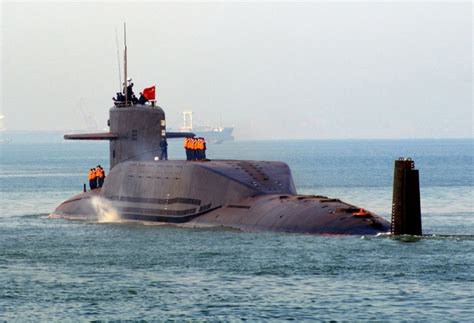
The Type 093B Shang III variant has entered serial production, incorporating pumpjet propulsion and 12 vertical launch cells. Future plans include the Type 096, which is expected to carry between 16 and 24 submarine-launched ballistic missiles, further strengthening China’s sea-based nuclear deterrent.
The estimated cost of the Type 095 ranges between 100 billion and 150 billion yuan per unit, roughly $1.4 billion to $2.1 billion. While lower than the U.S. Virginia-class Block V at approximately $3.2 billion or Russia’s Yasen-M at around $2.5 billion, cost comparisons must account for differing labor and industrial structures.
The United States and the Submarine Production Challenge
The emergence of the Type 095 coincides with what many analysts describe as a U.S. submarine production bottleneck. The United States currently operates 65 submarines, including 14 ballistic missile boats and 51 attack or guided missile submarines. However, Virginia-class production has averaged roughly 1.2 to 1.3 boats per year since 2022, short of the targeted two per year. Additionally, maintenance cycles render roughly one-third of the attack submarine fleet unavailable at any given time.
Projections indicate the U.S. attack submarine force may decline from 50 to 47 boats by 2030 as aging Los Angeles-class submarines retire faster than replacements enter service. In strategic terms, numerical margins matter less than availability and geographic distribution, yet both trends point toward tighter operational margins in the Pacific.
A Changing Undersea Equilibrium
The anticipated launch of the Type 095 marks more than a technological milestone; it signals a transition toward a denser and more persistent Chinese undersea presence. In any Western Pacific scenario, planners must now assume a higher baseline level of submarine risk. The traditional American assumption of assured undersea superiority can no longer be treated as a constant.
Underwater warfare has always been a realm of shadows, patience, and invisible maneuver. As China introduces quieter, more capable nuclear attack submarines into its fleet, the Pacific’s strategic map becomes less about visible surface formations and more about silent geometries beneath the waves. The Type 095 is not merely a new submarine class—it is a statement that the contest for undersea dominance is entering a sharper, more competitive phase.