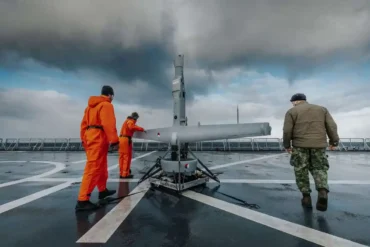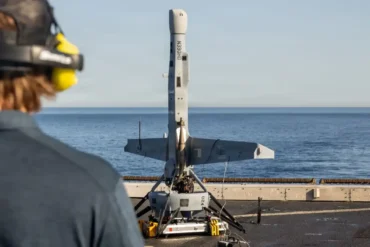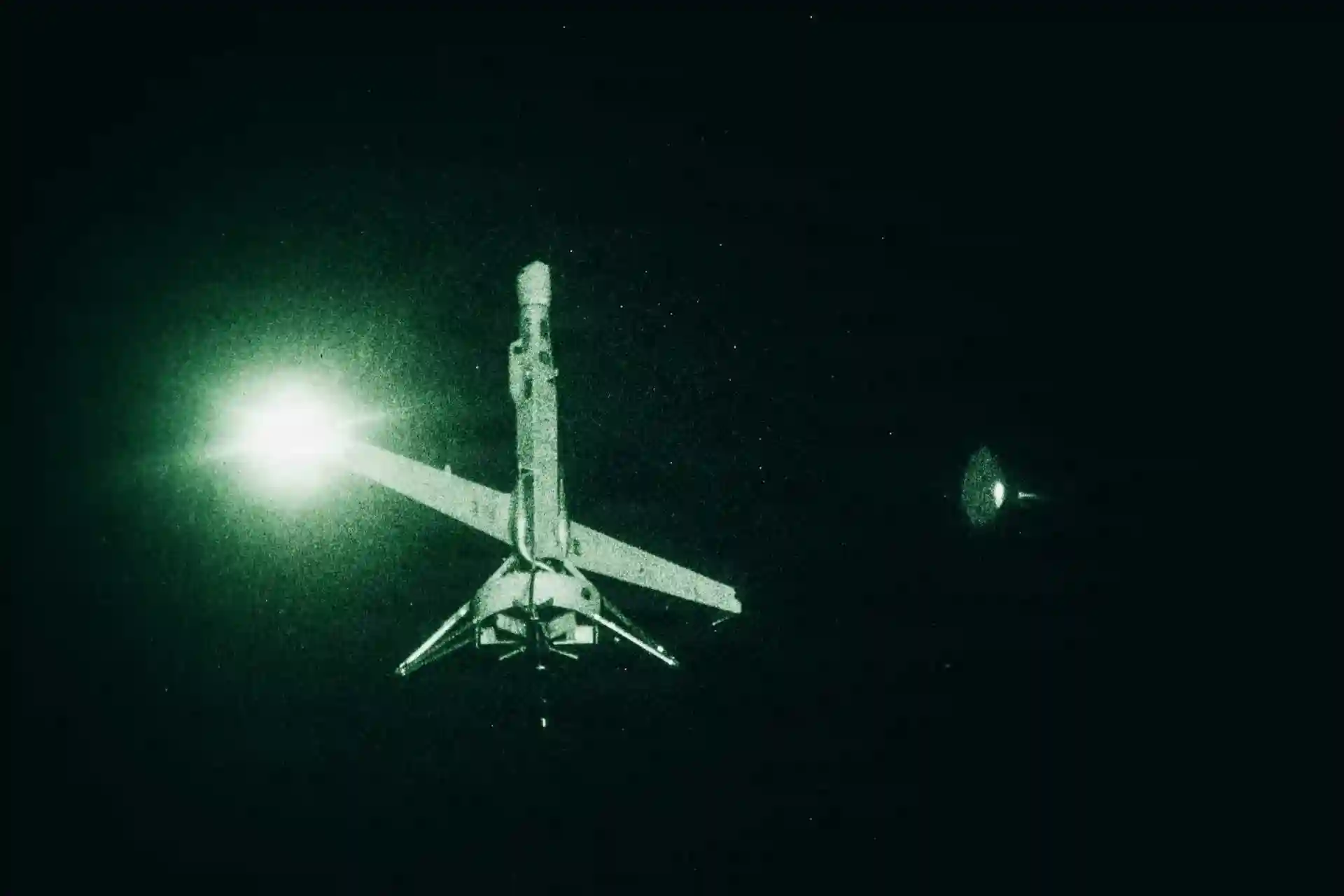
The U.S. Marine Corps has taken another decisive step toward a more distributed and technology-driven future by successfully testing the V-BAT vertical takeoff and landing unmanned aircraft from a U.S. Navy warship during nighttime operations in the Pacific. Conducted on January 23, 2026, the evolution involved Marines from the 11th Marine Expeditionary Unit (MEU) launching the aircraft from the flight deck of the San Antonio-class amphibious transport dock USS Portland (LPD-27), marking one of the first operational night flights of the system from an LPD-class vessel.
The event is more than a routine test. It reflects growing confidence within the Navy–Marine Corps team that compact, ship-launched drones can deliver persistent intelligence, surveillance, and reconnaissance in maritime environments where traditional aviation assets are constrained by distance, weather, or the absence of runways. In the vast reaches of the Pacific, that confidence is rapidly becoming a necessity.
The nighttime launch and recovery were deliberately designed to replicate combat-realistic conditions, where low visibility, complex sea states, and electromagnetic clutter are the norm rather than the exception. Operating in darkness adds layers of risk to any flight operation at sea, yet the V-BAT performed as intended, validating both the aircraft’s design and the training of the Marines and sailors supporting the mission.
Night Operations Validate Shipboard Drone Integration
Launching an unmanned aircraft from a moving warship after sunset places unique demands on flight control systems, deck crews, and command-and-control networks. During the January test, the V-BAT demonstrated stable vertical launch, smooth transition to forward flight, and safe recovery despite limited visual cues. Coordination between Marine operators, Navy flight deck personnel, and embarked civilian contractors highlighted how unmanned aviation is increasingly blending into standard shipboard routines.
For the 11th MEU, embarked as part of the Boxer Amphibious Ready Group, the flight reinforced the operational relevance of organic ISR assets that can be launched on demand without diverting manned helicopters or fixed-wing aircraft. In expeditionary scenarios, minutes matter, and the ability to generate real-time intelligence directly from the ship can shape tactical decisions ashore and at sea.
V-BAT Design Tailored for Expeditionary Warfare
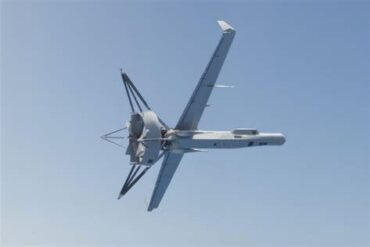
Developed by Shield AI in partnership with Northrop Grumman, the V-BAT occupies a distinctive niche among unmanned systems. Classified as a Group 3 unmanned aerial system, it combines the vertical agility of a rotary-wing platform with the endurance and efficiency of a fixed-wing aircraft. Its single-engine ducted-fan configuration allows it to lift off and land vertically from confined spaces, then transition seamlessly to horizontal flight.
The aircraft’s compact dimensions—just over 10 feet long with a wingspan of roughly 9 feet—make it well suited for amphibious ships, austere island outposts, and forward operating locations where space is at a premium. Once airborne, the V-BAT can remain aloft for up to eight hours, a significant advantage over many small unmanned systems currently in service.
Sensors, Autonomy, and the Nighttime ISR Mission
Payload flexibility is central to the V-BAT’s appeal. The platform can carry electro-optical and infrared sensors, synthetic aperture radar, and even electronic warfare packages, allowing commanders to tailor the aircraft to specific mission requirements. During nighttime operations, EO/IR systems become especially valuable, enabling detection and tracking of targets that would be invisible to the naked eye.
Equally important is the aircraft’s autonomy. Shield AI’s Hivemind software enables the V-BAT to navigate, identify targets, and manage flight paths with minimal human input, even in GPS-denied or communications-contested environments. For Marines operating inside an adversary’s sensor and jamming envelope, this resilience is not a luxury; it is a prerequisite for survival and effectiveness.
Supporting Expeditionary Advanced Base Operations
Marine Corps officials involved in the trial emphasized how the V-BAT aligns with emerging concepts such as Expeditionary Advanced Base Operations (EABO) and Distributed Maritime Operations (DMO). These doctrines envision small, mobile units operating across wide maritime spaces, often far from traditional command hubs and fixed infrastructure.
In such scenarios, persistent ISR becomes the connective tissue that links dispersed forces into a coherent operational picture. A ship-launched drone capable of operating day or night extends the sensing range of the amphibious force, providing early warning, target cueing, and force protection for Marines ashore and ships at sea.
Enhancing the Maritime Sensor Network
Sources familiar with the test indicated that the nighttime sortie included real-time data sharing with other vessels in the amphibious ready group. This capability hints at the V-BAT’s role in contributing to a shared maritime sensor network, an essential component of the Pentagon’s broader Joint All-Domain Command and Control (JADC2) vision.
By feeding sensor data directly into shipboard and joint command systems, unmanned aircraft like the V-BAT can help commanders fuse information from air, sea, land, and space into a unified operational picture. In high-end conflict, where decision cycles are compressed and information superiority can determine outcomes, this integration becomes a decisive advantage.
Implications for Future Amphibious Operations
The successful night test aboard USS Portland underscores how unmanned systems are reshaping amphibious warfare. Unlike traditional aircraft that demand extensive support infrastructure, the V-BAT requires minimal deck space and crew, reducing the operational footprint while expanding capability. For amphibious ships operating in contested littorals, that trade-off is particularly attractive.
As the Marine Corps continues to adapt to the realities of great-power competition in the Indo-Pacific, systems like the V-BAT offer a glimpse of how future forces will fight: distributed, sensor-rich, and increasingly autonomous. The January 2026 flight was a single event, but its implications ripple far beyond one night at sea, signaling a steady shift toward a more agile and information-driven maritime force.