India’s decision to select the U.S.-built V-BAT vertical takeoff and landing unmanned aircraft system paired with Hivemind autonomy software marks a sharp pivot toward resilient, software-defined intelligence, surveillance, and reconnaissance across its most demanding theaters. Announced in late January 2026, the selection places a premium on operational persistence, runway independence, and sovereign autonomy development, all while signaling confidence in a combat-tested autonomy stack designed to function when GPS is degraded and communications are contested.
The choice reflects a sober assessment of India’s security geography. From the Himalayan frontier to the Indian Ocean littorals, Indian formations operate at the edges of infrastructure and under persistent electronic pressure. Pairing a Group 3 VTOL ISR platform with a licensable autonomy development kit allows India to field a single expeditionary baseline that can be adapted locally for mountains, deserts, jungles, and maritime approaches without surrendering control of mission logic to closed foreign code.
At the heart of the program is the software. By acquiring licenses and access to the Hivemind software development kit, India gains the ability to design, validate, and deploy mission-specific autonomy at home. That matters because autonomy is no longer a convenience; it is a survivability feature. In environments shaped by jamming, spoofing, and intermittent links, autonomy determines whether sensors keep collecting and whether aircraft return.
A VTOL ISR Platform Built for the Edges of the Map
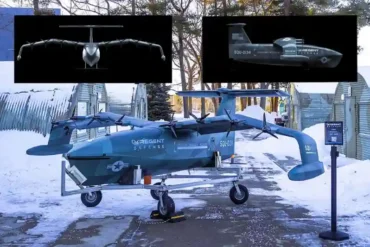
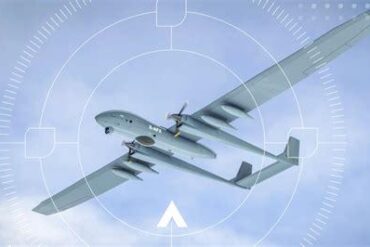
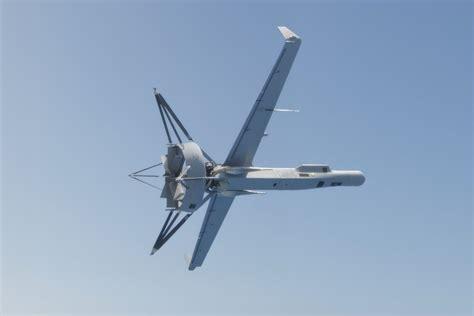
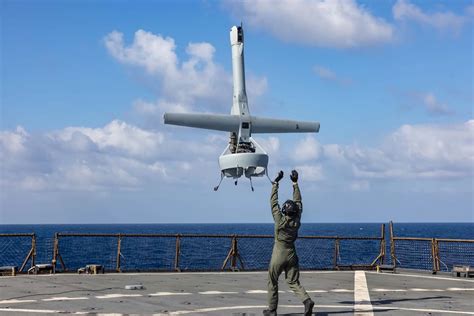
V-BAT occupies a carefully chosen niche between man-portable quadcopters and runway-dependent tactical UAVs. Its ducted-fan VTOL design enables vertical launch and recovery from a 4.6 m by 4.6 m footprint, including rooftops and compact ship decks. With a 3.8 m wingspan and a maximum gross takeoff weight of roughly 73 kg, the aircraft is sized to deliver endurance without demanding airfield infrastructure.
Endurance is the headline advantage. With an electro-optical/infrared payload, V-BAT is advertised to exceed 12 hours on station, a decisive shift for commanders who need continuous track in broken terrain. The propulsion system runs on heavy fuel compatible with JP-5, easing logistics for forward units already standardized on common fuels and simplifying sustainment in austere areas.
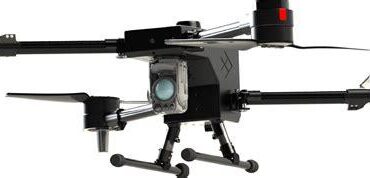
The aircraft’s architecture is explicitly open, designed to integrate radios and sensors while maintaining STANAG compliance. Payload capacity reaches 18.1 kg with 600 W available, creating headroom for growth beyond basic ISR. EO/IR turrets are standard, but options extend to synthetic aperture radar, laser rangefinding, and laser designation, allowing the platform to progress from observation to precise targeting support for artillery, rockets, and precision munitions.
Software as a Combat Multiplier: Hivemind and Edge Autonomy
The differentiator is autonomy engineered for friction. Hivemind functions as both an onboard autonomous pilot and a development environment, built atop EdgeOS middleware optimized for deterministic, low-latency behavior. Static configuration and localized computation reduce dependence on continuous links, while network-aware coordination enables multi-agent synchronization when connectivity permits.
This approach is tailored for degraded GPS and electronic attack, conditions increasingly treated as the baseline rather than the exception. Autonomy is not a replacement for human command; it is a hedge against the moments when command is delayed or denied. For India, the ability to own and evolve autonomy behaviors aligns with long-standing requirements to avoid black-box dependencies in frontline systems.

The autonomy stack’s modular compute model allows capability to scale without redesigning the airframe. As sensors grow more capable and coordination becomes more sophisticated, the aircraft can absorb those advances through software and payload integration, extending relevance across multiple service lives.
Operational Logic Across Mountains, Borders, and Seas
India’s most acute contingencies are defined by distance, terrain, and spectrum contestation. Along the Line of Actual Control and the Line of Control, line-of-sight is fractured by ridgelines and valleys, while weather and altitude complicate aviation. In these sectors, a VTOL platform that can launch from small forward sites and remain on station for half a day changes the rhythm of reconnaissance. Persistent orbits reduce gaps, compress sensor-to-shooter timelines, and give commanders confidence that tracks are current.
Laser designation adds weight to that logic. With organic designation, formations can cue long-range fires with precision, minimizing collateral risk while accelerating engagement cycles. For route reconnaissance, infiltration monitoring, and battle damage assessment, persistence matters more than speed. V-BAT’s profile favors staying power over dash.
Maritime security benefits are equally clear. The ability to recover onto small decks expands options for coastal patrol, choke point monitoring, and small craft identification without tying up larger strategic UAV fleets. Endurance enables wide-area optical sensing and cueing for surface assets, a practical fit for India’s extended coastline and island territories.
Bridging a Capability Gap in India’s UAS Portfolio
India fields a layered unmanned fleet, but gaps remain. Runway-dependent tactical UAVs deliver reliable ISR where infrastructure exists, while strategic systems cover vast maritime spaces. At the tactical edge, indigenous VTOL hybrids provide portability but are optimized for shorter missions. V-BAT bridges these layers, offering runway independence with tactical endurance, and doing so with a lower logistical burden than high-altitude long-endurance systems reserved for strategic tasks.
This middle tier is where modern conflicts extract value. Persistent ISR at brigade and division level supports maneuver, fires, and logistics without escalating to scarce strategic assets. It also distributes sensing, reducing vulnerability to single-point failures.
Industrial Implications and Domestic Autonomy Development
Beyond immediate capability, the selection carries industrial consequences. Plans tied to domestic manufacturing and technology transfer point to a sustainment model that prioritizes availability under stress. A Hyderabad-area facility associated with licensed production is expected to bring manufacturing online by late 2026, anchoring a local ecosystem for airframes, payloads, and software integration.
Local autonomy development is the strategic prize. With the SDK in hand, Indian teams can tailor behaviors for altitude, weather, spectrum conditions, and doctrine, iterating rapidly as threats evolve. That feedback loop—operations informing software, software reshaping operations—is how autonomy matures from novelty to necessity.
A Signal to the Region
India’s choice sends a message beyond procurement. It underscores a shift toward software-defined resilience as the foundation of ISR in contested environments. Autonomy that keeps sensors working when links fail is no longer experimental; it is expected. VTOL endurance that sustains presence without infrastructure is no longer niche; it is central.
The selection also reflects pragmatic alignment. By pairing a U.S.-built platform with sovereign development rights, India balances access to proven hardware with control over mission logic. In a region where electronic warfare and counter-UAS capabilities are proliferating, that balance matters.
From Acquisition to Advantage
Capability only becomes advantage when it is fielded, sustained, and evolved. V-BAT’s design choices—heavy-fuel compatibility, open architecture, compact footprint—reduce friction in deployment. Hivemind’s autonomy framework reduces friction in use. Together, they aim to keep ISR relevant under pressure, not just available on paper.
As production ramps and units integrate the system, the measure of success will be simple: more time on station, fewer blind spots, and decisions made with current data despite interference. In that calculus, India’s selection looks less like a purchase and more like a statement of how it intends to see—and act—in the contested battlespace ahead.