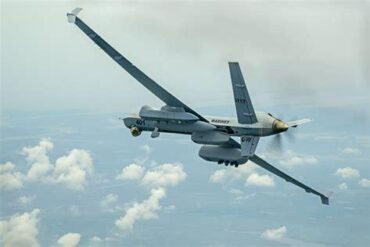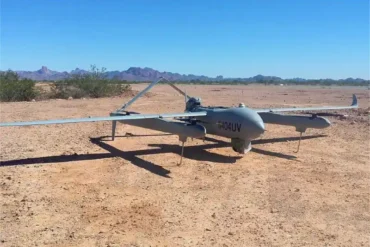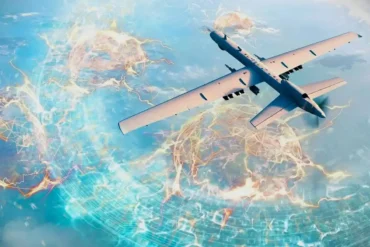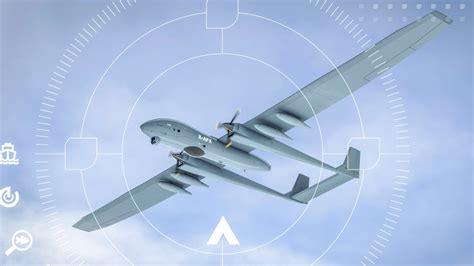
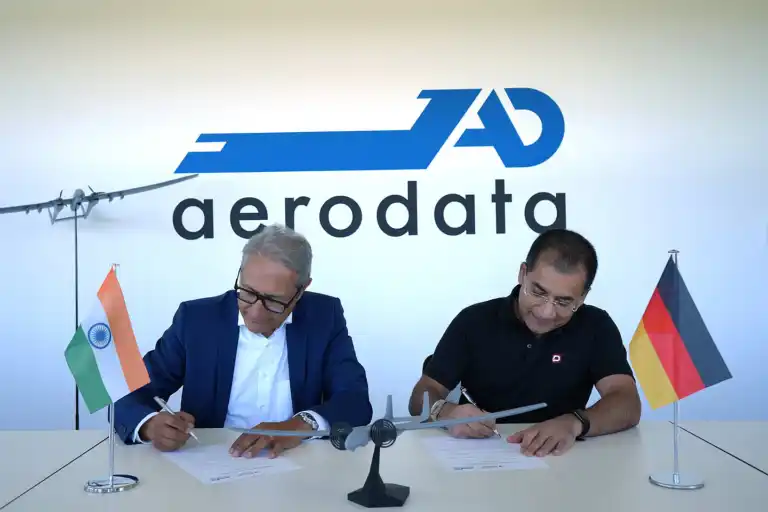
India and Germany are moving toward a deeper strategic partnership in unmanned aviation with the joint development of the AeroForce X, a next-generation medium-altitude long-endurance (MALE) unmanned aerial vehicle designed for demanding intelligence, surveillance and reconnaissance missions. The collaboration, announced through a Memorandum of Understanding between Germany’s Aerodata AG and India’s Dynauton Systems, signals a significant push toward building a flexible ISR platform tailored specifically for India’s mountainous borders and maritime security environment.
The agreement comes at a time when global defence priorities are rapidly shifting toward persistent surveillance capabilities, autonomous systems and network-centric warfare. For India, the need for long-endurance drones has intensified due to increasing operational demands along the Himalayan frontier and across the Indian Ocean Region. These two theatres represent some of the most complex surveillance environments in the world, requiring aircraft capable of remaining airborne for extended periods while carrying advanced sensor suites over enormous distances.
Aerodata’s AeroForce X is now emerging as a serious contender in the expanding MALE UAV market, particularly because it combines endurance, heavy payload capacity and export flexibility in a single platform. The partnership with Dynauton Systems, a subsidiary linked to Dynamatic Technologies, also reflects India’s growing preference for industrial collaborations that strengthen domestic aerospace manufacturing capabilities while reducing dependence on traditional suppliers.
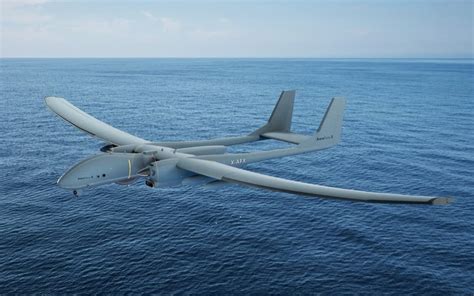
AeroForce X Designed for India’s Unique Operational Geography
The operational demands placed on India’s military and security agencies are unlike those faced by many other nations. Surveillance over the Himalayas requires unmanned aircraft capable of operating in thin air, turbulent weather and high-altitude conditions where performance margins become increasingly narrow. At the same time, maritime patrol operations across the Indian Ocean require wide-area coverage, extended persistence and seamless integration with naval command networks.
The AeroForce X has been positioned as a platform capable of handling both environments without requiring major structural reconfiguration. This versatility is central to the project’s appeal. Instead of operating multiple specialized drone fleets for separate missions, India could potentially deploy a single adaptable ISR platform across mountain borders, coastal regions and maritime patrol zones.
Aerodata’s design philosophy focuses heavily on endurance and mission flexibility. According to available programme details, the AeroForce X is expected to remain airborne for up to 40 hours, placing it among the higher-end endurance platforms currently under development outside the United States and China. Such endurance dramatically expands the aircraft’s usefulness for persistent surveillance operations where maintaining uninterrupted situational awareness is critical.
The platform’s projected payload capacity of approximately 1.3 tonnes further distinguishes it from lighter tactical drones. This allows the aircraft to carry multiple sensor systems simultaneously, including electro-optical payloads, maritime radar, signals intelligence equipment and electronic reconnaissance systems. In practical terms, the drone could monitor border movements, track naval activity and conduct electronic intelligence gathering during a single mission cycle.
Aerodata and Dynauton Build a Strategic Industrial Partnership
The agreement between Aerodata and Dynauton is more than a technical collaboration. It represents a broader industrial strategy that aligns with India’s long-term objective of strengthening indigenous aerospace manufacturing and defence technology integration.
Aerodata contributes significant expertise in airborne surveillance system integration and mission management technologies. The German company has built a reputation around specialized ISR platforms and mission system development, making it well positioned to lead the core design and systems architecture of the AeroForce X programme.
Dynauton Systems brings local engineering support, manufacturing infrastructure and operational understanding of India’s defence environment. Through Dynamatic Technologies, the Indian side already possesses aerospace production experience, which could become critical if the programme eventually advances toward localized manufacturing or assembly operations.
Speaking about the partnership, Aerodata AG CEO Neset Tükenmez described the MoU as a foundation for developing high-performance unmanned reconnaissance systems specifically optimized for missions in the Himalayas and the Indian Ocean Region. On the Indian side, Dynamatic Technologies CEO Udayant Malhoutra emphasized the importance of building upon an already capable platform rather than beginning development from the ground up.
That distinction matters because developing a MALE UAV entirely from scratch is both technically difficult and financially expensive. By leveraging an existing platform architecture, the programme may accelerate testing timelines and reduce developmental risk while still allowing India-specific customization.
Long-Endurance ISR Capability Becoming a Strategic Necessity
Modern ISR missions increasingly demand persistence rather than speed alone. Military planners now prioritize platforms capable of remaining on station for extremely long durations, continuously feeding intelligence back into integrated command networks.
The AeroForce X is being developed precisely for this evolving operational doctrine. A drone capable of remaining airborne for nearly two days can monitor troop movements, maritime traffic patterns and emerging threats without requiring constant aircraft rotation. This significantly improves operational efficiency while reducing logistical strain.
For India, the implications are substantial. Along the Himalayan frontier, persistent ISR coverage can help monitor remote sectors where physical patrols are difficult and weather conditions often restrict manned aviation. Over the Indian Ocean, long-endurance drones provide a cost-effective method of tracking maritime activity across vast areas that would otherwise require expensive crewed patrol aircraft.
The platform’s modular architecture is another major advantage. Rather than locking operators into fixed mission equipment, the AeroForce X is designed to support interchangeable payload configurations depending on mission requirements. This could allow Indian operators to integrate domestically produced sensors, communication systems or electronic warfare packages over time.
The ability to network with manned aircraft and broader surveillance systems also transforms the drone into a force multiplier rather than a standalone reconnaissance asset. ISR data gathered by the UAV can potentially feed directly into wider operational networks, enabling faster decision-making and improved threat assessment.
ITAR-Free Status Gives AeroForce X Major Export Advantages
One of the most strategically important aspects of the AeroForce X programme is its ITAR-free status. Because the aircraft is being developed in Germany without reliance on American export-controlled components, it avoids restrictions associated with the United States International Traffic in Arms Regulations.
This gives the platform considerable export flexibility compared to many Western-origin UAV systems.
For India, this matters both operationally and politically. Indian defence procurement policy has increasingly focused on diversification, seeking to avoid excessive dependence on any single defence supplier. An ITAR-free platform allows greater freedom in future upgrades, payload integration and potential third-party exports.
The absence of restrictive American export controls could also make the AeroForce X attractive to international customers seeking advanced ISR capabilities without the political limitations often attached to US-built systems. Countries in Southeast Asia, the Middle East and Africa may view such a platform as an appealing alternative in the growing MALE UAV market.
Additionally, the modular architecture supports easier localization of components and mission systems. This means India could eventually integrate indigenous communication systems, surveillance payloads or even domestically produced electronic warfare equipment without major redesign requirements.
Flight Testing Scheduled as Development Moves Forward
Despite the growing attention surrounding the programme, the AeroForce X remains in an early development phase. The Memorandum of Understanding establishes a framework for evaluation and collaboration rather than a finalized procurement programme.
Both companies are expected to conduct detailed assessments regarding environmental performance, mission integration requirements and operational concepts tailored specifically to India’s geographic conditions. Adapting the aircraft for high-altitude Himalayan operations may involve additional aerodynamic optimization, engine performance adjustments and specialized sensor calibration.
Aerodata has indicated that ground testing and initial flight trials are expected to begin during the second half of 2026. These trials will likely focus on endurance validation, systems integration and mission payload performance under operational conditions.
The development timeline also reflects the increasingly competitive nature of the global MALE UAV market. Nations worldwide are investing heavily in autonomous surveillance platforms capable of replacing or supplementing traditional crewed ISR aircraft. Persistent surveillance, electronic intelligence gathering and autonomous mission capability are rapidly becoming standard requirements for modern defence forces.
The Aerodata-Dynauton collaboration fits directly into this broader transformation. Instead of pursuing isolated domestic programmes, countries are increasingly combining international technology partnerships with local industrial participation to accelerate capability development.
India’s Expanding Drone Strategy Gains Momentum
The AeroForce X partnership highlights how India’s unmanned systems strategy is evolving beyond tactical drones toward sophisticated long-endurance ISR platforms capable of operating across multiple domains. As regional security challenges continue to grow, the demand for persistent surveillance capability is becoming central to India’s broader defence modernization efforts.
If development proceeds successfully, the AeroForce X could emerge as one of the most capable non-American MALE ISR drones available in the international market. Its combination of long endurance, heavy payload capacity, modular architecture and export flexibility gives the programme significant strategic relevance at a time when autonomous surveillance systems are reshaping modern military operations.
For both India and Germany, the project represents more than a UAV development initiative. It is a demonstration of how international aerospace partnerships are increasingly driving the future of defence technology, combining industrial collaboration with region-specific operational requirements to create platforms designed for the realities of modern security environments.