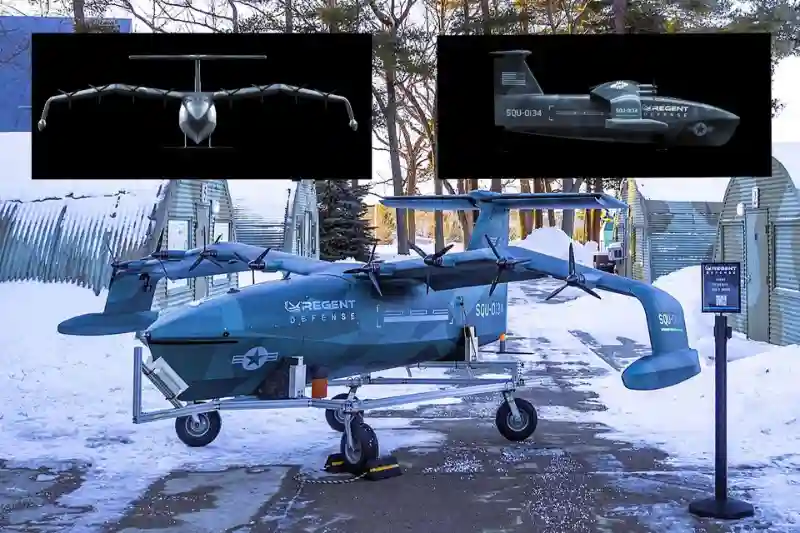
REGENT has introduced Squire, an autonomous Seaglider USA-V (Unmanned Surface and Aerial Vehicle), positioning the compact wing-in-ground craft as a rapid-response platform for reconnaissance, logistics, and medical evacuation across contested maritime environments. Presented to U.S. defense officials in Rhode Island, the vehicle represents a deliberate push toward hybrid mobility systems capable of operating where conventional ships and aircraft face elevated risk from surveillance networks and anti-access threats.
The unveiling took place at the Seabee Museum in Quonset, Rhode Island, where REGENT leadership met with U.S. Secretary of War Pete Hegseth and senior staff. The briefing centered on operational gaps in contested littorals—those dense coastal regions where adversary radar, missile systems, mines, and patrol assets compress maneuver space. In these environments, survivability hinges on speed, signature management, and the ability to launch and recover without reliance on large, fixed infrastructure.
REGENT defines Seagliders as a distinct maritime mobility class: hydrofoiling wing-in-ground effect (WIG) craft that transition from hull-borne movement to foil-supported lift before entering sustained low-altitude flight, typically within a wingspan of the water’s surface. By operating in this narrow aerodynamic corridor, the vehicle exploits a cushion of compressed air between wing and sea surface, increasing efficiency while maintaining a low radar and acoustic profile.
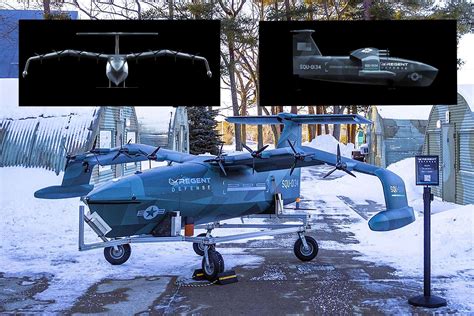
Hybrid Wing-in-Ground Design for Contested Maritime Operations
Unlike traditional uncrewed surface vessels or vertical-lift drones, Squire blends maritime handling with aircraft-like transit speeds. Its hydrofoils raise the fuselage above drag-heavy displacement mode, after which the vehicle accelerates into ground-effect flight. This profile enables it to travel above sonar detection layers yet below many long-range radar horizons, exploiting curvature of the earth and sea clutter to complicate tracking.
This operational envelope is particularly relevant in anti-access/area-denial (A2/AD) zones, where layered defenses threaten both slow surface craft and high-altitude aircraft. By skimming close to the water at speeds up to 70 knots, Squire aims to compress response times while reducing exposure windows. REGENT frames this as a means to move supplies, sensors, or critical payloads between distributed units without committing larger, more vulnerable platforms.
The craft’s external dimensions—13 feet in length, 5.5 feet in height, and an 18-foot wingspan—underscore its deployability. Compact sizing allows storage aboard amphibious ships, auxiliary vessels, or expeditionary staging areas. The emphasis is not brute payload mass but rapid, modular capability insertion.
Modular Payload Architecture and ISR Flexibility
At the core of Squire’s mission adaptability is its internally mounted payload bay, measuring 14 x 14 x 12 inches, offering approximately 2,400 cubic inches of protected volume. The enclosed configuration prioritizes aerodynamic cleanliness and signature discipline over external hardpoints, a design choice aligned with reconnaissance and electronic warfare roles.
Potential mission kits include compact electro-optical/infrared sensors, secure communications relays, signals intelligence packages, or time-critical resupply modules. Because payloads remain internal, drag penalties are minimized and vulnerability to saltwater exposure is reduced. This architecture suggests a platform optimized for modular, repeatable sorties rather than single-use deployments.
With a foil speed of 35 knots and operational range of 100 nautical miles, Squire is tailored to short-notice littoral missions. The speed-range pairing indicates emphasis on tactical insertion rather than strategic endurance. In distributed maritime operations doctrine, such assets can function as connective tissue—linking dispersed forces, ferrying medical supplies, or extracting casualties under fire.
Low-Altitude Survivability and Signature Management
Ground-effect flight inherently supports survivability through physics rather than armor. Radar systems struggle to isolate targets operating within sea clutter, while infrared detection is complicated by water surface reflections and lower engine heat signatures relative to larger aircraft. Autonomy further reduces human risk exposure, allowing the vehicle to operate in environments deemed too hazardous for crewed sorties.
This approach aligns with a broader Pentagon emphasis on attritable systems—platforms affordable and resilient enough to absorb operational losses without strategic paralysis. Squire’s size and production ambitions suggest a design philosophy favoring scalability over exquisite singular capability.
The ability to transition seamlessly between surface maneuver and flight also complicates adversary targeting cycles. A platform that can loiter afloat, then accelerate into low flight, presents an ambiguous detection signature. In contested waters, ambiguity is a form of defense.
Industrial Scaling and Strategic Positioning
REGENT ties Squire’s operational narrative to a domestic production strategy centered in Rhode Island. The company’s 255,000-square-foot manufacturing facility at Quonset is intended to support scaled output of Seaglider variants, reinforcing U.S. industrial capacity in advanced maritime systems. By coupling commercial and defense production streams, REGENT aims to leverage economies of scale uncommon in niche defense platforms.
The firm reports more than $10 billion in global commercial orders and $15 million in contracts with the U.S. Marine Corps, alongside over $100 million in private investment from backers including 8090 Industries, Founders Fund, Japan Airlines, and Lockheed Martin. This blended capital structure suggests confidence in dual-use applications, where passenger and cargo variants may subsidize defense innovation cycles.
The commercial interest is not incidental. Wing-in-ground craft historically struggled with regulatory ambiguity and niche mission sets. By positioning Seagliders as both civilian coastal connectors and defense logistics enablers, REGENT is attempting to normalize the category at industrial scale.
Operational Implications for Distributed Maritime Forces
For commanders confronting contested seas, mobility is no longer defined solely by tonnage or range. It is defined by survivability per mile and time to effect. Squire’s combination of speed, low-altitude flight, and modular payload carriage offers a potential bridge between traditional surface craft and unmanned aerial systems.
In humanitarian or counternarcotics missions, the platform could shuttle medical kits or surveillance payloads rapidly across archipelagic terrain. In higher-end conflict scenarios, it might insert sensors into denied areas or resupply isolated units without exposing larger vessels. The concept hinges on tempo—arriving, delivering, and departing before adversary detection cycles fully activate.
The broader Seaglider family remains under development, but Squire serves as a proof point: a compact, autonomous vehicle built to exploit the narrow aerodynamic margin between sea and sky. In an era where maritime dominance increasingly depends on agility rather than sheer displacement, such hybrid systems may define a new layer of operational maneuver space.
REGENT’s demonstration signals an effort to transform wing-in-ground craft from experimental curiosity into deployable military asset. If production scales as projected and operational testing validates survivability claims, Squire could emerge as a specialized but influential component of future U.S. maritime reconnaissance and logistics architecture—an aircraft that thinks like a boat, and a boat that flies just low enough to matter.