
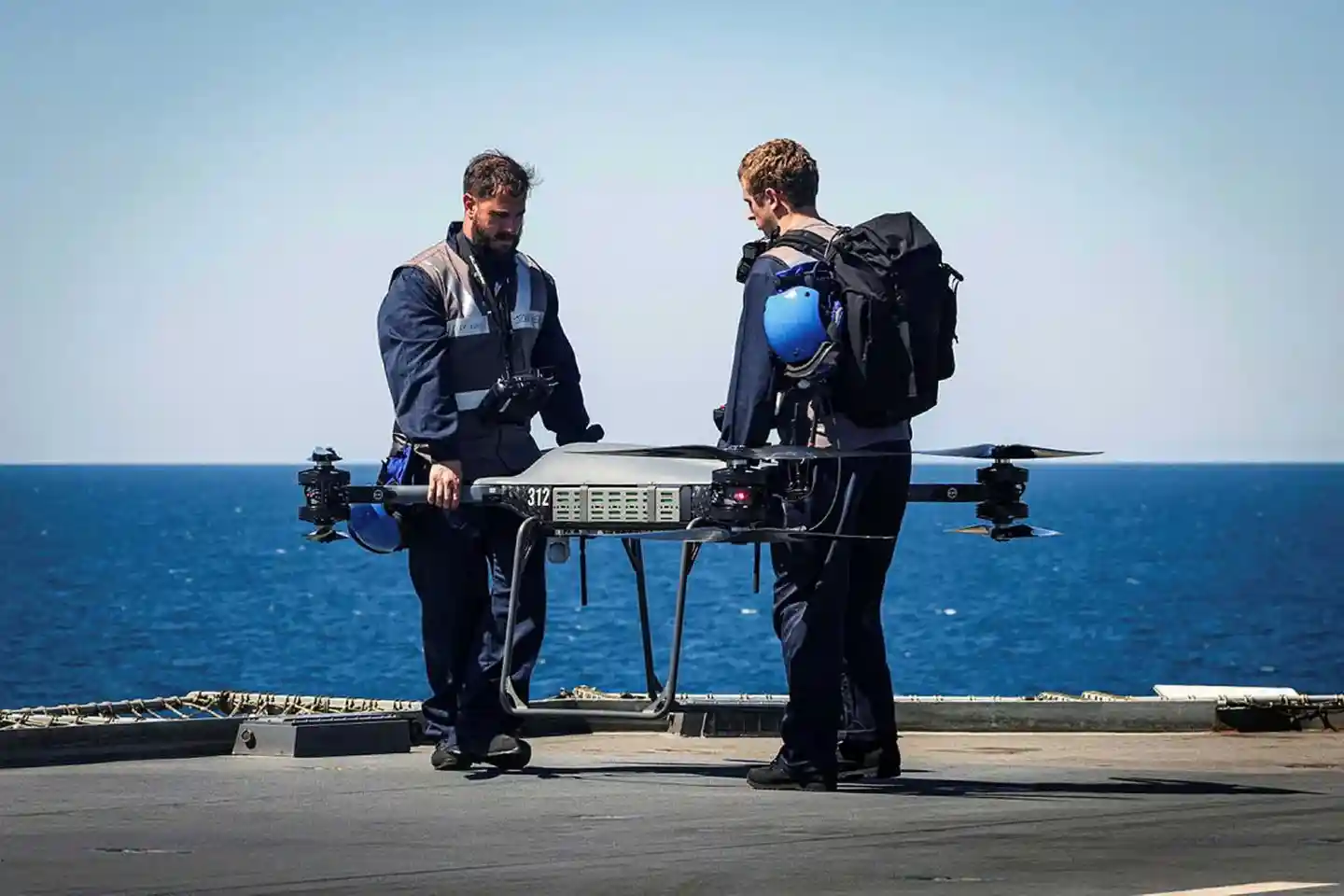
In a strategic leap toward autonomous naval logistics, the British Royal Navy has conducted pioneering flight tests of the Malloy Aeronautics Heavy Lift Drone aboard the aircraft carrier HMS Prince of Wales, redefining how future maritime operations could be sustained. Conducted on July 9, 2025, as part of Operation Highmast, the testing represents a significant milestone in the United Kingdom’s unmanned systems strategy, targeting logistical efficiency and enhanced operational survivability in high-threat maritime environments.
HMS Prince of Wales: A Launchpad for Autonomous Naval Aviation
The HMS Prince of Wales, one of the Royal Navy’s two Queen Elizabeth-class aircraft carriers, served as the operational testbed for this critical drone evaluation. With its expansive flight deck, modern command infrastructure, and capacity to support complex air operations, the ship provided an ideal platform to trial the vertical take-off and landing (VTOL) system under real-world maritime conditions. The integration of drone technology into a platform of this scale underscores the Royal Navy’s ambitions under its Future Maritime Aviation Force (FMAF) program.
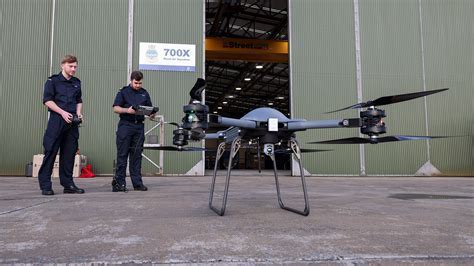
The tests were carried out by 700X Naval Air Squadron, a specialist unit under the Fleet Air Arm, charged with pioneering Remotely Piloted Air Systems (RPAS) within the Royal Navy. Their focus on integrating unmanned aerial vehicles into naval doctrine has made them the vanguard of maritime drone operations in the UK’s military.
Malloy Aeronautics Drone: Technical Superiority at Sea
The Malloy Heavy Lift Drone distinguishes itself through a powerful blend of payload capacity, range, and stealth features:
- Payload: Capable of lifting over 180 kilograms, the drone can transport vital equipment, medical supplies, or ammunition with ease.
- Range: Operational over distances of up to 70 kilometers, ideal for ship-to-ship or ship-to-shore resupply.
- Propulsion: Features an electric propulsion system, lowering its thermal and acoustic signature—a major advantage in covert or contested operations.
- Modular Architecture: Allows rapid reconfiguration, supporting diverse mission sets such as casualty evacuation, supply drops, or surveillance relay.
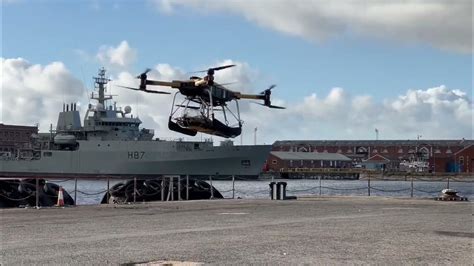
The drone’s VTOL capability makes it particularly well-suited to naval environments, where landing zones can be unpredictable or confined. Unlike conventional rotorcraft, the Malloy drone requires no extensive infrastructure and can operate autonomously or semi-autonomously, even in high sea states or turbulent flight decks.
Operation Highmast: A Live Maritime Testbed
The drone tests are part of Operation Highmast, the UK’s 2025 Carrier Strike Group (CSG) deployment, encompassing multi-theatre naval exercises across the Mediterranean, Middle East, and Indo-Pacific. This high-profile operation involves more than 4,500 British personnel, including:
- 2,500 Royal Navy sailors and Royal Marines
- 600 Royal Air Force crew
- 900 British Army soldiers
The exercise brings together military assets from over a dozen allied nations, providing a live, multinational testing environment for evaluating advanced systems like the Malloy drone. It demonstrates how cutting-edge British defense technologies can integrate seamlessly within joint coalition frameworks and adapt to complex operational demands.
A Response to Modern Warfare Demands
Modern naval warfare increasingly requires distributed operations, where small, agile units operate independently across vast oceanic areas. In such scenarios, logistical flexibility becomes a critical factor in mission success. The Malloy drone directly addresses the Royal Navy’s need for resilient logistics in degraded or contested environments. Unlike manned helicopters, which are expensive and vulnerable to ground or air-based threats, drones can perform repetitive supply runs without risking lives.
The benefits are manifold:
- Reduced crew exposure in hostile zones
- Greater logistical frequency and coverage
- Rapid deployment of critical assets
- Improved endurance for forward-deployed forces
In amphibious assault operations or special forces insertions, where stealth and rapid resupply are vital, the drone offers a significant tactical edge.
Malloy Aeronautics: A Homegrown Innovation
The Malloy Heavy Lift Drone is developed by Malloy Aeronautics, a Berkshire-based defense firm specializing in autonomous aerial solutions. The drone has been tailored to meet stringent requirements from both NATO and the UK Ministry of Defence, focusing on sustainability, modularity, and multi-environment operability.
This collaboration between the Royal Navy and Malloy Aeronautics is emblematic of a broader defense industrial trend: prioritizing indigenous technology development that is both agile and scalable. The firm’s heavy-lift drones are already attracting attention from multiple defense partners seeking logistical autonomy without increased human risk.
The Strategic Implications for Carrier Strike Doctrine
The successful trials aboard HMS Prince of Wales signal a transformative shift in the Royal Navy’s carrier strike group doctrine. Integrating unmanned aerial logistics systems into carrier operations opens new avenues for sustained power projection, especially in regions where resupply lines are vulnerable.
Drones like the Malloy Heavy Lift model could form part of a dedicated unmanned logistics wing aboard carriers, supporting sustained deployments by enabling rapid resupply of:
- Munitions and spares to strike aircraft
- Emergency medical equipment to damage control teams
- High-value tools to isolated elements in a task force
By offloading routine logistics from helicopters and manned aircraft, operational tempo increases, while maintenance burdens and crew fatigue are reduced.
Future Maritime Aviation Force (FMAF): Vision in Action
Under the Future Maritime Aviation Force roadmap, the Royal Navy envisions a hybrid fleet of manned and unmanned air platforms capable of meeting 21st-century threats across air, sea, and land domains. From combat ISR drones to autonomous logistics enablers, the goal is an aviation force that’s resilient, adaptive, and minimally dependent on vulnerable supply chains.
This vision is now becoming reality:
- The Malloy drone’s integration shows scalable drone deployment is viable at the carrier level.
- 700X Squadron’s hands-on testing validates maritime drone doctrine in live operations.
- Partnerships with UK-based manufacturers ensure sovereign technology leadership.
Global Relevance and NATO Interoperability
The drone trials send a clear signal to international allies and competitors alike: the British Royal Navy is prepared to lead in unmanned naval logistics. As peer adversaries invest in anti-access/area-denial (A2/AD) strategies, maintaining supply chains through traditional methods becomes increasingly hazardous. Drones provide a low-profile, high-impact alternative.
Through joint exercises and inter-NATO technology sharing, the lessons from Operation Highmast will likely influence allied doctrine and procurement strategies. As NATO navies move toward greater interoperability, systems like the Malloy drone could see deployment across multiple fleets, especially in forward operating groups or littoral missions.
Conclusion: Redefining Naval Logistics for the 21st Century
The British Royal Navy’s testing of the Malloy Heavy Lift Drone aboard HMS Prince of Wales is more than a technological milestone; it is a bold declaration of intent. As global maritime threats evolve and logistic vulnerabilities increase, the integration of unmanned logistics into the carrier strike framework offers a decisive advantage.
Through homegrown innovation, strategic foresight, and coalition collaboration, the UK is carving out a leadership role in the future of autonomous naval warfare. The Malloy drone isn’t just lifting payloads—it’s lifting the very concept of what’s possible in maritime operations.




![Big Drones & Heavy Lift Drones: A Comprehensive Guide for Drone Pilots [New for 2025]](https://boltflight.com/wp-content/uploads/2025/05/big-drones-heavy-lift-drones-comprehensive-guide-drone-pilots-new-2025-370x247.jpg "Big Drones & Heavy Lift Drones: A Comprehensive Guide for Drone Pilots [New for 2025]")