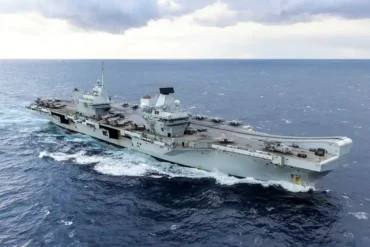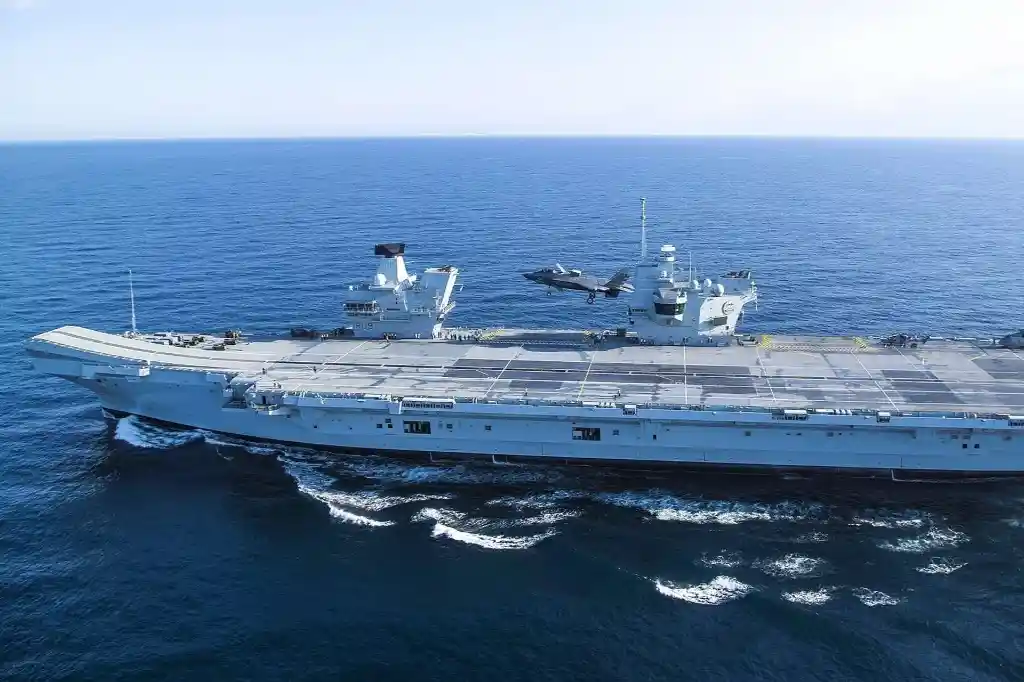
The United Kingdom has initiated a major naval deployment aimed at reinforcing NATO’s northern flank, dispatching HMS Prince of Wales and its accompanying Carrier Strike Group (CSG) to the North Atlantic and High North under Operation Firecrest. Confirmed by the UK Ministry of Defence on 14 February 2026, the mission reflects London’s sharpened focus on deterring Russian maritime activity and safeguarding critical undersea infrastructure that underpins transatlantic connectivity.
The High North has re-emerged as a strategic arena where sea lanes, seabed cables, energy pipelines, and submarine patrol routes intersect in a dense web of geopolitical significance. Russian naval operations in the North Atlantic have reportedly increased by approximately 30 percent over the past two years, elevating concerns within NATO about freedom of maneuver, reinforcement corridors, and the vulnerability of fiber-optic networks linking Europe and North America. Against this backdrop, the deployment of Britain’s largest warship signals not escalation, but calibrated deterrence.
Operation Firecrest and NATO’s Northern Shield
Operation Firecrest is framed squarely within NATO’s collective defense architecture. British officials describe the mission as a direct contribution to Euro-Atlantic security, reinforcing alliance readiness while integrating seamlessly with multinational command structures. The Carrier Strike Group will conduct interoperability drills with Nordic allies, the United States, and Canada, strengthening cohesion in a theater where harsh environmental conditions demand seamless coordination.
The North Atlantic and Arctic environments impose unique operational challenges: unpredictable weather systems, limited daylight during winter months, sparse fixed infrastructure, and vast maritime distances. Sustained presence in such conditions requires not only advanced platforms but also a robust command-and-control backbone capable of coordinating distributed maritime operations. HMS Prince of Wales provides precisely that capability.
HMS Prince of Wales: A 65,000-Ton Strategic Instrument
Displacing approximately 65,000 tons, HMS Prince of Wales is engineered for sustained high-tempo air operations. Its ski-jump flight deck enables efficient short takeoff and vertical landing operations for the F-35B Lightning II, maximizing sortie generation rates even in constrained weather windows. Expanded aviation fuel reserves and deep munitions magazines allow prolonged operations without immediate resupply, a critical factor in remote northern waters.
Internally, the carrier’s design supports a comprehensive joint command staff, allowing British and allied commanders to orchestrate maritime and air assets across an expansive operational grid. In regions where land-based airfields are scarce or distant, the carrier effectively becomes a sovereign, mobile airbase capable of repositioning as the tactical situation evolves.
During surge conditions, the Queen Elizabeth-class carriers can generate up to 72 fast-jet sorties per day. Aircraft lifts capable of moving multiple F-35Bs from hangar to flight deck in roughly one minute enable rapid response cycles. In high-latitude operations where weather patterns can compress flight windows, such efficiency translates directly into operational advantage.
Layered Defense: Destroyers, Frigates and Submarines
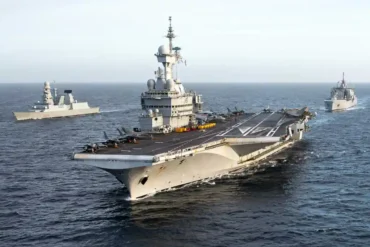
The Carrier Strike Group’s defensive architecture is built around layered protection. Type 45 destroyers equipped with the Sea Viper air-defense system and advanced SAMPSON radar provide long-range detection and engagement of multiple airborne threats simultaneously. Their role is to establish an outer defensive shield capable of countering aircraft and missile threats before they approach the carrier.
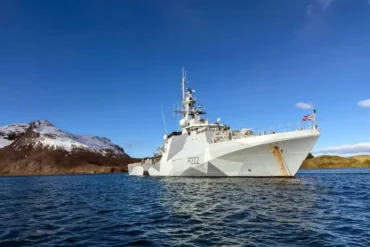
Complementing this air-defense umbrella are anti-submarine warfare assets. Type 23 frigates or the newer Type 26 Global Combat Ships contribute advanced sonar suites and quiet propulsion systems optimized for tracking adversary submarines. Embarked anti-submarine helicopters extend detection ranges, creating a dynamic undersea surveillance envelope.
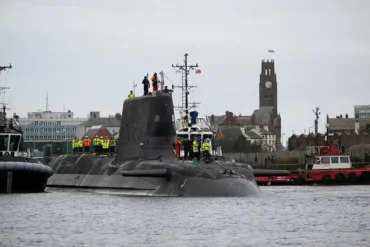
Beneath the surface, an Astute-class nuclear-powered attack submarine enhances the strike group’s stealth and intelligence capabilities. Its ability to operate undetected provides both deterrent presence and flexible strike options. In an environment where Russian submarine activity has intensified, such subsurface capability is indispensable.
Together, these assets create a resilient, multi-domain formation. Aircraft expand reconnaissance reach, destroyers provide air defense, frigates and helicopters patrol the undersea battlespace, and submarines operate invisibly to contest adversary movements. Presence, in this configuration, becomes persistence.
The F-35B and Multi-Domain Awareness
At the heart of the strike group’s combat power lies the F-35B Lightning II. More than a strike aircraft, it functions as a sensor node within a broader network. Its AN/APG-81 radar and distributed aperture system collect and fuse data across air and maritime domains, while secure data links distribute this information to allied platforms.
In contested waters such as the Greenland-Iceland-UK (GIUK) gap, real-time data sharing enhances maritime domain awareness and accelerates decision-making cycles. An F-35B detecting a surface contact or potential submarine cue can relay that information instantly to destroyers, frigates, or allied maritime patrol aircraft. This integration transforms isolated platforms into a cohesive operational web.
Such capabilities are particularly relevant to undersea infrastructure protection. Fiber-optic cables and energy pipelines are increasingly viewed as strategic assets vulnerable to interference or sabotage. Persistent surveillance, rapid identification of anomalies, and coordinated response are central to deterring gray-zone activities below the threshold of open conflict.
Multinational Integration and Arctic Sentry
Firecrest extends beyond national signaling. The deployment includes participation in NATO’s Arctic Sentry mission and coordination with Standing NATO Maritime Group 1. Additionally, Joint Force Command Norfolk—soon to be led by the United Kingdom—provides a transatlantic command nexus focused on securing reinforcement routes between North America and Europe.
A planned port visit to the United States and the integration of US aircraft on the British carrier deck underscore practical interoperability. This cross-decking demonstrates that allied air wings can operate interchangeably, amplifying combat mass without requiring permanent basing.
The deployment also aligns with Britain’s broader northern posture. London has pledged to double troop deployments to Norway from 1,000 to 2,000 personnel and to raise defense spending to 2.6 percent of GDP beginning in 2027. These measures signal that carrier presence in the High North is not episodic but embedded within a sustained strategic framework.
Securing the Transatlantic Lifeline
The North Atlantic remains the connective tissue of the alliance. In a crisis, reinforcement of Europe depends on secure sea lanes and protected communication networks. Russian naval modernization, including submarine fleet enhancements and long-range precision capabilities, has sharpened attention on these arteries.
Operation Firecrest positions the United Kingdom as a central maritime guarantor in this environment. By combining sustained carrier aviation, advanced surface escorts, subsurface stealth, and multinational command integration, the Carrier Strike Group serves both as a visible symbol of resolve and as a practical instrument of sea control.
Deterrence in the High North is less about dramatic confrontation and more about steady presence. It is about ensuring that shipping routes remain open, that cables remain intact, and that alliance forces can maneuver without obstruction. In deploying HMS Prince of Wales to these contested waters, Britain reinforces a simple strategic proposition: that the maritime corridors binding North America and Europe will remain monitored, defended, and operational under NATO’s collective shield.