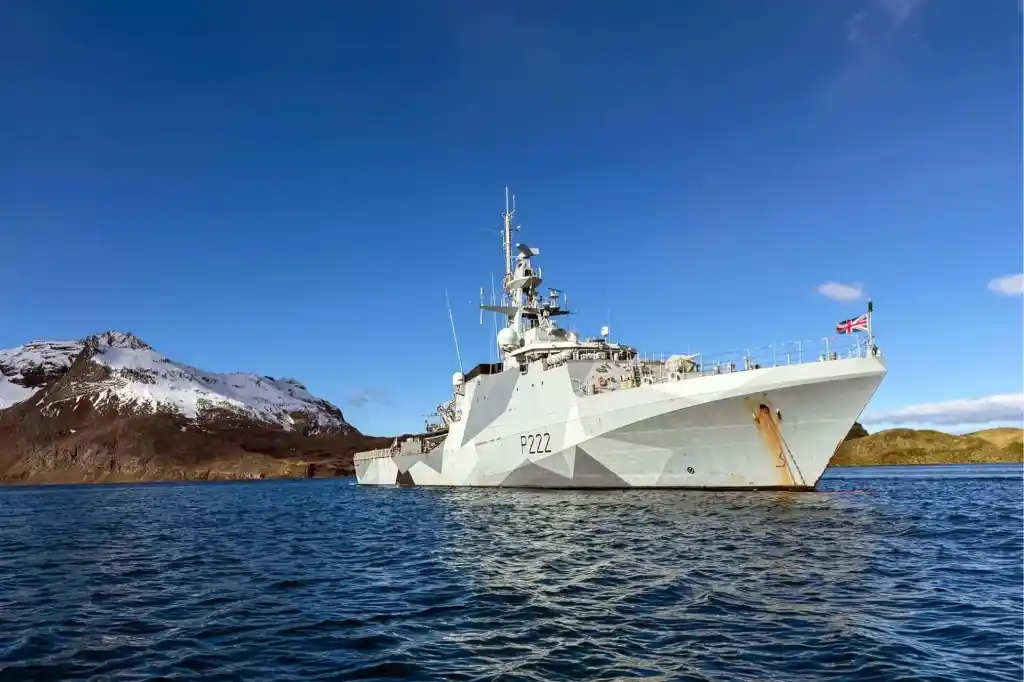
The United Kingdom has once again affirmed its enduring presence in the South Atlantic through the successful completion of Operation Southern Sovereignty, a sweeping tri-service deployment that concluded in December 2025. At its helm was HMS Forth (P222), a Batch 2 River-class offshore patrol vessel whose voyage reaffirmed Britain’s military capability, logistical endurance, and sovereign commitment across its far-flung overseas territories.
HMS Forth: Strategic Sentinel of the South Atlantic
HMS Forth, launched in 2016 and commissioned in 2018, represents a new breed of offshore patrol vessels designed not merely for constabulary roles, but for strategic deterrence and presence. Permanently stationed at Mare Harbour in the Falkland Islands since replacing HMS Clyde in 2020, Forth has emerged as a keystone of UK military posture in the region.
With a displacement of 2,000 tonnes, an endurance of 35 days, and a hull engineered for remote operations, HMS Forth excels in autonomy and persistence. Her 90.5-meter frame supports a suite of systems—BAE Systems CMS-1 combat management, Terma Scanter 4100 radar, and SharpEye navigation sensors—which provide seamless integration with air and land assets.
Operation Southern Sovereignty: Military Cohesion at Extreme Distance
Launched by the UK Ministry of Defence, Operation Southern Sovereignty was more than a naval patrol; it was a comprehensive display of joint-force integration across 1.5 million square miles of unforgiving ocean and terrain. HMS Forth served as the command hub for Brigadier Charlie Harmer, Commander of British Forces South Atlantic Islands, who orchestrated synchronized operations among Royal Navy, British Army, and Royal Air Force components.
The patrol included not only the Falkland Islands but extended to Ascension Island and South Georgia, regions that remain geopolitically sensitive and geographically remote. Navigating iceberg-laced waters in the Southern Hemisphere’s summer, Forth braved sea temperatures averaging just 6°C and peaks rising over 9,000 feet—emphasizing the resilience demanded of both crew and vessel.
Versatility in Combat and Constabulary Missions
While HMS Forth does not possess the firepower of a frigate or destroyer, her layered defense systems—30 mm DS30M Mk2 naval gun, general-purpose and .50 caliber machine guns—support a wide range of scenarios. A Merlin-capable flight deck allows for rotary-wing operations, crucial for surveillance, logistics, and boarding missions. Her two rigid inflatable boats further extend reach in littoral zones.
Onboard, a Royal Irish Regiment detachment embarked to conduct amphibious training, embodying the ship’s modular capacity to host up to 50 personnel for flexible mission profiles. Their exercises, coordinated with RAF Typhoon jets and an A400M Atlas airlifter from Mount Pleasant Complex, demonstrated integrated rapid response capabilities across vast distances.
Dual-Purpose Diplomacy: Military and Civil Cooperation
Beyond combat readiness, Operation Southern Sovereignty featured a significant civil support mission. HMS Forth transported construction materials for the government of South Georgia, bridging Maiviken Cove and Grytviken without traditional infrastructure. This endeavor not only showcased military logistical acumen but also reinforced the UK’s role in supporting governance and resilience in its overseas territories.
The Strategic Symbolism of Sovereignty
Operation Southern Sovereignty was not merely a projection of British might—it was a reaffirmation of sovereign presence in territories with enduring geopolitical relevance. The UK’s ability to maintain high-readiness forces thousands of miles from its mainland signals not just operational competence, but unwavering commitment to territorial integrity and deterrence.
HMS Forth’s motto, “Go Forth and Conquer,” encapsulates a new paradigm for patrol vessels. These ships are no longer passive guardians of coastal waters; they are forward-deployed sentinels enabling active sovereignty, deterrence, and regional engagement. Her successful deployment sends a clear message that the UK remains a steadfast guardian of its territories, even in the world’s most austere environments.
Modern Naval Strategy in Action
Defense analysts emphasize that the effectiveness of HMS Forth lies not in her armament, but in her deployability, sensor suite, interoperability, and endurance. In low-intensity yet strategically charged environments, such vessels provide disproportionate impact when paired with air and land forces.
The tri-service model showcased during the operation echoes modern military doctrine: joint, agile, networked forces capable of delivering political and tactical effects from minimal platforms. From patrolling icy waters to facilitating local governance, HMS Forth exemplified the kind of versatile maritime power increasingly relevant in 21st-century defense strategy.
Christmas at Sea: Living the Mission
For the crew of HMS Forth, Christmas 2025 came not with warm hearths but with snowfall and sub-zero wind spray. The symbolic weight of this sacrifice was not lost: maintaining sovereignty in remote theaters is not a matter of rhetoric but of daily, lived commitment.
As 2025 came to a close, HMS Forth’s mission underscored that Britain’s global role remains deeply tied to its capacity for sustained engagement in distant geographies. Operation Southern Sovereignty reinforced the principle that sovereignty is not static—it must be continually asserted, protected, and manifested through presence.
Conclusion: Sovereignty in Action, Not Assertion
Through Operation Southern Sovereignty, the UK has demonstrated that its commitment to the South Atlantic is active, strategic, and enduring. HMS Forth’s successful operation showcased the power of naval agility, tri-service coordination, and the quiet persistence required to uphold a nation’s claim over distant soil and sea.
It was not merely a mission. It was a message: sovereignty, like the seas it’s claimed upon, must be patrolled—not presumed.