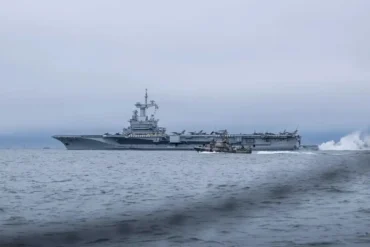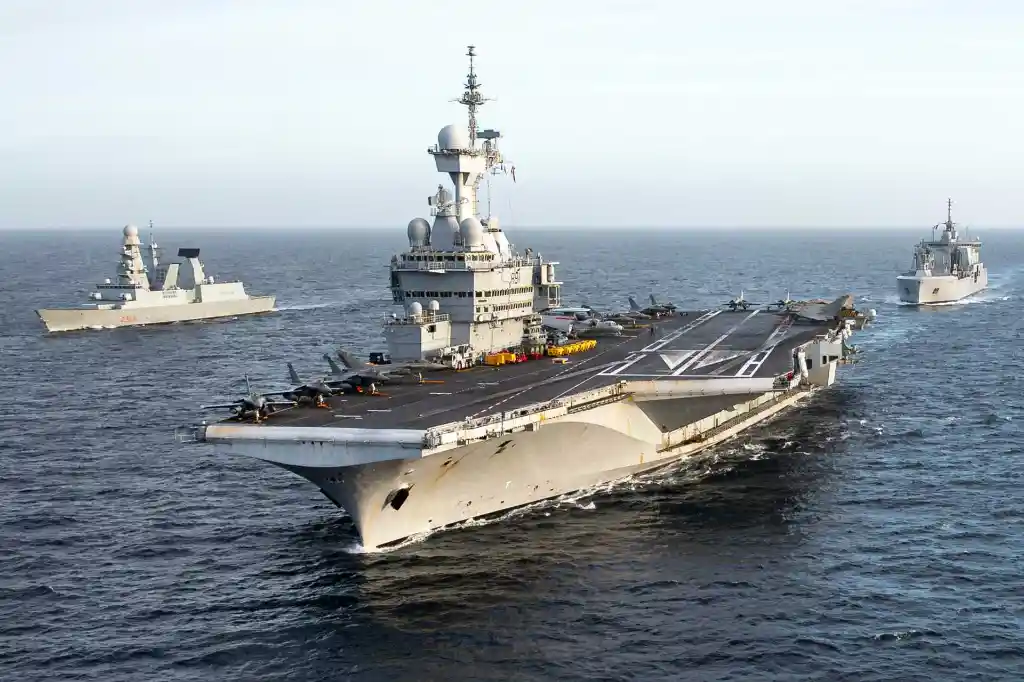
France’s nuclear-powered aircraft carrier Charles de Gaulle has shifted strategic theaters, sailing from the Mediterranean into the Atlantic as the centerpiece of ORION 26, the largest high-intensity joint military exercise ever organized by France. Confirmed by the French Navy on February 5, 2026, the deployment marks a decisive transition from preparatory naval drills to a full-spectrum multinational warfighting scenario designed to simulate modern great-power conflict conditions across Europe’s maritime and continental approaches.
The maneuver is not a symbolic sail-past. It represents a national-level operational stress test—one that blends naval power projection, coalition command authority, logistics endurance, and multi-domain warfare integration. By repositioning the carrier strike group into the Atlantic operating space, French planners are anchoring the maritime dimension of a sprawling exercise architecture that stretches across land, air, cyber, and space environments. The Atlantic frontage, historically tied to reinforcement corridors and transoceanic supply routes, provides the geographic depth required to simulate prolonged coalition warfare.
The deployment follows the carrier’s departure from Toulon Naval Base on January 27, 2026, a movement executed under the command of Captain Thomas Puga. The exit from the vast Mediterranean roadstead was completed in roughly twenty minutes—an efficient but symbolically potent evolution signaling the start of France’s most ambitious operational rehearsal in decades. From that moment, the strike group’s mission shifted from national readiness to allied warfighting integration.
ORION 26: A Strategic Warfighting Laboratory
ORION 26 is engineered as far more than a routine multinational drill. Structured as a progressive escalation scenario, the exercise simulates the full spectrum of conflict—from hybrid destabilization to open conventional warfare. Its architecture is designed to test whether France can command, sustain, and synchronize coalition forces under the pressures of a large-scale European conflict.
The fictional crisis underpinning the exercise revolves around an expansionist state known as Mercure, which seeks to dominate regional geopolitics by destabilizing its neighbor, Arnland. Through disinformation campaigns, political coercion, and proxy militia support, Mercure gradually erodes Arnland’s sovereignty before triggering open hostilities. The scenario’s design deliberately mirrors contemporary security dynamics in Eastern Europe, translating real-world tensions into a legally neutral but operationally realistic framework.
France assumes coalition leadership at Arnland’s request, a political trigger that initiates the exercise’s combat phases. From that point forward, ORION 26 forces participants to manage deterrence failure, escalation control, and high-intensity warfare simultaneously. Military operations unfold alongside civilian crises—cyber disruption, infrastructure strain, and population protection—reflecting the blurred boundary between battlefield and homeland in modern conflict doctrine.
Scale, Coalition Integration, and Operational Reach
The magnitude of ORION 26 underscores its strategic ambition. The exercise gathers 24 participating nations and roughly 10,000 military personnel, operating across multiple French regions and maritime approaches. Activities officially begin on February 8, 2026, and extend through April 30, creating a sustained operational tempo rather than a short tactical burst.
French headquarters structures are placed in a role equivalent to leading a NATO-scale operation. This includes testing multinational staffing procedures, command continuity, intelligence fusion, and political-military decision cycles under prolonged stress. The emphasis is not simply battlefield success but coalition cohesion—ensuring allied forces can fight effectively without fragmentation in command or doctrine.
Naval forces play a central role, particularly along the Atlantic seaboard where maritime security, amphibious maneuver, and reinforcement logistics converge. The presence of a nuclear-powered carrier strike group adds strategic depth, enabling long-range airpower, sea control, and strike coordination within the simulated theater.
Four Phases of Escalation Warfare
ORION 26 unfolds through four interconnected operational phases, each designed to replicate a different layer of modern conflict.
The first phase, O.1, focuses on campaign design—translating political directives into executable military strategy. Planning staffs must integrate multinational assets, define rules of engagement, and synchronize joint force objectives.
Phase O.2 shifts into theater entry. Coalition forces deploy into contested environments, executing rapid concentration maneuvers while facing simulated anti-access and area-denial threats. Initial high-intensity engagements test readiness under compressed timelines.
Phase O.3 expands beyond the battlefield into an interministerial crisis simulation. Civil authorities confront infrastructure disruption, cyber incidents, and homeland defense pressures, reinforcing the reality that modern wars extend far beyond front lines.
Phase O.4 integrates French command structures into a NATO framework. This stage rehearses alliance interoperability—aligning national command chains, communications protocols, and operational authorities under unified control.
Naval Power at the Core of the Exercise
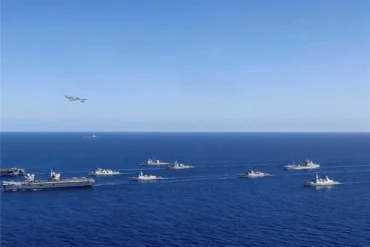
At the heart of ORION 26 sails the Charles de Gaulle Carrier Strike Group, functioning as both a combat platform and a coalition command hub. Before entering the Atlantic phase, the formation conducted extensive Mediterranean interoperability drills with allied forces.
Training sequences included layered air defense operations, anti-submarine warfare hunts, surface combat simulations, and coordinated precision strike rehearsals. These evolutions ensured that multinational escorts and air wings could operate as a single integrated force rather than parallel national contingents.
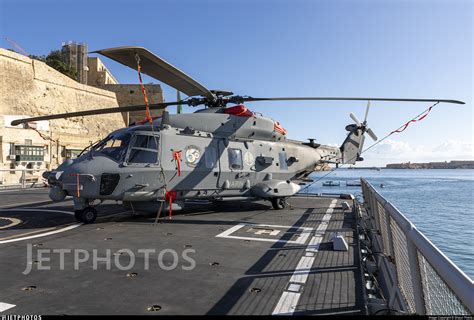
A replenishment-at-sea exercise with the Italian destroyer Andrea Doria validated logistics interoperability. Cross-deck helicopter operations further demonstrated aviation compatibility, with an Italian SH-90 landing directly on the French carrier’s flight deck—an evolution requiring harmonized procedures, communications, and deck handling protocols.
Order of Battle: Escorts and Air Wing Composition
While the French Navy did not publish a complete official order of battle, key surface and subsurface escorts accompanying the carrier have been identified. The strike group reflects a balanced defensive and offensive configuration designed for high-threat maritime environments.
Escorting units include the air defense frigate Alsace, the Horizon-class destroyer Chevalier Paul, and Italy’s Andrea Doria. Sustained operations are supported by the fleet replenishment tanker Jacques Chevallier, ensuring fuel, munitions, and supply continuity. A nuclear-powered attack submarine operates as part of the screen, providing undersea surveillance and deterrence.
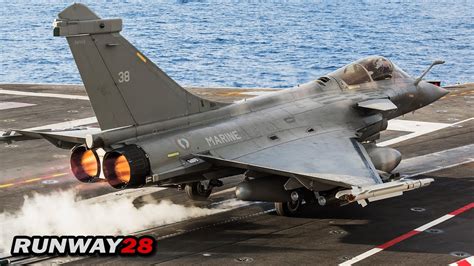
Embarked aboard the carrier is an air wing centered on 20 Rafale Marine fighter aircraft. These multirole jets conduct fleet air defense, deep strike missions, reconnaissance, and escort operations—forming the airborne striking arm of the maritime task force.
Engineering a Nuclear-Powered Warship
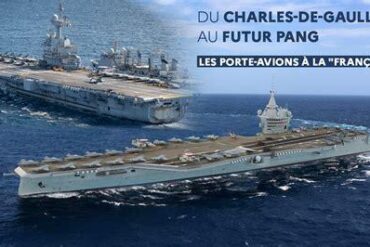
The Charles de Gaulle remains France’s only nuclear-powered aircraft carrier, a status that grants it exceptional endurance and operational autonomy. Displacing approximately 42,500 tonnes at full load, the vessel stretches 261.5 meters in length with a 64.4-meter flight deck beam—dimensions that place it firmly among the world’s major carrier platforms.
Propulsion is delivered by two K15 pressurized-water nuclear reactors, generating roughly 83,000 horsepower across twin shafts. This configuration enables sustained high-speed transit reaching 27 knots while eliminating the need for conventional fuel refueling cycles—an immense strategic advantage during prolonged deployments.
The flight deck operates under a CATOBAR system—Catapult Assisted Take-Off But Arrested Recovery—using two 75-meter steam catapults and arresting wires. This arrangement allows heavier, fully armed aircraft launches and recoveries, expanding mission flexibility compared to ski-jump carriers.
Sensors, Defenses, and Combat Systems
Defensive architecture aboard the carrier integrates layered missile and gun systems tied together by the SENIT 8 combat management network. Aster 15 surface-to-air missiles provide medium-range interception capability, launched from Sylver vertical systems embedded within the ship’s structure.
Short-range threats are countered by Sadral launchers firing Mistral missiles, while Narwhal remotely operated 20 mm cannons offer close-in protection against asymmetric or aerial hazards. Electronic warfare suites blanket the electromagnetic spectrum, disrupting hostile sensors and missile guidance systems.
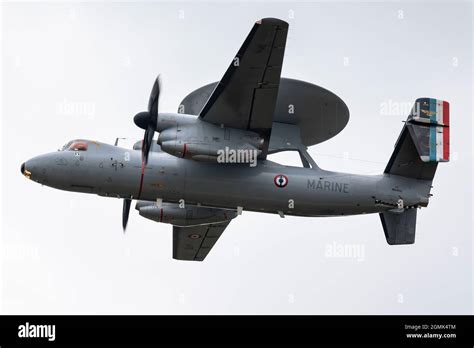
The carrier’s airborne early warning component, typically fielded through E-2C Hawkeye aircraft, extends radar coverage hundreds of kilometers beyond the fleet—transforming the strike group into a floating surveillance node capable of detecting threats long before visual contact.
Operational Legacy and Strategic Significance
The Atlantic deployment for ORION 26 builds on the carrier’s long operational history. Since entering service, Charles de Gaulle has supported combat operations over Afghanistan, Libya, Iraq, and Syria—demonstrating France’s ability to project power far beyond European waters.
Its participation in ORION 26 is less about immediate conflict and more about future war preparedness. The exercise environment replicates peer-level warfare conditions—dense air defenses, submarine threats, cyber disruption, and coalition command friction. By rehearsing these stressors simultaneously, France and its allies are refining the muscle memory required for large-scale combat operations.
The carrier’s relocation from the Mediterranean to the Atlantic also signals geographic flexibility. It underscores the French Navy’s capacity to reposition strategic assets rapidly between theaters—an essential trait in an era where crisis flashpoints can ignite with little warning.
As ORION 26 unfolds through spring 2026, the Charles de Gaulle Carrier Strike Group operates not just as a fleet formation but as a floating laboratory of modern warfare integration—testing how nations fight together when deterrence fractures and the theoretical becomes operational reality.