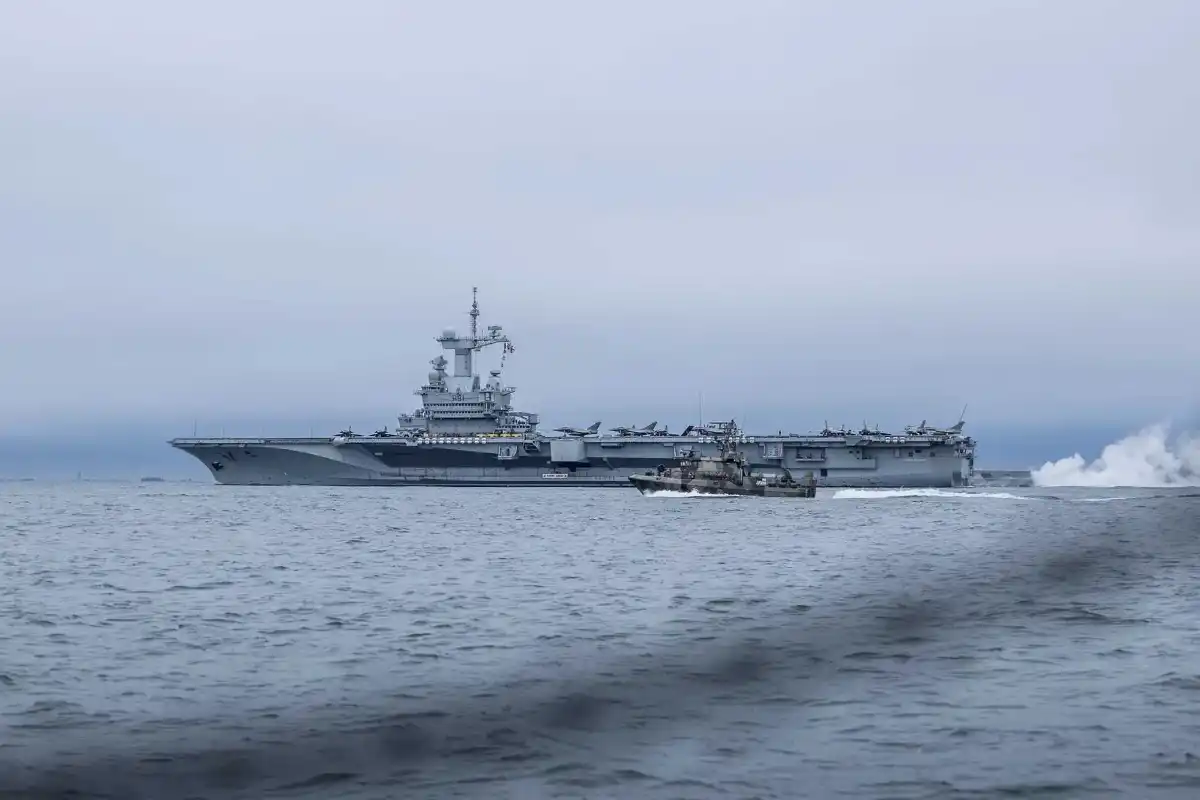
The sudden redeployment of France’s Charles de Gaulle aircraft carrier strike group toward the Eastern Mediterranean marks one of the most significant European naval movements since the beginning of the expanding US–Iran conflict in 2026. Ordered directly by President Emmanuel Macron, the mission reflects France’s effort to protect its strategic interests, reinforce allied defenses, and maintain stability along vital maritime corridors as hostilities spread across the Middle East.
The French naval formation, which had been operating in northern Europe as part of a multinational military exercise, abruptly halted its participation and began a rapid transit southward toward the Mediterranean theater. The move underscores the strategic flexibility of carrier-based naval aviation and signals France’s readiness to deploy high-end military power to crisis zones when regional stability is threatened.
As missile exchanges, drone strikes, and naval operations expand across the Persian Gulf, Levant, and Eastern Mediterranean, France’s decision to reposition its only nuclear-powered aircraft carrier introduces a new European dimension to the widening conflict.
Strategic Redeployment Triggered by Escalating US–Iran Conflict
The order to redeploy the Charles de Gaulle carrier strike group came on March 3, 2026, as the regional conflict intensified following coordinated air and missile strikes conducted by the United States and Israel against Iranian military infrastructure.
These operations, known as Epic Fury and Roaring Lion, targeted a wide network of Iranian strategic assets across multiple cities including Tehran, Isfahan, Qom, Karaj, and Kermanshah. Hundreds of military targets were struck during the opening phase, ranging from missile launch complexes and air-defense batteries to command facilities and leadership compounds.
The attacks were not limited to kinetic strikes alone. Cyber operations reportedly disrupted Iranian communications systems and military networks, amplifying the impact of the initial assault. Within hours, the confrontation escalated dramatically.
Iran responded with a broad campaign of ballistic missile launches and drone strikes, targeting locations across the Persian Gulf and the Levant. Israeli cities such as Tel Aviv and Haifa came under attack, while military installations hosting American personnel across Qatar, Kuwait, Bahrain, Jordan, Iraq, Saudi Arabia, and the United Arab Emirates were also struck.
The scale and geographic spread of these retaliatory operations transformed the conflict into a multi-theater confrontation involving air, naval, and missile warfare.
France Interrupts Major NATO Exercise to Redirect Carrier
At the time of the redeployment order, the Charles de Gaulle was not positioned anywhere near the Middle East. The carrier had been participating in ORION 26, a large multinational military exercise designed to simulate high-intensity warfare scenarios involving allied forces.
The deployment had begun on January 27, 2026, when the carrier departed its home port of Toulon and sailed toward the Atlantic and northern European waters. In February, the vessel transited the Strait of Dover and moved into the Baltic region, where its embarked aircraft conducted joint training operations with allied air forces.
The carrier made a scheduled port visit to Malmö, Sweden, before preparing to join the Cold Response exercise in Norway, which involved approximately 25,000 personnel from fourteen participating nations. Air, naval, and amphibious forces were conducting complex warfighting drills intended to test interoperability among NATO and partner militaries.
That schedule changed abruptly when the order came from Paris.
The carrier group immediately began a long transit route back toward the Mediterranean. Its journey included passage through the North Sea, the English Channel, and the Bay of Biscay, before turning south toward the operational theater in the Eastern Mediterranean.
Airpower at Sea: Rafale Fighters and Hawkeye Surveillance Aircraft
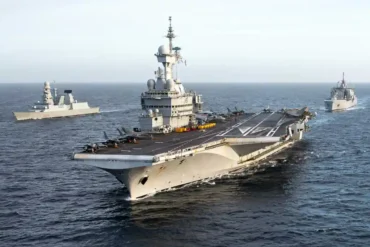
The Charles de Gaulle carrier strike group functions as a mobile airbase capable of projecting airpower far beyond France’s borders. At the center of the formation is the carrier’s embarked air wing, composed of advanced naval aircraft designed for a wide range of missions.
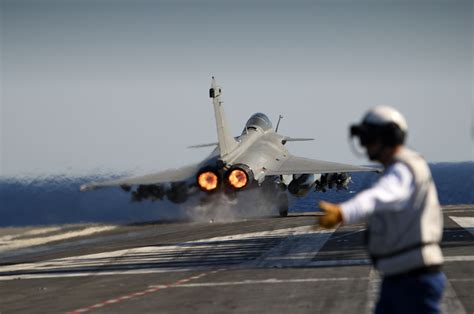
Approximately twenty Rafale Marine fighter jets operate from the carrier’s flight deck. These aircraft are capable of conducting air superiority missions, precision strike operations, reconnaissance flights, and maritime interdiction.
Supporting the fighter force are E-2C Hawkeye airborne early warning aircraft, which serve as the fleet’s flying radar stations. These planes can detect airborne and surface threats hundreds of kilometers away while coordinating air operations across complex battlespaces.
Helicopters deployed aboard the carrier perform additional tasks including:
- Maritime surveillance
- Anti-submarine warfare
- Personnel transport
- Search and rescue operations
Together, these aviation assets transform the carrier into a fully integrated command platform capable of sustained combat operations without relying on land-based infrastructure.
Escort Warships and Submarine Protection
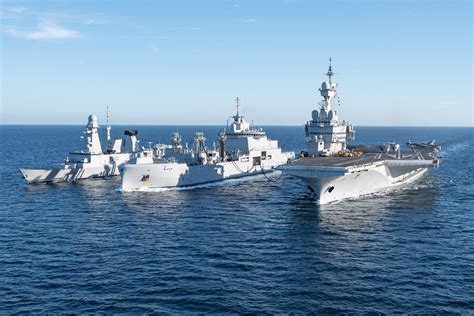
A modern aircraft carrier rarely operates alone. The Charles de Gaulle strike group includes a network of escort vessels designed to protect the carrier from threats above, on the surface, and beneath the sea.
The formation typically includes:
- Air-defense frigates equipped with advanced missile systems for protection against aircraft and cruise missiles
- Multi-mission frigates capable of anti-submarine warfare and surface combat
- Fleet replenishment ships that deliver fuel, ammunition, and supplies at sea
In addition, the strike group is often accompanied by a nuclear-powered attack submarine, which operates covertly to monitor underwater activity and deter hostile submarines.
This layered defense network ensures that the carrier can operate in high-threat environments, including regions where adversaries possess advanced missile and drone capabilities.
French Forces Already Operating Across Middle Eastern Waters
France’s naval footprint in the region was already significant before the carrier redeployment.
Several French warships were positioned across strategic maritime zones stretching from the Mediterranean Sea to the Persian Gulf. These vessels were part of multinational missions focused on maritime security and protection of commercial shipping routes.
A French air-defense frigate had been operating between the Red Sea and the Gulf of Aden, supporting European efforts to safeguard merchant vessels against missile and drone threats.
Meanwhile, a multi-mission frigate deployed in the Persian Gulf had been monitoring maritime traffic and regional military activity. Another French warship was dispatched toward Cyprus after increased drone and missile activity raised concerns about the island’s security.
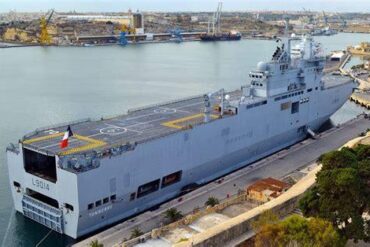
Additional naval units were also active in the Red Sea, including the amphibious helicopter carrier Dixmude and the frigate Aconit, which had recently conducted exercises with Egyptian naval forces after transiting the Suez Canal.
These ships were originally scheduled to continue operations toward the Indian Ocean, but the deteriorating security environment forced a strategic reassessment.
Iranian Missile Strikes Expand the Geographic Scope of the War
Iran’s retaliation against the initial US–Israeli strikes has dramatically expanded the geographic scope of the conflict.
Missile launches and drone attacks have targeted both military installations and infrastructure across multiple countries in the Gulf region. Explosions were reported near facilities connected to the US Fifth Fleet headquarters in Bahrain, while areas near Kuwait International Airport were also affected.
Debris from intercepted missiles damaged residential neighborhoods in several Gulf states, highlighting the growing danger faced by civilian populations as defensive systems attempt to neutralize incoming threats.
Reports also indicated attacks against:
- Civilian airports
- Maritime ports
- Energy infrastructure
- Military bases hosting foreign personnel
In Iraq, areas near Erbil International Airport were struck, while fragments from intercepted missiles caused damage in residential districts in Dubai and Doha.
The expanding battlefield illustrates how quickly modern conflicts can spread across interconnected regions.
French Military Bases Targeted During Early Retaliation
French military infrastructure has not been immune to the escalating violence.
During the first phase of Iranian retaliation, two French military bases in the region were struck, causing material damage to logistics infrastructure. No casualties were reported, but the attacks highlighted the vulnerability of foreign forces operating in the Middle East during a large-scale regional crisis.
In response, France significantly increased security measures around its diplomatic missions, military installations, and strategic facilities throughout the region.
French air defense units and fighter aircraft also participated in defensive operations during the early hours of the conflict, intercepting hostile drones approaching allied territories.
These actions reflect France’s broader defense commitments to regional partners, including Qatar, Kuwait, and the United Arab Emirates, all of which maintain defense cooperation agreements with Paris.
The Charles de Gaulle: France’s Only Nuclear Aircraft Carrier
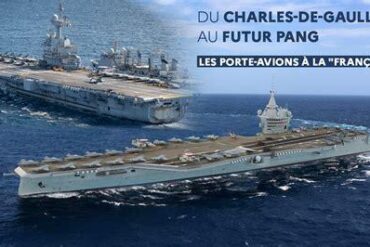
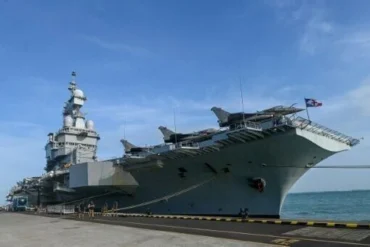
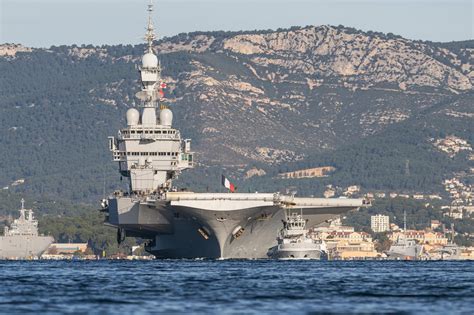
At the center of France’s naval aviation capability stands the Charles de Gaulle, the country’s only nuclear-powered aircraft carrier and one of the most powerful warships operated by any European navy.
The vessel has a full-load displacement of approximately 42,500 tons and measures 261.5 meters in length with a flight deck spanning more than 64 meters in width.
Propulsion is provided by two K15 pressurized water nuclear reactors, generating roughly 83,000 horsepower and enabling the carrier to reach speeds of about 27 knots. Nuclear propulsion allows the ship to remain at sea for extended periods without refueling, giving it exceptional operational endurance.
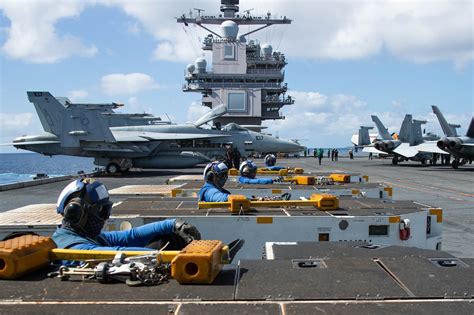
The flight deck uses a catapult-assisted takeoff but arrested recovery (CATOBAR) configuration similar to American aircraft carriers. Two 75-meter steam catapults launch aircraft, allowing the carrier to operate heavier combat aircraft with full fuel and weapons loads.
Maritime Trade Routes Under Growing Threat
The redeployment of the French carrier strike group also reflects mounting concerns about the security of global maritime trade routes.
The Middle East sits astride several of the world’s most important shipping corridors, including the Strait of Hormuz, the Red Sea, and the Suez Canal. These waterways handle a massive share of global energy shipments, particularly oil and liquefied natural gas exports.
Amid the escalating conflict, Iran has effectively closed the Strait of Hormuz, disrupting tanker traffic and sending shockwaves through global energy markets. Meanwhile, missile and drone threats have also affected shipping routes connected to the Red Sea and the Suez Canal.
These disruptions create both economic and strategic risks, as energy supplies and commercial goods rely heavily on these maritime passages.
By positioning the Charles de Gaulle carrier strike group in the Eastern Mediterranean, France gains the ability to monitor events across multiple theaters while supporting allied operations aimed at protecting shipping lanes.
In modern geopolitics, aircraft carriers are not just symbols of military power. They are mobile platforms capable of influencing crises thousands of kilometers from home ports. With the arrival of the Charles de Gaulle near the conflict zone, Europe’s most powerful naval air asset now stands ready to operate in one of the most volatile theaters on the planet.