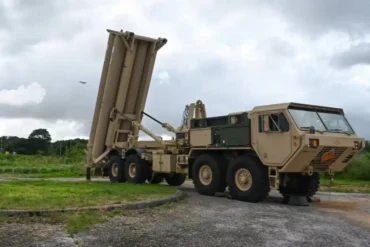
France is moving decisively to reinforce the Eastern Mediterranean’s fragile security architecture after an Iranian-designed Shahed drone strike targeted the vicinity of the UK’s RAF Akrotiri base in Cyprus. The deployment of advanced air and missile defense systems, coupled with at least one French frigate stationed offshore, marks a significant escalation in protective measures around one of Europe’s most strategically vital outposts.
The decision, communicated by French President Emmanuel Macron to Cypriot President Nikos Christodoulides, reflects growing concern that Cyprus is no longer a peripheral observer in regional tensions but an operational hub vulnerable to direct attack. While Paris has not immediately detailed the precise systems involved, the language surrounding the deployment makes clear that this is not a symbolic gesture. It is a concrete attempt to construct a layered air defense shield capable of countering drones, cruise missiles, and potentially even ballistic threats.
The trigger for this reinforcement was a drone incident near RAF Akrotiri, a British sovereign base area that plays a critical role in regional operations. Reporting from Cypriot and British-linked sources described Shahed-type unmanned aerial vehicles approaching the airfield, with at least one drone impacting or crashing in the runway area and others intercepted. Cypriot officials assessed the strike as most likely launched by Hezbollah from Lebanon, using Iranian-supplied systems. Although authorities emphasized that the intended target was the British base rather than the Republic of Cyprus itself, geography renders that distinction operationally meaningless when airspace safety and civilian infrastructure are at stake.
A Rapidly Constructed Layered Air Defense Shield
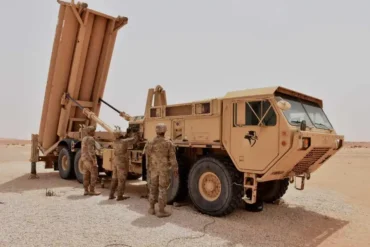
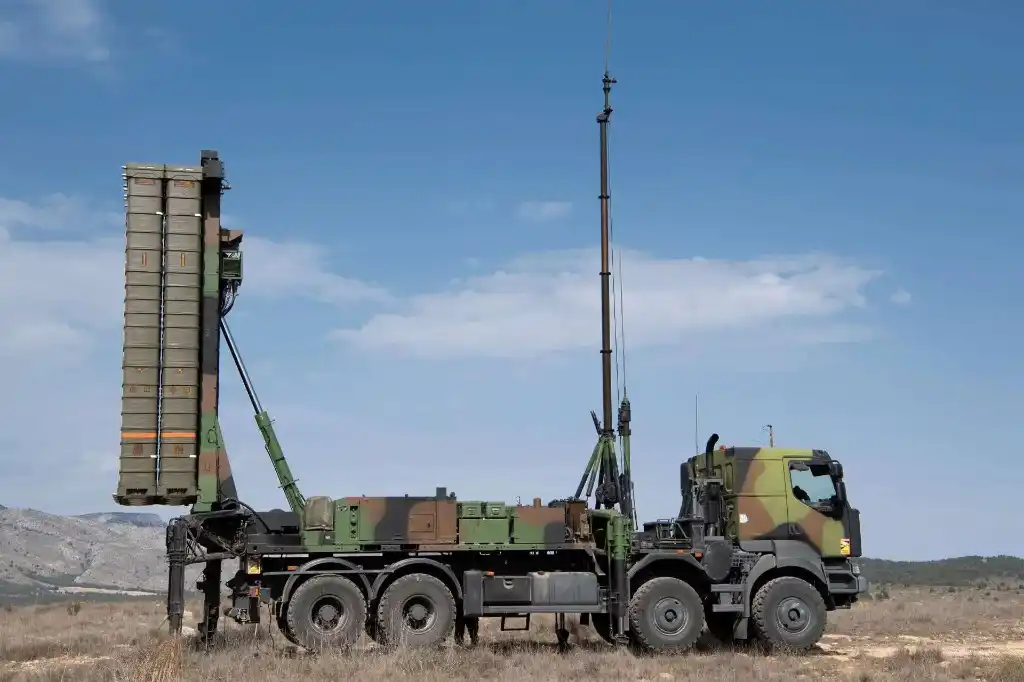
France’s response is designed around the principle of layered defense—a concept that integrates multiple tiers of detection and interception to prevent single-point failure. At the upper end of this spectrum, the most probable candidate for deployment is the SAMP/T system, built around the highly capable Aster missile family. In its advanced configurations, SAMP/T provides 360-degree engagement capability against aircraft and missile threats, including evolved ballistic profiles.
The Aster interceptor is widely characterized as a Mach 4.5-class missile, with engagement ranges exceeding 150 kilometers depending on configuration. Even a single battery stationed on Cypriot soil would dramatically alter the geometry of regional air defense, extending a protective umbrella over key airfields, ports, and military facilities. It would also provide a defended corridor for allied aircraft operating from or transiting through Cyprus.
Below this upper-tier interceptor capability, France is likely to deploy medium-range systems such as VL MICA NG, optimized for complex targets including low-signature UAVs. This system extends defensive reach beyond 40 kilometers and is specifically engineered to improve detection and engagement of atypical aerial profiles—precisely the challenge posed by Shahed drones operating at low altitude in coastal clutter.
At the inner defensive ring, the Mistral 3 very short-range missile provides point-defense capability against drones and cruise missiles at ranges exceeding seven kilometers. In the compressed warning timelines of drone warfare, this short-range layer becomes critical. It acts as a final kinetic safeguard if electronic countermeasures fail.
Counter-Drone Warfare: Electronic and Kinetic Integration
The “anti-drone” component of France’s deployment extends beyond missiles. Modern counter-UAS doctrine prioritizes sensor fusion and electronic warfare to defeat threats before resorting to expensive interceptors. France has invested heavily in deployable counter-drone architecture under the PARADE program, a modular system developed to detect, classify, and neutralize micro- and mini-drones around sensitive sites.
PARADE emphasizes 24/7, 360-degree surveillance and scalable response. Its integration of radar, electro-optical sensors, and electronic attack modules reflects a broader European recognition that drone warfare is as much about disrupting signals and navigation as about physical destruction.
At the tactical level, French forces can field systems such as the NEROD RF electronic jamming rifle, which uses directional antennas to disrupt drone command links and satellite navigation signals. Against one-way attack drones like the Shahed series, jamming can induce loss of guidance early enough to cause a miss without expending high-value missiles. This preserves interceptor stocks for more advanced threats.
France is also developing mobile gun-based counter-UAS platforms, including the SERVAL Counter-UAV concept equipped with a 30 mm remotely operated cannon firing airburst munitions. While such platforms may not be immediately deployed to Cyprus, they illustrate the trajectory of European short-range air defense modernization.
The Frigate: Extending the Radar Horizon Offshore
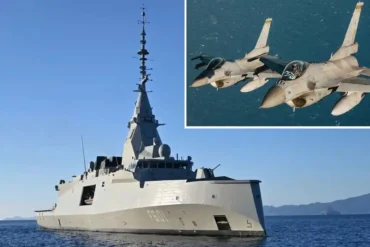
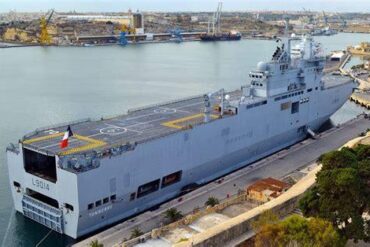
The maritime component of France’s response is equally consequential. Stationing at least one French frigate off Cyprus extends sensor coverage well beyond the island’s coastline, creating a maritime air-defense node capable of detecting and engaging threats at greater distances.
If an air-defense-configured frigate equipped with Aster missiles is deployed, Cyprus effectively gains a mobile, sea-based extension of its land shield. The vessel can reposition as threat vectors shift, whether from Lebanon, Syria, or more distant launch points. Its radar systems elevate detection horizons, reducing reaction time against low-flying drones skimming the sea surface.
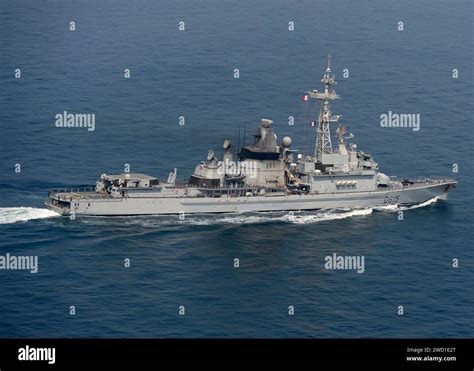
A warship offshore also provides command-and-control flexibility. It can integrate with allied naval and air assets, share targeting data, and protect commercial shipping routes in a region increasingly threatened by missile and drone attacks. The mention of a potential second frigate suggests Paris is preparing for sustained presence rather than a temporary show of force.
Cyprus: From Peripheral Actor to Strategic Frontline Node
Cyprus occupies a unique geopolitical position. It is geographically close to the Levant yet politically aligned with the European Union and Western security structures. The island hosts critical infrastructure used by U.S., UK, and European forces for operations across the Middle East.
The drone strike near RAF Akrotiri has underscored that Cyprus is no longer insulated from direct spillover. Even if the intended target was a British sovereign base, the implications for civil aviation, energy infrastructure, and commercial activity are profound. A runway rendered temporarily unusable by a drone impact demonstrates how relatively inexpensive systems can disrupt high-value assets.
Cypriot leadership has reportedly urged the UK to restrict base activities to humanitarian purposes in an effort to lower the island’s threat profile. Yet operational realities complicate such positioning. The Eastern Mediterranean is now a dynamic theater where maritime patrols, air operations, and missile defense intersect.
France’s involvement deepens an already established strategic relationship. A bilateral defense cooperation agreement signed in 2017 and implemented in 2020 laid the groundwork for expanded naval exercises and defense-industrial collaboration. Cyprus has acquired French missile systems in recent years, enhancing interoperability and strengthening political alignment.
Shahed Drones and the New Air Defense Equation
The Shahed family of drones represents a disruptive shift in warfare economics. These one-way attack UAVs are relatively inexpensive, capable of low-altitude flight, and difficult to detect against ground clutter. When deployed in numbers, they can saturate air defenses and force defenders into costly interceptor usage.
Defending against such systems demands disciplined fire control and layered engagement logic. Electronic warfare should disrupt navigation where possible. Guns and short-range missiles handle residual threats. High-end interceptors remain reserved for complex or high-value targets.
This doctrine is precisely what France appears poised to implement in Cyprus. The integration of land-based missile batteries, electronic countermeasures, and a maritime air-defense platform creates redundancy and resilience. It transforms the island from a vulnerable node into a defended hub.
Regional Ripple Effects and Allied Coordination
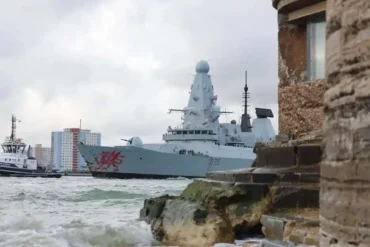
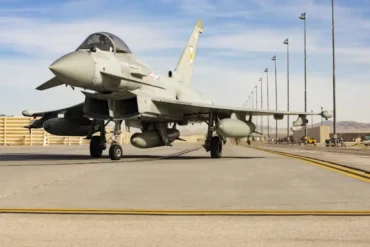
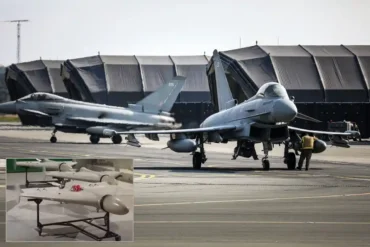
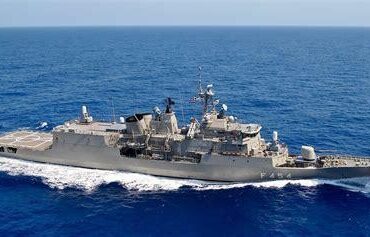
France’s move is unfolding amid broader allied activity. The United Kingdom has reportedly considered deploying the destroyer HMS Duncan to reinforce defenses around RAF Akrotiri. Greece has already moved assets toward Cyprus, including F-16 fighter aircraft and frigates equipped with counter-drone systems. The Eastern Mediterranean is evolving into a dense network of overlapping defensive arcs.
This concentration of capability serves both deterrent and operational functions. It signals to potential aggressors that attacks on facilities in Cyprus will encounter integrated multinational resistance. It also ensures continuity of operations for allied missions reliant on Cypriot infrastructure.
The strategic message is unambiguous: the airspace over Cyprus will not remain a permissive environment for drone incursions. By deploying a comprehensive air defense shield and maritime escort, France is reinforcing not only an island but the credibility of European collective security in a volatile region.
As drone warfare continues to blur the boundaries between state and proxy conflict, Cyprus stands at the intersection of geography and geopolitics. France’s deployment reflects a recognition that in modern conflict, air superiority is no longer defined solely by fighter jets in the sky. It is equally determined by radar screens on the ground, electronic pulses in the spectrum, and frigates silently extending the defensive horizon beyond the shoreline.