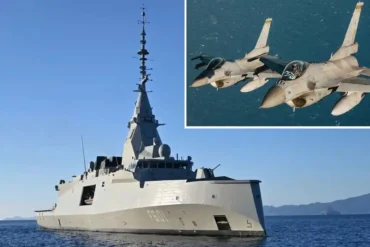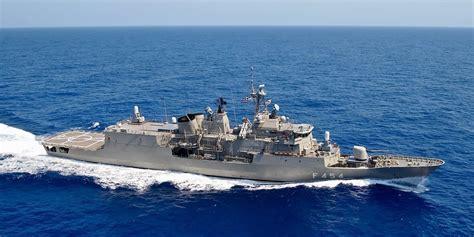
Greece has moved decisively to reinforce security in the Eastern Mediterranean by deploying the frigate HS Psara (F-454) to waters off Cyprus, signaling a shift in how modern naval forces confront the growing threat of low-cost unmanned aerial systems. Rather than relying primarily on expensive missile interceptors, the deployment emphasizes electronic warfare dominance, targeting Iranian-made drones through disruption instead of destruction.
The mission follows a recent drone incident near RAF Akrotiri, which underscored the vulnerability of fixed installations and maritime routes to low-altitude, low-cost UAV incursions. In response, Athens has positioned Psara as a defensive asset, tasked with neutralizing threats before they escalate into larger engagements.
This deployment is not an isolated maneuver but part of a broader regional recalibration as Western and allied forces adapt to a battlefield increasingly shaped by asymmetric aerial threats. The emphasis is clear: cost-efficiency, persistence, and layered defense are now as critical as raw firepower.
Strategic Shift: Electronic Warfare Over Missile Interception
At the heart of Psara’s mission lies a fundamental change in engagement doctrine. Traditional air defense relies heavily on interceptors such as the ESSM or Aster systems—each costing millions per launch. In contrast, Iranian drones, including variants from the Shahed family, can be produced for tens of thousands of dollars, creating a dangerous economic imbalance.
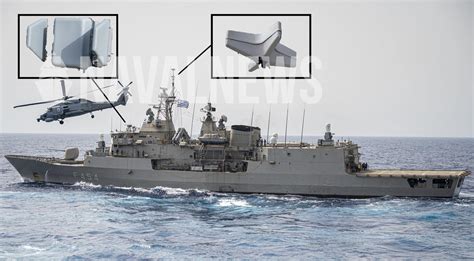
This disparity has forced navies to rethink their approach. Firing a $2 million missile at a $20,000 drone may achieve tactical success, but it leads to strategic exhaustion over time. The Psara addresses this imbalance by deploying the Centauros electronic warfare system, a domestically developed solution designed to neutralize threats without kinetic expenditure.
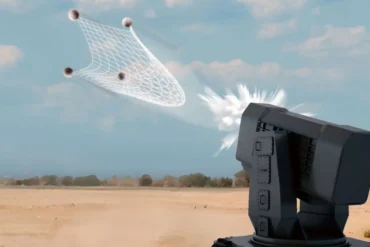
Rather than destroying drones outright, the system disrupts their control links, GPS navigation, and communication channels. The result is often mission failure for the drone—it veers off course, crashes, or becomes ineffective—without a single missile fired.
This approach reflects a broader military evolution: winning no longer depends solely on firepower, but on efficiency and sustainability.
Inside the Centauros System: Silent Detection and Precision Disruption
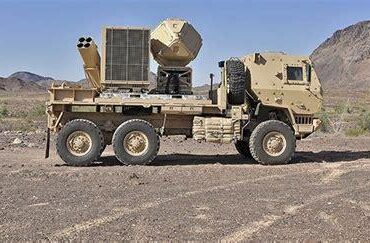
The Centauros system, developed by Hellenic Aerospace Industry, represents a leap forward in counter-drone warfare. Unlike conventional radar systems that emit signals and risk detection, Centauros operates through passive sensing, identifying UAVs at distances of up to 150 kilometers without revealing its own position.
Once a drone is detected, the system applies targeted radio-frequency jamming, focusing on individual threats rather than blanketing entire frequency bands. This precision allows Psara to engage multiple drones simultaneously while minimizing interference with friendly systems.
Effective disruption occurs within a range of approximately 25 kilometers, creating a protective bubble around the vessel and nearby assets. Crucially, the system can operate continuously as long as power is available, making it far more sustainable than finite missile inventories.
Combat-Proven Doctrine: Lessons from the Red Sea
The Psara’s current mission builds on real-world experience gained during its 2024 deployment under EU Operation Aspides. During that operation, the frigate was tasked with protecting commercial shipping lanes from drone attacks linked to Iranian-backed forces.
One notable engagement in the Gulf of Aden illustrated the effectiveness of its hybrid approach. Psara detected multiple incoming UAVs and initiated electronic interference, disrupting their guidance systems. When some drones continued their approach, the crew transitioned seamlessly to kinetic engagement, using the ship’s 127 mm naval gun.
The outcome was decisive: two drones were destroyed, while others were forced off course, effectively neutralizing the threat. This layered response—disrupt first, destroy if necessary—has since become a model for counter-drone operations.
The lesson was unmistakable: electronic warfare extends endurance, while traditional weapons provide a reliable backup when disruption alone is insufficient.
Technical Profile: A Versatile Hydra-Class Warship
The Psara is the third unit of Greece’s Hydra-class frigates, built for versatility and endurance. Displacing 3,350 tons and measuring 117 meters in length, the vessel combines speed, range, and multi-role capability.
Powered by a CODOG propulsion system, integrating gas turbines and diesel engines, Psara can reach speeds of up to 31 knots while maintaining an operational range of over 4,000 nautical miles. Its onboard systems include advanced radar suites, sonar, and fire-control systems, enabling it to operate effectively across air, surface, and subsurface domains.
Its armament remains formidable:
- A 127 mm Mk 45 naval gun for surface and air engagements
- Phalanx CIWS for close-in defense
- Harpoon anti-ship missiles
- A vertical launch system for ESSM interceptors
- Torpedo systems and helicopter support capabilities
Yet, in its current deployment, these weapons serve as secondary tools, with electronic warfare taking center stage.
Layered Defense Around Cyprus: Coordinated Naval Shield
Psara’s role is part of a broader multi-layered defense network forming around Cyprus. Operating alongside the Kimon-class frigate, the ship contributes to a division of labor designed to maximize efficiency.
The Kimon focuses on high-altitude and long-range threats, using advanced radar and missile systems to intercept fast-moving targets. Psara, meanwhile, specializes in low-altitude drone defense, addressing the gap beneath traditional air defense coverage.
This layered approach ensures that:
- High-value missiles are reserved for critical threats
- Drone swarms are handled with cost-effective methods
- Defensive coverage remains continuous across altitude bands
The result is a balanced, resilient defensive posture capable of withstanding both conventional and asymmetric attacks.
Rising Regional Tensions and Multinational Naval Presence
The deployment comes amid heightened tensions involving Iran, Israel, and the United States, with the Eastern Mediterranean emerging as a strategic flashpoint. In response, European nations have surged naval assets into the region, creating a dense network of maritime defense capabilities.
France has deployed a carrier strike group centered on the Charles de Gaulle (R91), accompanied by multiple frigates and amphibious vessels. Italy, Spain, the Netherlands, Germany, and the United Kingdom have also contributed ships, forming a multinational shield around critical maritime routes.
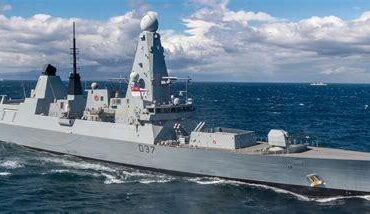
Among these, vessels like the HMS Dragon (D35) provide long-range air defense, while others focus on escort and patrol duties. Together, more than fifteen warships now operate in coordinated patterns, reinforcing both deterrence and response capability.
Economic Warfare at Sea: The Cost Equation Driving Innovation
What makes the Psara deployment particularly significant is not just its tactical role, but what it reveals about the economics of modern warfare. Drone warfare has introduced a disruptive equation: cheap attackers versus expensive defenders.
In traditional engagements, superiority was measured in firepower and technology. Today, it is increasingly measured in cost-per-engagement and sustainability. A force that exhausts its high-value munitions too quickly risks becoming vulnerable, regardless of its technological edge.
By prioritizing electronic warfare and low-cost engagement methods, Greece is aligning itself with a growing recognition among Western militaries: the future battlefield rewards those who can outlast, not just outgun, their adversaries.
This philosophy is likely to influence procurement, doctrine, and operational planning across NATO and beyond.
A Blueprint for Future Naval Warfare
The deployment of Psara to Cyprus is more than a tactical response—it is a preview of how naval warfare is evolving. Electronic warfare, once a supporting capability, is now emerging as a primary line of defense, especially against unmanned threats.
By combining passive detection, precision jamming, and selective kinetic response, Psara demonstrates a model that is scalable, sustainable, and adaptable. It shows that modern warships must function not just as platforms for weapons, but as integrated systems of intelligence, disruption, and control.
As drone technology continues to proliferate, the importance of such capabilities will only grow. The Eastern Mediterranean, with its dense concentration of assets and rising tensions, is becoming a proving ground for these innovations.
And right now, cutting through those contested waters, Psara is quietly proving that sometimes the most effective weapon isn’t the one that explodes—but the one that prevents the fight from happening at all.