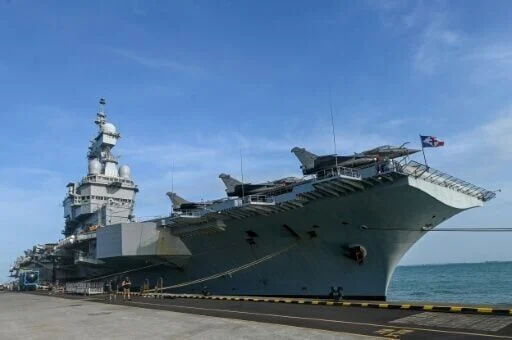
The sudden re-emergence of Greenland at the center of global power politics has jolted Europe into a rare show of strategic urgency. Once perceived as a distant Arctic outpost, the autonomous Danish territory is now a geopolitical fulcrum where climate change, military positioning, and alliance politics collide. France’s decision to deploy its nuclear-powered aircraft carrier into the North Atlantic signals that Europe is no longer content to watch events unfold from the sidelines.
This deployment comes amid unusually blunt rhetoric from former U.S. President Donald Trump, who recently threatened to annex Greenland and impose punitive tariffs on European states opposing such a move. While Washington later softened the tone by ruling out military action, the message was unmistakable: Greenland matters, and great powers are prepared to contest influence over it.
For Paris, the crisis has become a defining test of European credibility. France is asserting that Arctic security is not solely a transatlantic issue managed by Washington, but a European responsibility tied directly to sovereignty, international law, and long-term stability in the High North.
France’s Strategic Signal in the Arctic
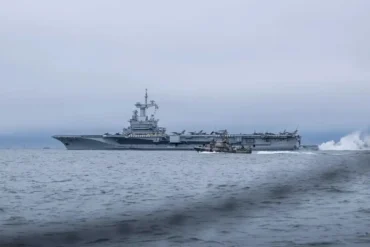
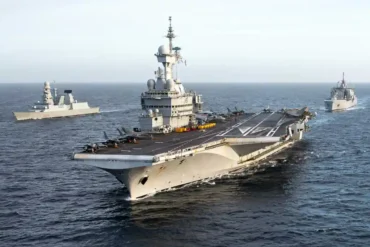
France’s deployment of the Charles de Gaulle, its sole aircraft carrier, is a calibrated yet unmistakable signal. Officially, the carrier strike group is participating in Orion 26, a large-scale joint exercise designed to enhance interoperability with allied forces in the Atlantic. Unofficially, the move underscores Europe’s growing unease with unpredictable American policy shifts and the vulnerability of Arctic territories.
The North Atlantic has become a strategic corridor once again, echoing Cold War-era tensions. Melting sea ice is opening new shipping lanes and exposing untapped natural resources, while submarine cables and undersea infrastructure now form the invisible backbone of the global economy. France’s naval presence reinforces the idea that European interests in this space are neither symbolic nor secondary.
By declining to specify the carrier’s exact destination, the French defence ministry has preserved operational ambiguity. Yet sources confirm the deployment places the Charles de Gaulle close enough to the Arctic theatre to matter, without crossing into overt provocation.
Diplomatic Pressure Meets Naval Power
Military posture alone does not define France’s approach. President Emmanuel Macron is set to host leaders from Denmark and Greenland in Paris, reinforcing a dual-track strategy that pairs diplomacy with deterrence. The message is clear: European solidarity is not abstract rhetoric but a practical commitment to territorial integrity and political autonomy.
Macron’s office has emphasized discussions on Arctic security alongside economic and social development for Greenland. This framing is deliberate. It positions Europe not as an external power jockeying for control, but as a partner invested in Greenland’s long-term resilience. In contrast to transactional power politics, Paris is presenting stability and cooperation as strategic assets.
This diplomatic choreography matters. Greenland’s population has long balanced autonomy with reliance on Denmark and external partners. France’s overt support strengthens Copenhagen’s hand while signaling respect for Greenlandic self-governance.
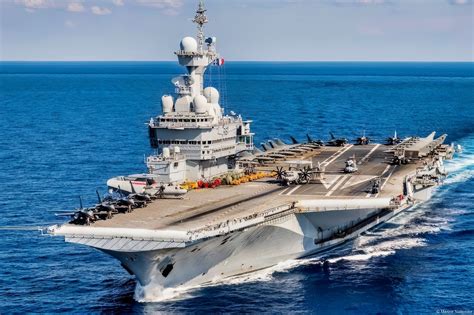
Inside the Charles de Gaulle Carrier Strike Group
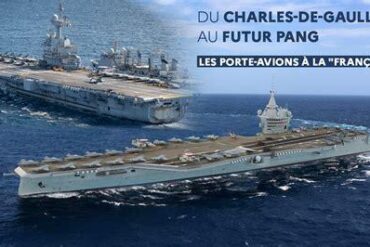
The Charles de Gaulle is a compact but formidable symbol of French military autonomy. Commissioned in 2001, the nuclear-powered carrier displaces roughly 42,000 tons, making it smaller than American supercarriers but uniquely capable among non-U.S. navies. It is the only aircraft carrier outside the United States equipped with catapults and arrestor wires, allowing it to operate a diverse range of fixed-wing aircraft.
A typical air wing includes Rafale-Marine fighter jets, E-2C Hawkeye airborne early-warning aircraft, and advanced helicopters such as the NH90. The accompanying strike group features air-defense frigates, a supply ship, and an attack submarine, creating a layered defensive and offensive capability well-suited for contested maritime environments.
Operational history has proven the carrier’s versatility. From early deployments in support of operations after September 11, to airstrikes against ISIS and missions off Libya, the Charles de Gaulle has evolved into a floating command center for French power projection. Its recent Clemenceau 25 mission extended that reach into the Indo-Pacific, underscoring France’s global maritime ambitions.
Trump’s Greenland Threat and European Shockwaves
Trump’s remarks about annexing Greenland struck a nerve across Europe. While his administration ultimately backed away from the idea of military seizure, the episode exposed fault lines within NATO and revived fears of unilateral decision-making by Washington. For European policymakers, the crisis was less about immediate danger and more about precedent.
The suggestion that a NATO ally’s territory could be claimed through pressure or coercion challenged assumptions underpinning postwar security architecture. Even rhetorical threats carry weight when backed by overwhelming military power, and European leaders understood that silence would be interpreted as acquiescence.
France’s response has therefore been as much psychological as strategic. Deploying a nuclear-powered carrier sends a message that Europe possesses both capability and resolve, even as it remains formally aligned with the United States.
NATO’s Dilemma and Europe’s Search for Autonomy
NATO Secretary-General Mark Rutte’s blunt assessment added fuel to the debate. He warned that Europe cannot defend itself without the United States, arguing that any illusion of full autonomy would require staggering increases in defense spending and nuclear capability. His remarks landed poorly in Paris, where officials have long advocated for greater European strategic independence.
French Foreign Minister Jean-Noël Barrot publicly countered that Europeans can and must take responsibility for their own security. This exchange encapsulates a deeper tension within the alliance: how to balance reliance on American power with the need for credible European agency.
Rutte reaffirmed Washington’s commitment to NATO’s mutual defense clause, yet emphasized U.S. expectations that Europe shoulder more of the burden. Greenland, sitting at the intersection of Arctic defense and alliance politics, has become a proving ground for this uneasy compromise.
The Arctic as the Next Geopolitical Frontier
Beyond immediate headlines, the Greenland crisis reflects a broader transformation of the Arctic from frozen periphery to strategic heartland. Climate change is accelerating access to resources, while military planners increasingly view the region as essential to missile defense, early warning systems, and control of transpolar routes.
France’s deployment acknowledges this reality. By acting now, Paris is positioning itself as a stakeholder in Arctic governance rather than a latecomer reacting to faits accomplis. The move also reinforces the European Union’s interest in shaping norms around security, environmental protection, and economic development in the High North.
The presence of the Charles de Gaulle does not herald confrontation, but it does redefine expectations. Europe is signaling that Arctic security is indivisible from its own future, and that sovereignty, once questioned, demands a tangible response.
As global attention shifts northward, the Greenland crisis may be remembered as the moment Europe rediscovered the strategic value of unity, backed not only by words, but by steel and resolve moving quietly through cold Atlantic waters.