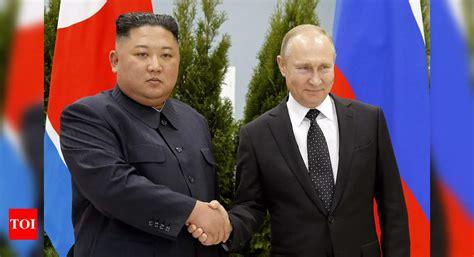
Russian President Vladimir Putin has declared an “invincible friendship” with North Korea, celebrating the deepening military and political alliance with Kim Jong Un amid mounting casualties of North Korean troops fighting in Ukraine. As Kim vows to boost his nation’s nuclear submarine program, the evolving relationship reflects a dramatic shift in global power dynamics and regional security threats.
Putin’s Message of Brotherhood: North Korea’s Blood for Russia’s Battlefield
In a New Year’s letter delivered to Pyongyang, President Putin praised the role of North Korean soldiers deployed in support of Russian forces in Ukraine, particularly in the Kursk region, as an embodiment of “militant fraternity.” The message, delivered by diplomatic courier on December 18, was widely circulated by North Korea’s Korean Central News Agency (KCNA).
“The heroic entry of soldiers of the Korean People’s Army into the battles for liberating the Kursk region from occupiers… clearly proved the invincible friendship,” wrote Putin.
Putin’s remarks underscore not only gratitude but also an ideological kinship forged through war. Western and South Korean intelligence sources estimate that over 10,000 North Korean soldiers have been deployed to Russian territory since 2024. These forces, alongside artillery, missiles, and long-range rocket systems, play a critical role in bolstering Moscow’s war machine.
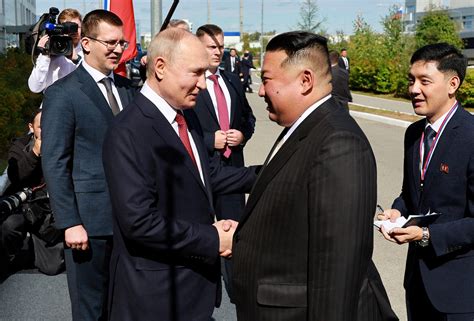
The death toll, however, has been staggering. According to South Korea’s National Intelligence Service, approximately 2,000 North Korean soldiers have died in combat since the deployment. North Korea officially acknowledged these casualties only in April 2025, following growing international scrutiny. In a striking public relations campaign, state media has showcased images of Kim consoling bereaved families, attempting to harness nationalist sentiment.
A Pact Beyond Borders: The Strategic Partnership
The roots of this growing axis lie in the Comprehensive Strategic Partnership Treaty signed during Putin’s landmark June 2024 visit to Pyongyang. The agreement included a mutual defense clause, compelling each nation to provide immediate military assistance in the event of foreign aggression.
Putin emphasized that the treaty had been “effectively implemented through joint efforts,” citing both battlefield cooperation and economic coordination. He further asserted that the Russia–North Korea alliance was essential to constructing “a just order of the multi-polar world,” a phrase increasingly invoked to counterbalance U.S.-led global structures.
Kim’s Nuclear Naval Ambitions Surge Amid U.S.-South Korea Threats
On the same day Putin’s letter was revealed, KCNA reported that Kim Jong Un visited a nuclear-powered submarine construction facility, signaling a bold escalation in North Korea’s maritime military strategy. Kim also personally oversaw the test-firing of new long-range, high-altitude anti-air missiles, reflecting a broader modernization of the country’s defensive and offensive capabilities.
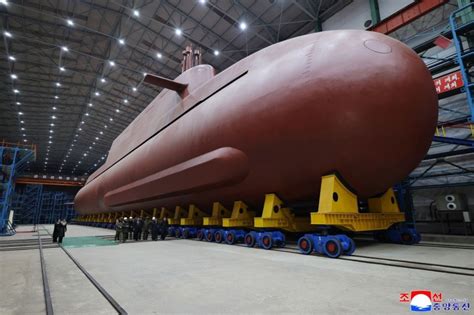
During his inspection, Kim denounced South Korea’s efforts, supported by the United States, to develop nuclear-powered submarines. Labeling the initiative a “direct threat,” Kim claimed it necessitated an “urgent” response, describing nuclear naval force development as “indispensable.”
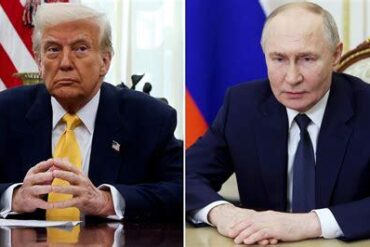
The U.S.-South Korea agreement, announced by President Donald Trump during an October 2025 visit to Seoul, authorizes South Korea to pursue such submarines, a domain historically limited to a select few global powers due to technological sensitivities.
The Missile Message: Reaching for the Stars—Literally
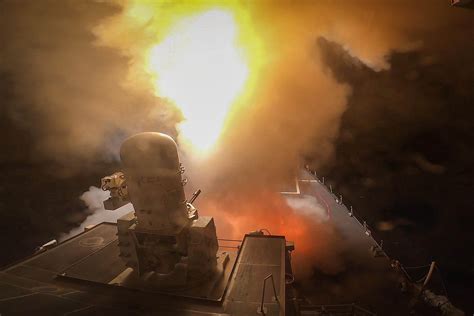
Kim’s rhetoric was matched with action. KCNA reported that the newly tested anti-air missiles successfully intercepted mock targets at an altitude of 200 kilometers, placing them in exospheric range—a capability rarely demonstrated even by major global powers.
The successful launch marks a significant stride in North Korea’s effort to counter perceived aerial threats and establish itself as a formidable space-capable military actor. Kim was shown applauding the missile team, praising their “brilliant victory of socialist science.”
Regional Fallout: South Korea’s Dilemma and Global Alarm
The deepening ties between Pyongyang and Moscow have alarmed both Seoul and Washington, who perceive the pact as a direct affront to regional security. Under President Yoon Suk Yeol, South Korea considered lifting its long-standing restriction against exporting lethal arms to Ukraine but ultimately refrained, fearing further escalation.
Kim’s push for underwater nuclear capabilities and anti-air systems further complicates strategic calculations. If successful, North Korea could possess second-strike capability, elevating its deterrent posture while threatening allied naval dominance in the region.
The Strategic Calculus: Russia’s Gains, Kim’s Leverage
For Putin, North Korean support offers immediate tactical relief on the Ukrainian front and an ideological counterweight to NATO. For Kim, the partnership brings access to wartime experience, potential defense technologies, and geopolitical recognition.
The military pact, coupled with actual battlefield involvement, represents a quantum leap in bilateral relations. It legitimizes Pyongyang’s long-sought goal of playing a more central role in global military affairs and aligns with Kim’s desire to position North Korea not as an isolated pariah but as an indispensable partner in reshaping world order.
As 2026 approaches, the Russia–North Korea alliance—cemented by blood, weaponry, and shared enemies—appears poised to redraw the regional power map, one missile and submarine at a time.